AARO's workshop paper proposes better ways to capture UAP reports. Its starting point is simple: how did a witness estimate what they saw?
The workshop's final exercise gave participants a hypothetical online form holding 1,000 UAP reports as PDFs. Their job was to make those reports usable.
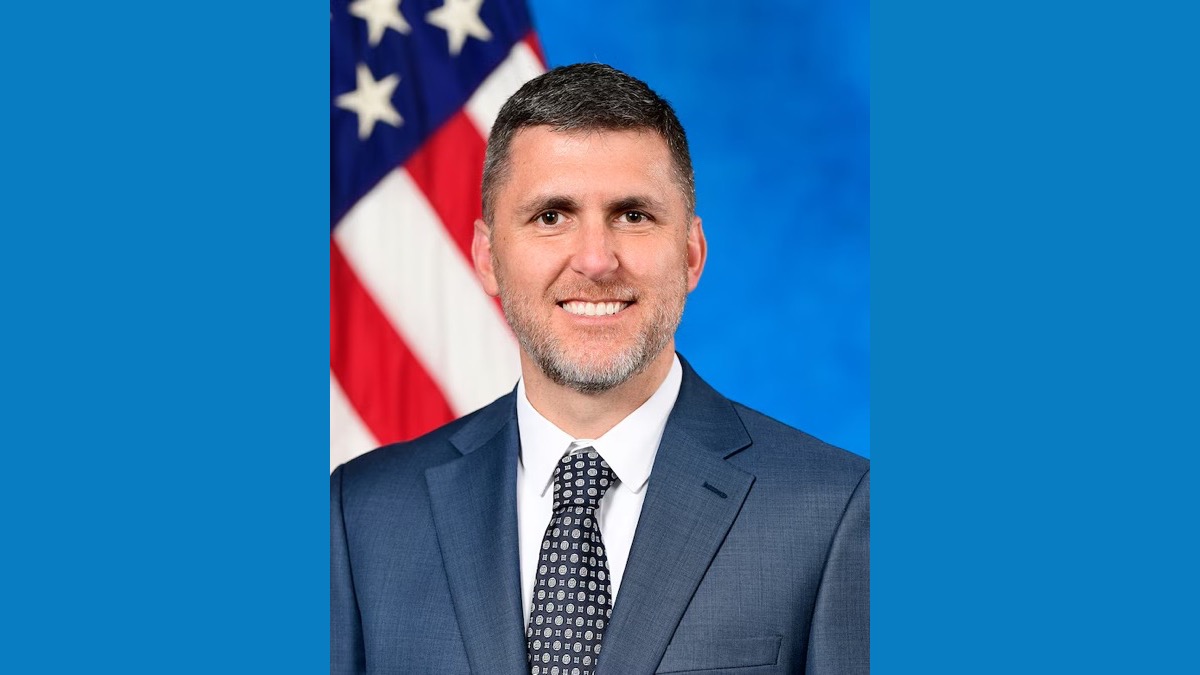
Dr. Jon T. Kosloski, director of AARO. Official Department of War portrait, 2024. The image does not depict the workshop.
Their answer begins with an ordinary question that is often missing from the stories people tell afterward: how did you make that estimate?
How did you decide the object was a mile away? What gave it its apparent size? What reference did you use for its speed?
That is the practical center of a 17-page workshop report sponsored by AARO. The meeting took place at Associated Universities Inc.'s headquarters on August 5–6, 2025, with 40 participants from government, academia, and independent research organizations. AUI announced the report's release on February 19, 2026; AARO later listed it as new content on its public records page on July 8.
This is not a new case release. It is a guide to the information a report needs before it can be compared with other evidence.
## Five findings, not a new sighting
The paper's executive summary identifies five cross-cutting findings:
- shared reporting templates and metadata for time, place, provenance, morphology, and context;
- links between military, civilian, archival, environmental, and technical records, without ignoring privacy, ethics, or classification;
- credibility assessed through corroboration, with automated triage used to identify reports worth a closer look;
- AI used cautiously for tasks such as transcription, clustering, and search; and
- a sustained research community built around public trust and cooperation.
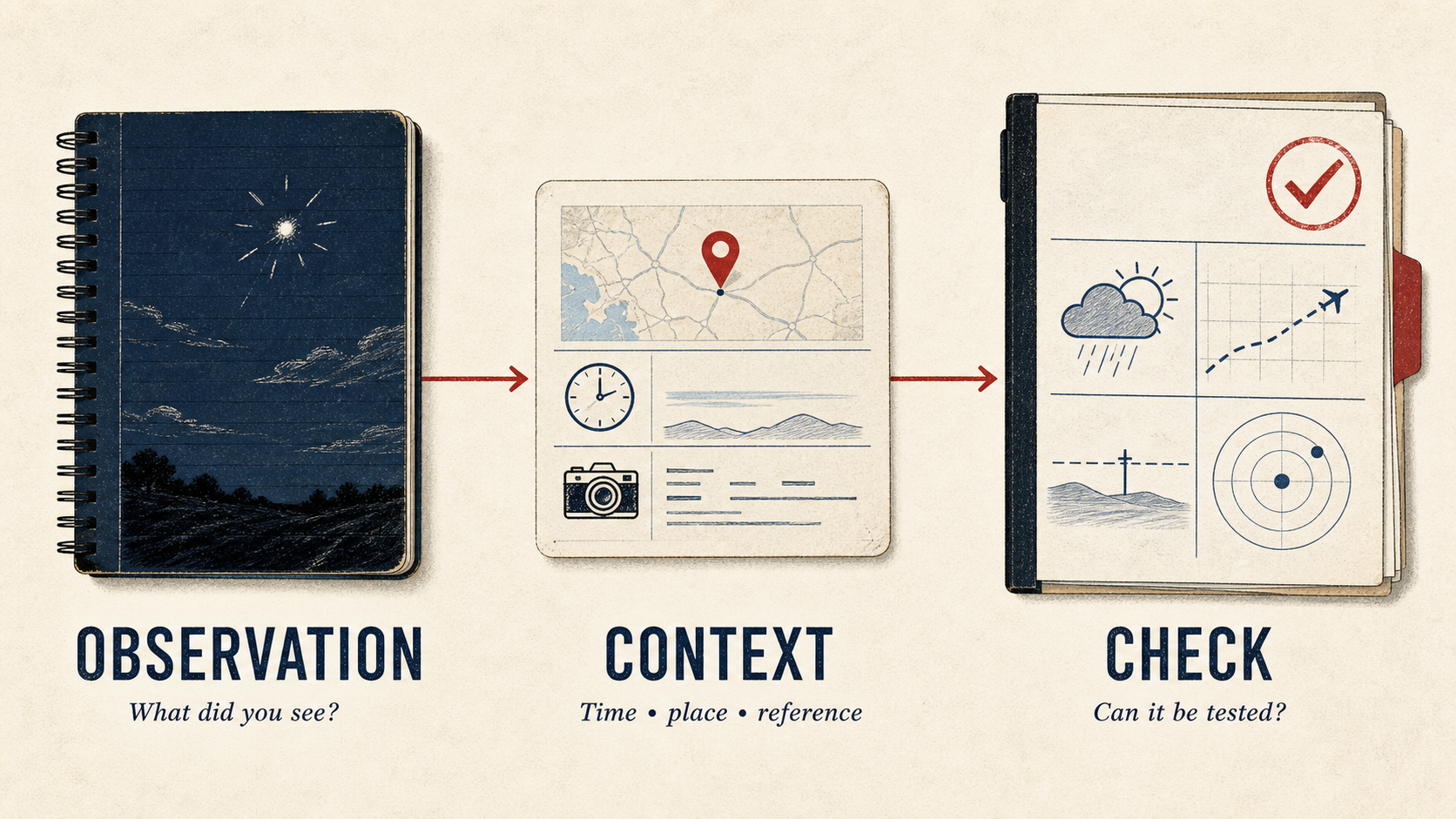
The recommendations for a future reporting interface are concrete. A witness would first describe an event in free text or optional audio. A system could propose structured fields, which the witness would then confirm or correct. The paper suggests asking how size, distance, or speed were estimated; recording the number of witnesses; retaining photo metadata where the reporter agrees; and keeping dates, times, locations, and multiple objects in consistent fields.
Those details give analysts something to compare with flight tracks, weather, astronomical records, radar, or another witness.
From a description to a checkable report: the workshop's basic data chain. Editorial infographic by UAP Logbook, generated with AI.
## DD 3212 is a different form
AARO already has a public form: DD Form 3212, dated April 2024. But it is not a public sighting form and the workshop paper does not present its proposed interface as a revision of DD 3212.
DD 3212 is for current or former U.S. government employees, service members, and contractor personnel with direct knowledge of U.S. government UAP programs or activities dating to 1945. AARO says those submissions inform its congressionally directed Historical Record Report. The form explicitly does not accept public sighting reports or current operational reports.
The workshop's hypothetical form tackles a broader data-design problem: how a future reporting system might preserve an account and its context before useful details disappear.
## What better context can change
The contrast is visible in AARO's own imagery record. For PR-006, a 20-second infrared video from Europe in 2022, AARO assessed with high confidence that the object was almost certainly a balloon. The assessment cites its morphology and movement with the wind.
PR-001, another 2022 infrared case from Africa, remains unresolved for a more basic reason. AARO says the available data cannot determine whether the visible heat signature came from a physical source, a thermal reflection, an environmental heat difference, or a sensor-display error.
The workshop report is about increasing the odds that future files look more like the first case than the second: enough context to test a plausible explanation, rather than a frame that can support several incompatible ones.
It also recommends AI for transcription, search, clustering, and triage. The paper repeatedly limits that role. It warns that automated tools can introduce bias, hallucinate, and amplify hoaxes, and calls for human review throughout.