News / May 17, 2026
Avi Loeb says some UAP file cases may have ordinary explanations
On NewsNation, Avi Loeb said Apollo moon lights may be cosmic rays and one star-like UAP image may be a camera effect. He still called the Indo-Pacific formation video unresolved.
video sourceNewsNation Prime: UFO files: Avi Loeb now has explanations for some cases
The segment
Avi Loeb appeared on NewsNation Prime on May 17, 2026, to discuss the Trump administration's recent release of UAP-related files.
The segment was short, but it added a useful counterweight to the usual file-release framing. Loeb did not treat every item as stronger evidence. He said some examples may have ordinary explanations.
Apollo lights: cosmic rays
NewsNation asked about images tied to Apollo 12 and reports of mysterious flashes of light during the 1969 mission.
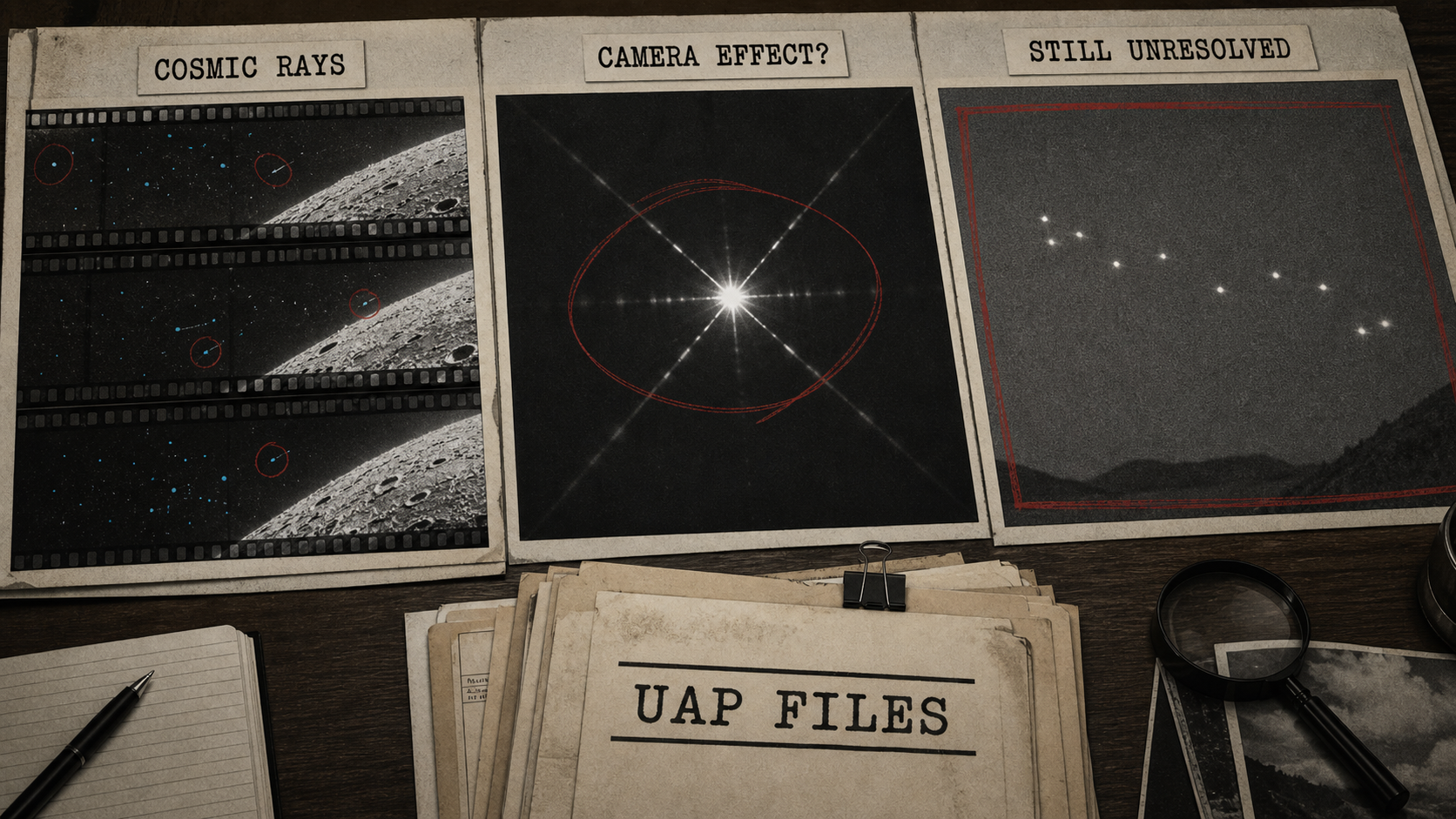
Loeb said he had calculated that the blue points of light were very likely caused by cosmic rays or energetic particles. His reason was that the same blue points appear in parts of the film not looking through the lens, which points toward particles hitting the film or camera rather than lights in the sky.
He also compared the Apollo material with more recent Artemis imagery. According to Loeb, Artemis astronauts used much better cameras and did not see comparable unusual lights around the Moon.
Old photographic plates
Loeb extended the same argument to some older transient-light claims from photographic plates.
He said points of light seen on old survey plates could also be caused by cosmic rays hitting the plate. That would make them transient without requiring a satellite, craft, or object in the sky.
His point was narrow: some historical light anomalies may be instrument or particle effects, not UAP evidence.
The star-like image
The interview also showed a star-like object from the released material.
Loeb said it was hard to interpret because information had been redacted. Still, he said his inclination was that the image could be a diffraction pattern inside the camera. He noted that the apparent orientation of the star-like shape did not change as it moved across the sky.
That does not prove the case is solved. It does show why original files, camera information, and sensor context matter.
The formation video remains open
Loeb was more cautious about another case: records from Indo-Pacific Command showing multiple unidentified objects moving in formation, separating, and coming back together.
He called that material intriguing and said it could involve drones, balloons, or technology from adversarial nations. His main point was not that it proved anything exotic, but that unidentified objects in controlled airspace are a national-security problem even if they are human-made.
Where this leaves it
The useful part of Loeb's interview is that it separates the file-release story into categories.
Some items may be explainable: cosmic rays, old cameras, optical effects. Other items may remain unresolved because the public record still lacks enough data. Those are different buckets.
That is the better way to read the UAP files: not as one pile of proof, and not as one pile of nothing. Each case has to survive its own boring checks.
Sources
- NewsNation Prime: UFO files: Avi Loeb now has explanations for some cases, published May 17, 2026.