News / May 17, 2026
Luna and Loeb discuss UAP records, CIA files, and the 46 videos
In a Sol Foundation interview, Rep. Anna Paulina Luna said the requested 46 UAP videos had been located and were under review. Avi Loeb said the first release was not convincing but could be a first step.
video sourceThe Sol Foundation: Congresswoman Luna and Dr. Avi Loeb
The interview
The Sol Foundation published a 38-minute interview with Rep. Anna Paulina Luna and Harvard astrophysicist Avi Loeb on May 15, 2026.
The discussion covered the presidential UAP records release, congressional pressure for declassification, a dispute over CIA records connected to MK-ULTRA, and Luna's request for 46 UAP videos.
The interview did not release new files. Its value is in what Luna and Loeb said about the process now surrounding those files.
Luna: look at the files yourself
Luna said her work on UAP records grew out of earlier congressional friction over access, including the Eglin Air Force Base episode involving members of Congress who said they were stonewalled.
She framed the current push as a transparency issue rather than a demand that the public accept a fixed interpretation. Her line was simple: look at the videos, testimony, and files, then decide.
She also said disclosure efforts had faced resistance in Congress and inside parts of the government, including failed reporting procedures and legislation that did not survive.
Loeb: the first release was not convincing
Loeb said the first public release did not contain an object clearly shown to be from outside Earth.
He pointed to redactions, missing camera information, and limited data quality. He also said some older Apollo-related imagery was not persuasive to him because modern Artemis imagery did not show the same kind of unusual lunar lights.
His summary was not dismissive, but it was restrained: the first release was not convincing, but it could be a first step.
Loeb said the useful path is still scientific analysis of better data. If the objects are human-made, he said, identifying them helps national security. If even a small fraction are not human-made, the result would be scientifically important.
The CIA and MK-ULTRA dispute
A large part of the interview moved away from UAP and into records handling.
Luna disputed online claims that she had said the CIA raided Tulsi Gabbard's office. She said that was not her claim.
Her account was narrower: she said documents under ODNI review for declassification were physically taken back by the CIA. She tied that dispute to records said to involve JFK, MLK, RFK, and MK-ULTRA.
Luna said House Oversight had sent a document-preservation request to the CIA and that she planned to go to the agency with Rep. Eric Burlison to ask which documents the CIA said it had taken back from ODNI.
The interview did not show those documents. It presented Luna's account of the dispute and her planned follow-up.
Ratcliffe and internal help
The host also asked Luna about support from John Ratcliffe, the former DNI and current CIA director.
Luna said Ratcliffe had been helpful in identifying where to look and who had authority over certain files. She also said he understood the difference between material that should remain protected for national security and material that could be released.
She did not present the conversation as a finished release path. She presented it as part of the ongoing records process.
The 46 videos
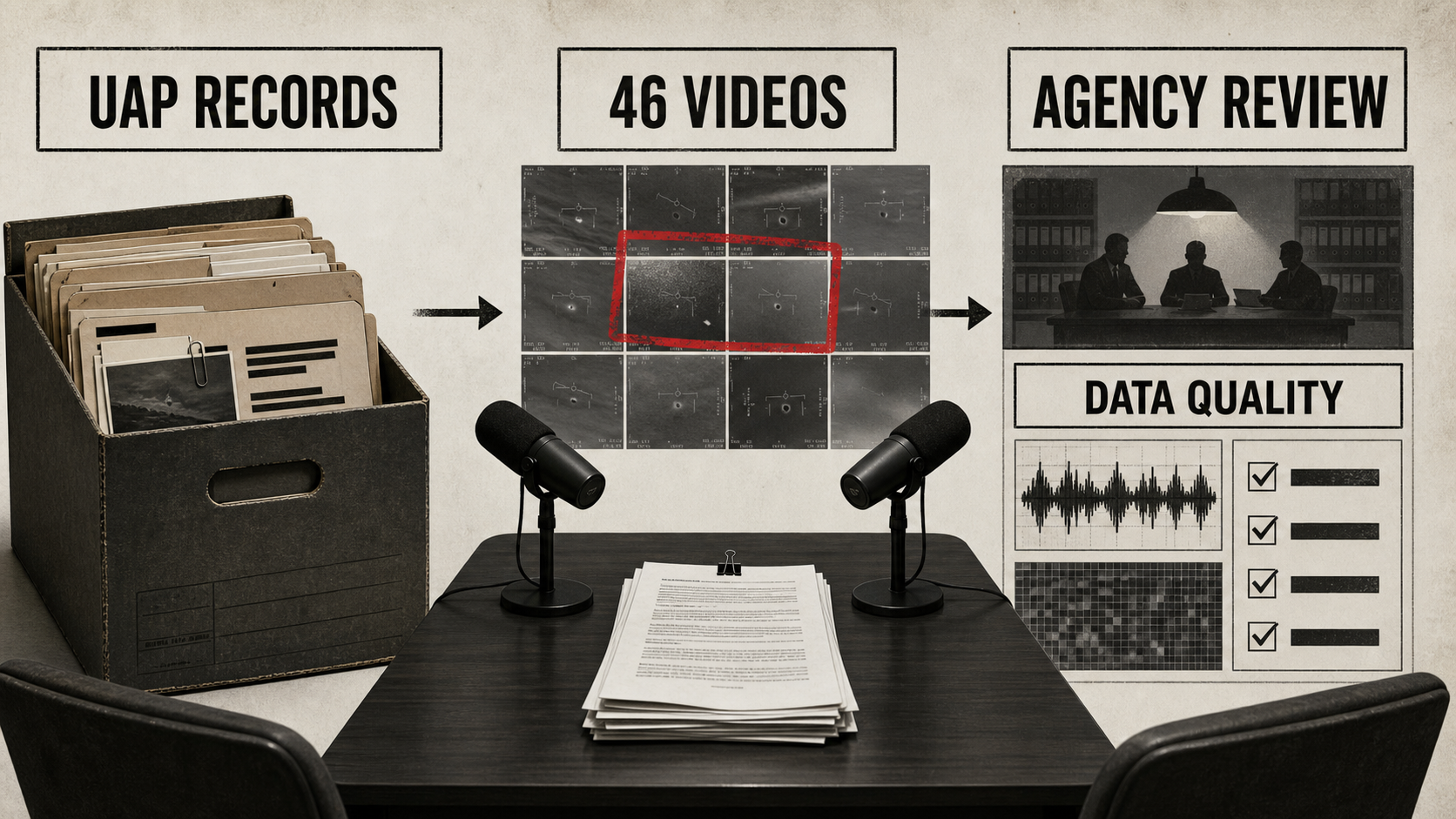
The clearest update concerned the 46 UAP videos Luna has publicly requested.
Luna said the list came from specific locators and documents brought to Congress from inside the intelligence community and the defense side. She said the department had located the files and was reviewing them to make sure sensitive technology was not exposed.
She said the timeline given to her was about 30 days for a next drop of documents and videos.
That is a process update, not a release. The videos were not shown in the interview.
International follow-up
Luna also mentioned international follow-up. She referred to Japan's recent UAP-related statements and said her side was following up with Japanese officials. She also said she had asked El Salvador's government whether it had anything relevant.
Loeb added that he had exchanged with senior leaders in Japan and that a senior member of the Galileo Project is now a professor there.
What Loeb says he has not seen
After Luna left the interview, the host asked Loeb about legacy-program allegations, recovered technology, and reverse engineering.
Loeb said he had not seen the evidence. He said that as a scientist he can respond to evidence, not storytelling.
He also left open multiple possibilities: there could be important evidence, the objects could be human-made, or some labels may have been used to deflect attention from adversarial technology.
His requested next step was a scientific advisory function that could examine whatever evidence government agencies have.
Where this leaves it
The interview adds one concrete public claim: Luna says the 46 requested videos have been located and are under review for a possible next release.
The rest remains process: who controls records, what the CIA returned or retained, whether the next batch contains usable data, and whether scientists outside government will be able to inspect anything more complete than clips and summaries.
For now, the useful question is not whether the interview sounded dramatic. It is whether the next release includes original files, dates, sensor context, and enough metadata to let outsiders test what is being shown.
Sources
- The Sol Foundation: Congresswoman Luna and Dr. Avi Loeb: Breaking UAP Disclosure News, published May 15, 2026.
- The Sol Foundation