
Short Note / Jun 26, 2026
Disclosure Forum Jordan Flowers tied Burlisons 1952 tape to the Washington flyover
"On NewsNation after the Disclosure Forum, Jordan Flowers said Rep. Eric Burlison's 1952 'flying saucer talk' request to MIT Lincoln Laboratory is the same file family as the July 1952 Washington National Airport flyover — radar returns, F-94 interceptors, and the lights that vanished on approach."
Jordan Flowers used the first post-Disclosure-Forum airtime to draw a line he had not drawn in public before.
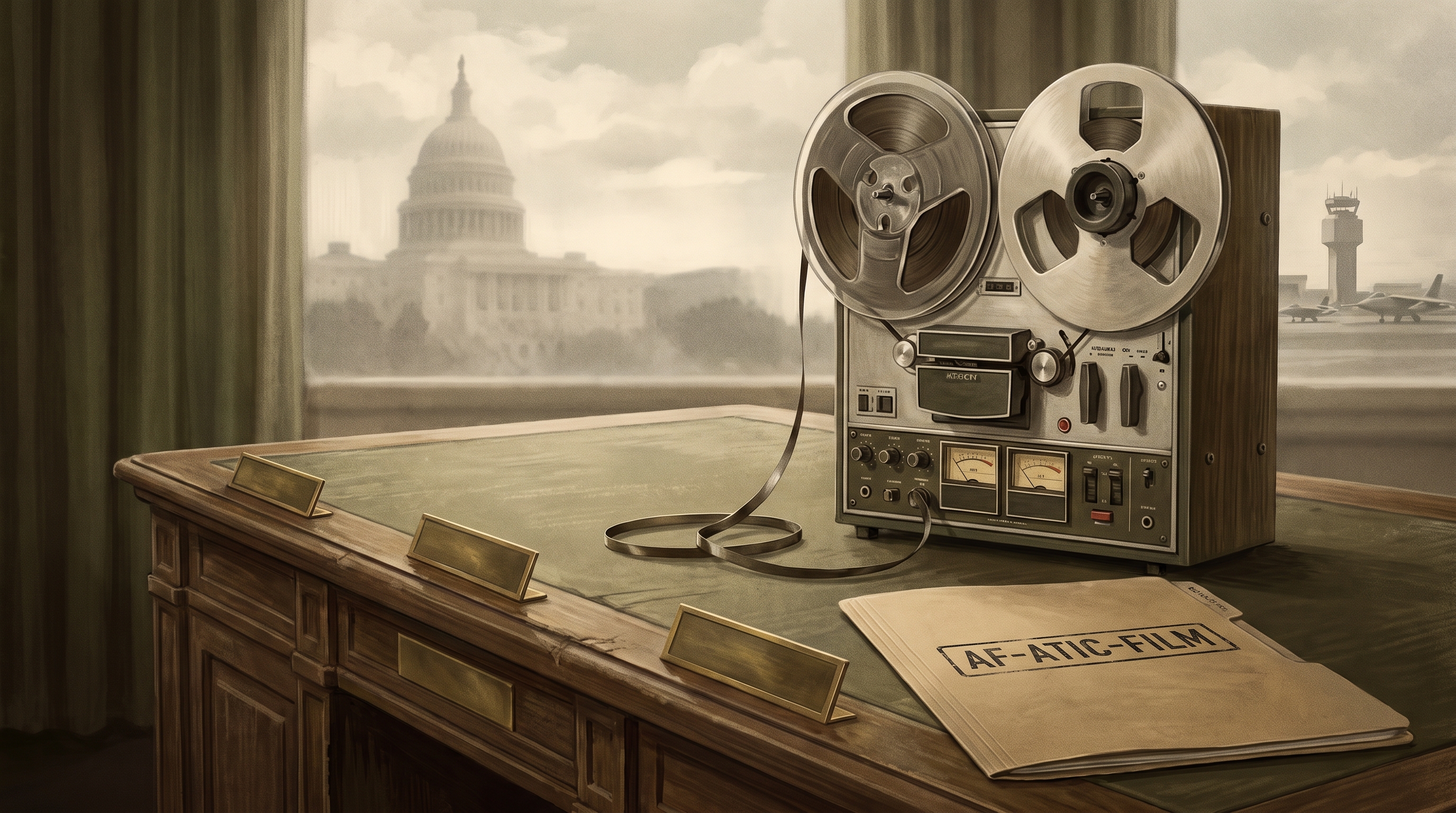
Appearing on Jesse Weber's after-show on NewsNation late on June 25, Flowers told the host that Rep. Eric Burlison's May letter to MIT Lincoln Laboratory — the one asking for a 1952 reel-to-reel labeled "flying saucer talk" and listing Edward J. Ruppelt as briefer — is, in his reading, aimed at the same family of files as the July 1952 Washington National Airport flyover.
"It's interesting you bring that up," Flowers said, "because that is, I believe, when Congressman Eric Burlison is requesting information from MIT Lincoln Labs. I may be mistaken, but I'm pretty sure that the information that he's requesting is related to that flyover. So he's directly pushing for the release of information about what happened here."
The clip is from Jesse Weber's news wrap, recorded at the Disclosure Forum 2026 afterparty in the Russell Senate Office Building. It aired the same evening.
What the 1952 Washington flyover actually was
The "1952 Washington flyover" is the canonical Cold War radar-and-visual case, not a fringe one.
The cluster runs across multiple weekends in July 1952. The two most-cited nights are July 19–20 and July 26–27.
On the night of July 19, controllers at Washington National Airport — Edward Nugent on scope, Harry Barnes supervising — picked up seven slow, unidentified returns south-south-east of the city, outside the known flight corridors Barnes was tracking. The same objects showed on the radar at nearby Andrews Air Force Base. Two F-94 interceptors were scrambled. Each time the jets closed on the radar fix, the returns faded. When the jets turned for home, the targets reappeared. By dawn on July 20, the scope was clear.
A second wave hit on the night of July 26. By then the case had reached the White House — Ruppelt records the call from Brig. Gen. Landry, Truman's Air Force aide, in Chapter 12 of his 1956 book, asking him to explain the radar returns and the visual sightings.
Ruppelt's preliminary answer, recorded in his 1956 book The Report on Unidentified Flying Objects, was that a temperature inversion over the capital could have bent the radar returns into false targets. Ruppelt said at the time he had not interviewed the witnesses or run a formal investigation before giving that read. The Air Force's later public position used the same explanation.
Why Flowers' reading matters — and why it's only a read
The read comes from Flowers — executive director of the Disclosure Foundation, the group that organized the June 25 forum. He is not on the letter, not the custodian, and not the lab.
His take: the "AF-ATIC-FILM, 03/52" item Burlison named in his May 7 letter to MIT Lincoln Laboratory Director Melissa G. Choi — a reel-to-reel from the Beacon Hill Study, with Ruppelt as briefer — is connected to the same investigation that produced the 1952 Washington sightings. The Beacon Hill Study itself was a 1952 Project Lincoln review run for the Air Force on aerial and balloon reconnaissance, which is the direct historical link between MIT Lincoln Laboratory and 1952-era federal air-defense work.
A few caveats from the same clip:
- Flowers called the congressman "Eric Berles." The actual requester is Eric Burlison (R-MO-07). Flowers caught himself mid-sentence — "I think that I may be mistaken" — but did not correct the name on air. The mistake matters less than the file link he was trying to draw, but it shows the after-party venue is not a transcript source.
- The PURSUE releases so far contain only "incremental" 1952 references, in Flowers' words. The main body of the file set — including whatever Ruppelt briefed that became the "flying saucer talk" reel — is not on the public site yet.
- Burlison's office has said MIT Lincoln's legal team agreed to comply within 30 days. Six weeks on, no reel has been transferred and no statement has been issued. That gap is the backdrop Flowers was reading against.
What is still missing
Three things would move the file link from Flowers' guess to a verifiable line.
- A custodian answer from MIT Lincoln Laboratory. Where is AF-ATIC-FILM, 03/52 right now, who holds it, what is the medium, has it been digitized, and what is its classification status.
- The catalog card or inventory entry that ties the reel to the 1952 Washington investigation rather than to a separate Ruppelt-era briefing in the same year. Ruppelt briefed widely in 1952; the file label alone does not pick the event.
- A second source for Flowers' reading. If anyone else at the forum, on a panel, or in Burlison's orbit has used the same phrasing — "related to that flyover" — the line stops being one after-party comment and starts being a working congressional premise.
Until at least one of those lands, the connection is a credible read by the forum's organizer, made on a news wrap at the end of a long day, in front of a host who had just asked about the case.
The reel may still be a label. The flyover has been a public case for seventy-four years.
Sources
- Jesse Weber, NewsNation — Disclosure Forum afterparty recap, June 25, 2026 (Jordan Flowers interview segment)
- Rep. Eric Burlison: Burlison Requests Review of Identified 1952 UAP Recording, May 8, 2026.
- Burlison letter to MIT Lincoln Laboratory, May 7, 2026.
- National Archives: Guidance to Federal Agencies on UAP Records Collection
- Edward J. Ruppelt, The Report on Unidentified Flying Objects, 1956 (Chapter 12 covers the July 1952 Washington cases).
- Gerald K. Haines, "CIA's Role in the Study of UFOs, 1947–90," Studies in Intelligence, 1997 (CIA Center for the Study of Intelligence).
- USAF, Beacon Hill Report (1952), released via Government Attic: USAF-BeaconHillReport_1952.pdf.