
News / May 16, 2026
Burlison asks MIT Lincoln Laboratory to find a 1952 'flying saucer' recording
Rep. Eric Burlison wants MIT Lincoln Laboratory to find a 1952 reel-to-reel labeled "flying saucer talk" and hand it to the National Archives. The lab has 30 days to respond.
The request
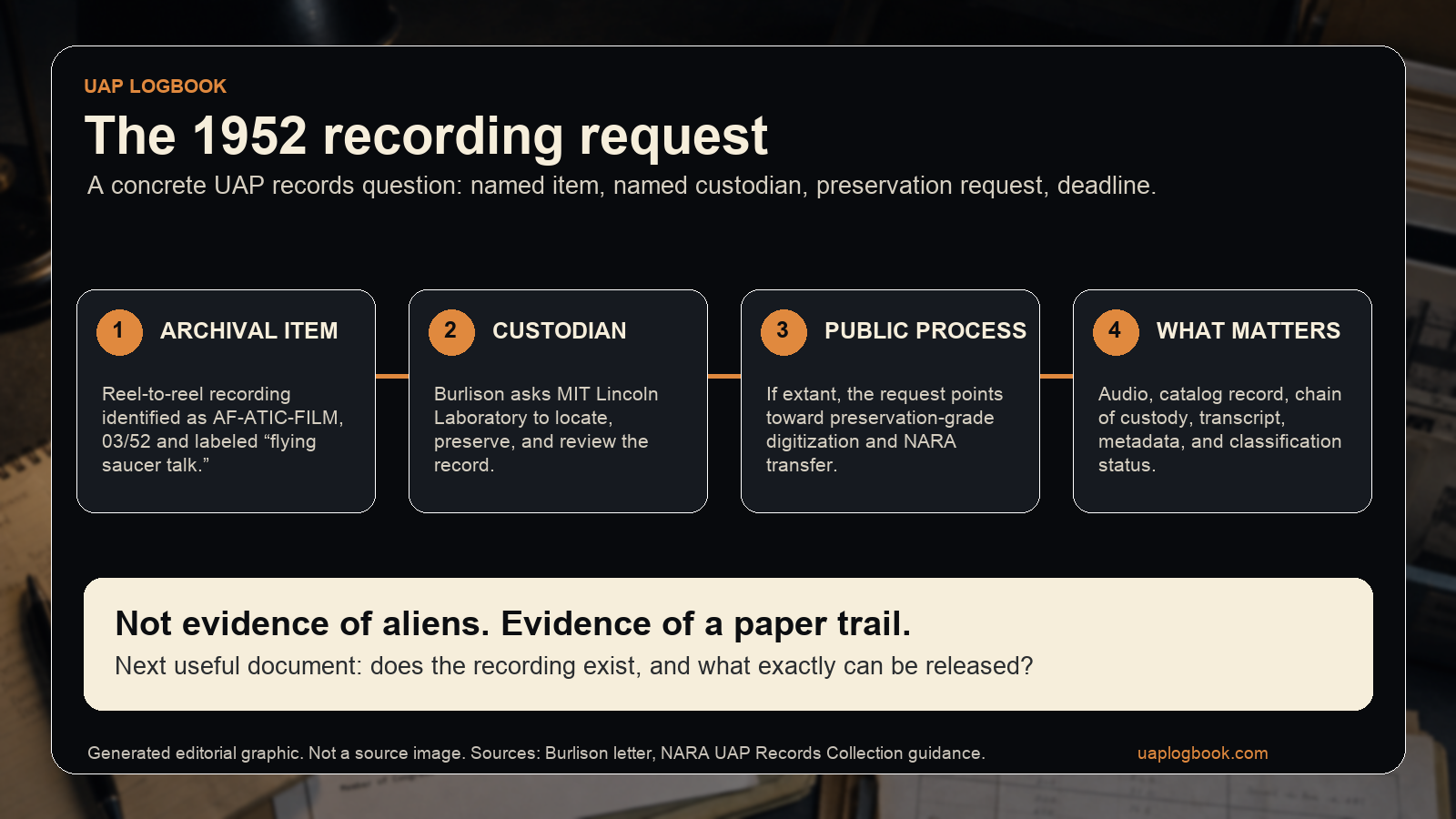
Rep. Eric Burlison has asked MIT Lincoln Laboratory to locate a reel-to-reel recording identified as AF-ATIC-FILM, 03/52 and labeled "flying saucer talk."
Burlison's office published the letter on May 8, 2026. On X, Burlison said MIT Lincoln Laboratory's attorneys responded quickly and that the lab would comply within 30 days.
The letter is narrower than the label. It asks whether the item still exists, where it is held, and whether it belongs in the federal UAP records process.
What the letter says
The letter is addressed to MIT Lincoln Laboratory Director Melissa G. Choi and counsel David A. Suski. It describes the item as a reel-to-reel recording from the Beacon Hill Study, marked "flying saucer talk," with former Air Force officer Edward J. Ruppelt listed as the briefer.
Ruppelt headed the Air Force's UFO investigations in the early 1950s and later wrote The Report on Unidentified Flying Objects.
Burlison asks MIT Lincoln Laboratory to determine whether the recording still exists, identify its custodial status, preserve the original medium and related documentation, and, if located, arrange preservation-grade digitization and transfer of the digital copy and metadata to the National Archives.
Why NARA is in the loop
The request relies on the UAP records framework created by the 2024 National Defense Authorization Act. NARA guidance says federal agencies must identify UAP records in any format, make digital copies, and prepare them for transfer to the National Archives.
That puts the question past one old audio reel. If a federally funded research lab, or anyone holding its records, sits on early UAP-related work, those files may fall under the UAP Records Collection process.
The letter also asks MIT Lincoln Laboratory to place a preservation hold on related material: inventories, correspondence, metadata, classification guidance, declassification records, transcripts, duplicates, and any prior digitization work.
What the label does and doesn't tell us
"Flying saucer talk" is a label on an old reel. The contents could be routine, historical, classified, misfiled, or gone.
What is documented is the item description: a specific old recording, a named lab, a named briefer, and a current congressional request for custody and preservation. The contents are not.
What would move the story
The story moves if MIT Lincoln Laboratory confirms the recording exists, names who holds it, says whether it has been digitized, or produces a transcript, catalog card, metadata, or access restriction.
If the reel is located, the useful release is the audio, the catalog record, the chain of custody, the date, the briefer information, and any associated briefing materials. Not a summary.
For now, the object is still mostly a label.
Where it sits
A named item, a named custodian, a preservation request, and a 30-day clock.
The reel may be boring, missing, or more interesting than the label. MIT Lincoln Laboratory has been asked to account for it.