News / May 20, 2026
DOW-UAP-PR35: Greece 2023 and the circular object over water
DOW-UAP-PR35 is the quieter Greece case in PURSUE Release 01: a small circular object over water, no reported maneuvering, and a public video description that fades into ambiguity.
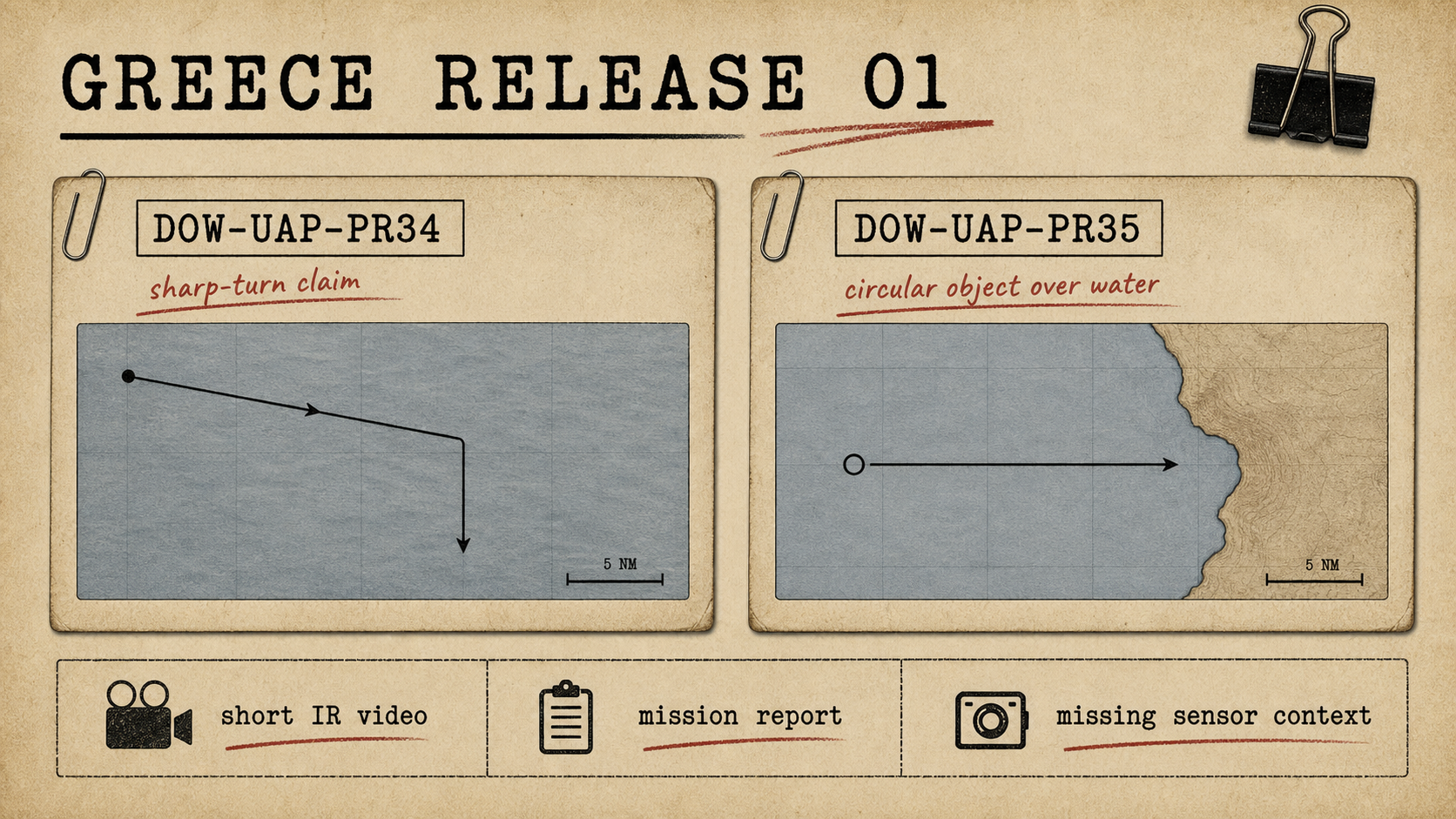
DOW-UAP-PR35 is the less dramatic Greece case in PURSUE Release 01.
That is why it is useful.
The better-known Greece file, DOW-UAP-PR34, carries the sharper phrase: “Sharp 90 degree turns.” PR35 does not. It is a shorter, quieter record: a small circular object, near the ocean surface, moving toward land, then becoming indistinguishable as the background changes.
If PR34 is the headline case, PR35 is the control sample.
What the file says
The case appears in the Department of War’s first public PURSUE release, published on May 8, 2026.
The unresolved UAP report is labeled DOW-UAP-PR35. The paired mission report is DOW-UAP-D35.
According to PR35, United States Central Command submitted a report to AARO consisting of 24 seconds of infrared sensor video from a U.S. military platform in 2023. The accompanying D35 mission report described the UAP as small and circular, flying near the surface of the ocean toward land.
The public video description is short:
- at 00:02, the sensor narrows its field of view to zoom in on an area of contrast near the center of the screen;
- from 00:03 to 00:19, the sensor tracks the area of contrast as it moves against the ocean background;
- at 00:20, as the background changes from mostly water to land, the area of contrast becomes indistinguishable.
That is the public video story.
No sudden acceleration. No sharp turns. No reported interaction. No recovered material.
What the mission report adds
D35 gives the operational frame.
The platform took off from LGLR at 1504Z on October 28, 2023, arrived on station at 2018Z, and returned to base the next day. The report lists a total mission time of 20 hours and 1 minute, with 9 hours and 24 minutes of full-motion-video time.
At 0811Z on October 29, 2023, the report says the platform observed one possible UAP while returning to base.
The UAP section is unusually modest:
- UAP maneuverability observations: none;
- response to observer actions: none;
- observer assessment: benign;
- under intelligent control: no;
- signatures: none;
- effects on persons: no;
- effects on equipment: none;
- objects or material recovered: no;
- estimated kinetic velocity: 30 mph;
- description: “seemingly circular, too small to make out details.”
The general event text says the UAP was spotted flying just above the surface of the ocean water, flew straight above the ocean toward land, and was lost from the feed at 0811Z.
That is not nothing. It is also not very much.
Why this matters next to PR34
PR35 helps because it keeps the Greece cluster honest.
PR34 has a stronger claim. Its paired mission report says the object made sharp 90-degree turns. That is a performance claim that needs platform and sensor context before the public can judge it.
PR35 does not carry that kind of claim. The record describes a small circular object, no maneuvering observations, no intelligent control, no effects, no signatures, and a modest estimated speed.
That makes PR35 weaker as a mystery case, but stronger as a comparison point.
It shows that not every Greece file in Release 01 is being presented as dramatic. Some are unresolved because the public record is thin, not because the behavior is spectacular.
What could be ordinary
The ordinary possibilities are broad.
A small contrast area near the water surface could involve a bird, a drone, a balloon, debris, a boat-related object, sensor artifact, tracking artifact, compression, range uncertainty, or background contrast change. The public description does not let an outside reader sort those options.
The moment at 00:20 is the important technical weakness. The object becomes indistinguishable when the background shifts from water to land.
That does not prove it was an artifact.
It does show that contrast and background are central to the case.
What is missing
The missing material is the same kind of material that matters across Release 01:
- the original video file and full-resolution sensor output;
- sensor mode and calibration context;
- range-to-target estimate;
- platform position, motion, and line of sight;
- any radar, SIGINT, visual, or Link 16 correlation;
- the analytic process used to rule out ordinary candidates;
- a public explanation of why the case stayed unresolved.
The mission report says the platform had full-motion video, an AN/DAS-4 target pod, G-MESH, and Link 16. That does not mean all of those systems produced useful corroboration. It means the mission environment may have had more context than the public PR35 summary provides.
What the public can say
The public can say this:
DOW-UAP-PR35 is a short infrared-video case from Greece in October 2023. The paired mission report says a U.S. military platform observed a small, seemingly circular object flying just above the ocean surface toward land at an estimated 30 mph. The public video description says the area of contrast was tracked against water and then became indistinguishable as the background changed.
The public cannot say this proves an extraordinary object.
It also cannot say the case is solved.
The better reading is boring but accurate: PR35 is an unresolved sensor-video report with modest described behavior and insufficient public context.
That is a useful entry in the Release 01 map.