News / May 18, 2026
DOW-UAP-PR34: Greece 2023 and the 90-degree-turns claim
DOW-UAP-PR34 is the Greece 2023 UAP report with the 90-degree-turns claim. The public video description supports a narrower read.
primary sourcePURSUE Release 01
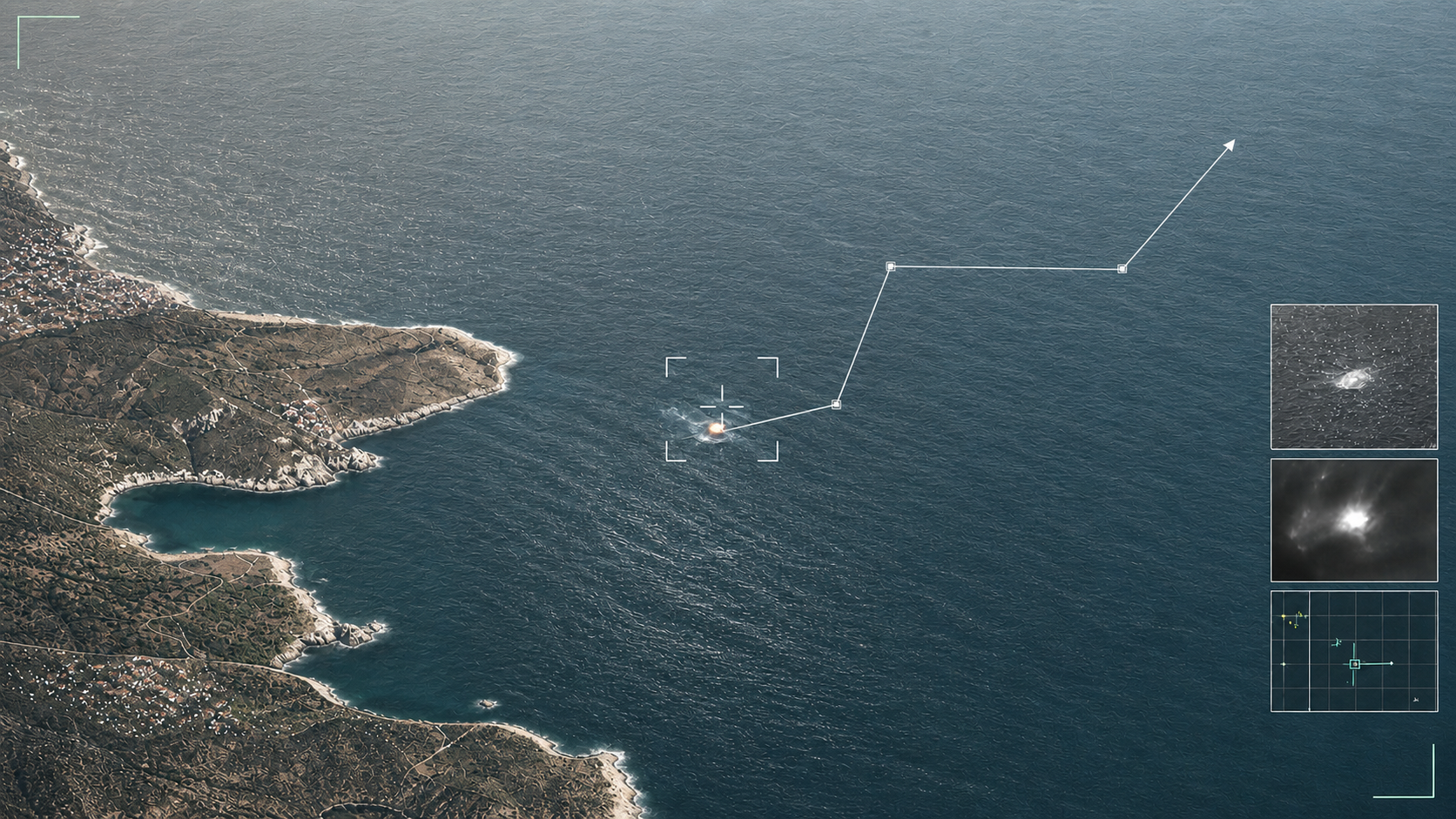
In the first PURSUE release, DOW-UAP-PR34 has the kind of phrase that travels fast: a UAP reportedly made multiple 90-degree turns near the surface of the ocean.
PR34 is the unresolved UAP report. DOW-UAP-D33 is the paired mission report. The sharp claim comes from that mission report. It is not, by itself, what the public video proves.
The useful question is smaller and better: what does the released file actually show, and what would have to be public before the sharper version of the claim could be evaluated?
What happened
The case appears in the Department of War's first public PURSUE release, published on May 8, 2026. The release includes an unresolved UAP report labeled DOW-UAP-PR34 and a related mission report labeled DOW-UAP-D33.
According to the mission report, a U.S. military platform was operating in the Greece area in October 2023 during an ISR mission. The aircraft took off from LGLR, later operated on station, and logged more than six hours of full-motion video time during the mission.
At 0035Z on October 27, 2023, the report says the crew observed one possible UAP.
The line that matters is in the UAP section. The report lists the maneuverability observation as "Sharp 90 degree turns." It also gives an estimated kinetic velocity of 80 mph.
The general text description is more vivid: the object was spotted "flying just above the surface of the ocean water," took multiple 90-degree turns at an estimated 80 mph, and was lost from the feed at 0038Z.
That is a report of an observation. It is not yet a solved event.
What the video record says
The related public video description is more cautious.
It describes a 2-minute, 57-second infrared sensor video. An "area of contrast" enters the sensor field of view from the lower-left part of the screen. The sensor pans to track it. The area remains generally centered for a while. A blue reticle later designates it. A contrast filter is used. Then the area becomes indistinguishable against the background and the reticle drops lock.
After that, the sensor cycles through zoom levels and contrast thresholds.
That is a very different evidentiary level from "we can see an object making impossible turns."
The public description is about sensor behavior and a visible contrast area. The mission report contains the sharper performance claim. Those two records may describe the same event, but they do not carry the same weight.
What is interpretation
The 90-degree-turns language depends on the observer's read of the object, the sensor feed, the platform geometry, and the estimate of speed and movement relative to the ocean surface.
The release itself warns against over-reading that kind of language. The D33 text notes that descriptive and estimative language reflects the reporter's subjective interpretation at the time of the event, and should not be treated as a conclusive indication of the object's nature or performance.
That caveat is doing real work.
It does not mean the report is worthless. It means the report is a claim with context missing.
What could explain it
Several ordinary possibilities would need to be worked through before the sharper claim means much.
The apparent motion could involve sensor panning, platform movement, tracking behavior, range uncertainty, stabilization effects, or contrast changes against the sea background. A target near the water is also a hard visual environment: glare, texture, wave contrast, horizon geometry, and compression can all make small moving features look more deliberate than they are.
None of those alternatives is a debunk by itself.
They are the checklist.
The public file does not yet give enough to decide whether this was a physical object making sharp turns, a sensor-track interpretation problem, or something more mundane that looked strange under infrared tracking conditions.
What would decide it
The next useful data would not be another caption.
It would be the original video file, not just a web player version; platform metadata; sensor mode and calibration context; range to target; aircraft position and movement; line-of-sight data; tracking and stabilization information; and any correlated radar, SIGINT, visual, or other sensor returns.
The mission report says the primary sensor was full-motion video, the target pod was AN/DAS-4, additional avionics included G-MESH, and the platform had Link 16. That does not mean those systems all produced decisive corroborating data. It means the public record hints at a wider mission context that is not fully visible in the release.
The key distinction is simple: a phrase in a mission report can justify investigation. It cannot replace the data needed to test the phrase.
Why it matters anyway
This is exactly the kind of case PURSUE is useful for.
Not because it proves something exotic. Because it shows where the public record is now: a military report with a striking performance claim, a public infrared video description that is much more modest, and enough missing technical context to keep the case unresolved.
The story is not "a UFO made impossible turns near Greece."
The story is that a U.S. military observer reported sharp turns near the ocean surface, the released video record does not let the public independently confirm that performance claim, and the deciding evidence would be sensor and platform context that is still not public.
That is less dramatic. It is also the part that matters.