News / May 19, 2026
What is Reveille Peak?
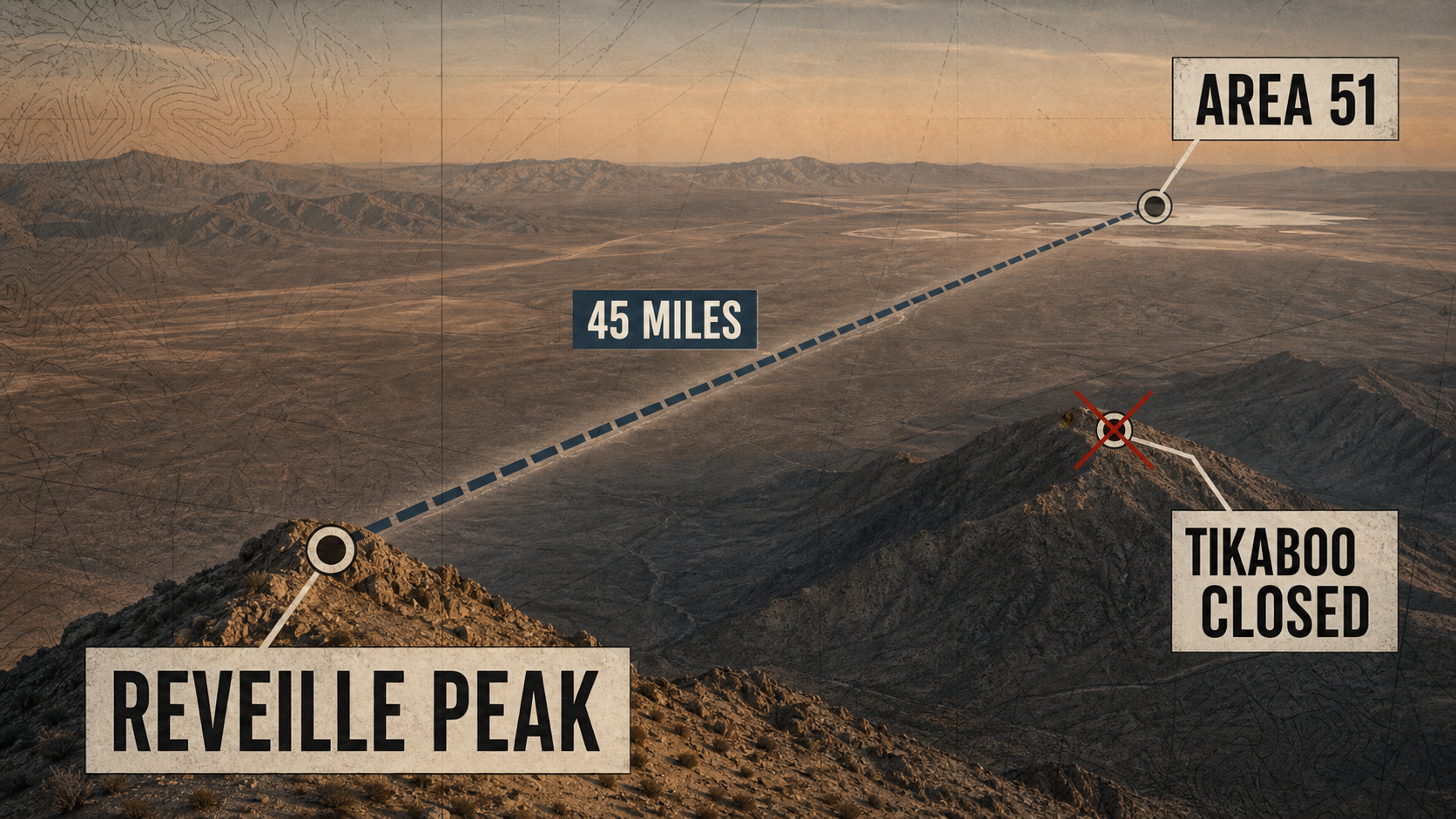
Reveille Peak is now being cited as the closest known public point with a full view toward Area 51 after the Tikaboo Peak closure. The catch is distance.
The short version
Reveille Peak is a Nevada mountain viewpoint now being mentioned in the Area 51 watcher world because Tikaboo Peak, the famous public long-lens viewpoint toward Groom Lake, is no longer accessible under a 2026 BLM temporary closure.
The short version is simple: Reveille Peak may now be the closest known public place with a full view of the base area. It is also much farther away.
The Aviationist reported that with Tikaboo inaccessible, the closest known full-view point is Reveille Peak, about 45 miles from the base. That adds roughly 19 miles compared with Tikaboo's long-used line of sight.
That makes Reveille Peak relevant. It does not make it a replacement in any practical sense.
The mountain before the mythology
Reveille Peak is not an Area 51 artifact. It is the high point of the Reveille Range in Nye County, Nevada, rising to about 8,812 feet. Peakbagger lists it with more than 2,600 feet of prominence, which is why it shows up in peakbagging records as well as in Area 51 conversations.
The range runs roughly north-south, with Reveille Valley on one side and Railroad Valley on the other. This is classic Basin and Range country: long dry valleys, tilted mountain blocks, volcanic rock, alluvial fans, and far more distance than a map makes obvious.
That geography is the point. Reveille Peak is high enough and isolated enough to matter as a viewpoint, but it is also far enough from Groom Lake that any "view" is a long-distance optical problem, not a cinematic overlook.
Why the terrain matters
Area 51 is not hidden only by secrecy. It is also hidden by ordinary Nevada.
The base sits inside a military range, behind restricted land, dry lakebeds, ridgelines, distance, haze, and summer heat shimmer. A mountain can give a line of sight, but it cannot remove the desert between the observer and the target.
That is why Tikaboo Peak became famous. It was not close in any normal sense, but it was close enough, high enough, and legal enough to make long-lens observation possible. Reveille Peak changes that balance. It keeps the height. It loses more of the distance fight.
There is also a small historical wrinkle in the name. The Reveille mining district dates back to the 1860s silver rush period, and Nevada history sites trace the name to the Reese River Reveille newspaper in Austin. So the place did not become interesting because of UFO culture. UFO culture arrived later and borrowed the map.
Why the name surfaced now
Tikaboo Peak mattered because it sat outside the restricted boundary while still allowing a distant view toward Groom Lake. It became important after closer public viewpoints, including Freedom Ridge and White Sides, were closed in 1995.
In March 2026, the Bureau of Land Management issued a temporary closure order covering about 22,987 acres around Badger Mountain in Lincoln County, Nevada. The order says the area is closed to public access and entry, with limited exemptions, for at least one year or until conditions are reassessed.
Area 51 watcher sources say that closure blocks access to Tikaboo Peak. Dreamland Resort and The Aviationist both connect the closure to the loss of the long-running Tikaboo viewpoint.
That is why Reveille Peak is now part of the story. It is not new. The access map changed around it.
What changes with Reveille Peak
The most important difference is distance.
Tikaboo Peak was already far from Groom Lake. It was not a casual roadside lookout. It required effort, weather, optics, and patience. Reveille Peak pushes the public viewpoint farther out again.
That matters because long-distance observation is not just about whether a line of sight exists. It is also about haze, heat shimmer, lens quality, elevation, weather, and whether the target is visible enough to document anything useful.
So the practical point is dry: Reveille Peak may preserve a public line of sight, but it makes the job worse.
What we know
- Tikaboo Peak was the best-known public viewpoint toward Groom Lake after closer viewpoints were closed in 1995.
- A BLM temporary closure took effect on March 25, 2026, covering about 22,987 acres around Badger Mountain.
- The closure order says public access is blocked for at least one year, unless authorized.
- The Aviationist cites Reveille Peak as the closest known full-view point after Tikaboo, at about 45 miles from the base.
- Dreamland Resort has been tracking the Tikaboo closure and the wider public-access issue.
- Reveille Peak is the high point of the Reveille Range in Nye County, with an elevation around 8,812 feet.
- The South Reveille area is known for remote terrain, rock formations, canyons, ridges, and large alluvial fans.
What we do not know
- Whether Tikaboo Peak access returns after the minimum one-year closure period.
- Whether Reveille Peak is practically useful for more than symbolic long-distance observation.
- Whether any public agency will give a more specific explanation for why this particular closure area was selected.
- Whether future land management actions will further narrow public viewpoints around the range.
Why it matters
Reveille Peak matters because the Area 51 viewing map has changed again.
This is not evidence of a UAP claim. It is not proof of a cover-up. It is not a new disclosure event.
It is a public-access story around a place where public access has always been part of the argument. When closer legal viewpoints disappear, the remaining ones become important by default.
That is what gives Reveille Peak its new role. Not drama. Geography.
For UAP Logbook, the useful question is narrow: what can still be legally observed, from where, and under what public record?
Reveille Peak is now part of that question.
Sources
- The Aviationist: Tikaboo Peak, Legendary Area 51 Viewing Spot, Closed by U.S. Government
- BLM Temporary Closure Order, March 25, 2026
- BLM Closure Area Map
- Dreamland Resort Tikaboo Peak map page
- Peakbagger: Reveille Peak, Nevada
- Friends of Nevada Wilderness: South Reveille Wilderness Study Area
- USGS: Mineral resources of the South Reveille Wilderness Study Area
- Nevada Expeditions: Reveille ghost town
- UAP Logbook: What is Tikaboo Peak?
- UAP Logbook: What is Dreamland Resort?