News / May 19, 2026
Japan UAP timeline: from the 2024 Diet security track to Kihara's case-by-case answer
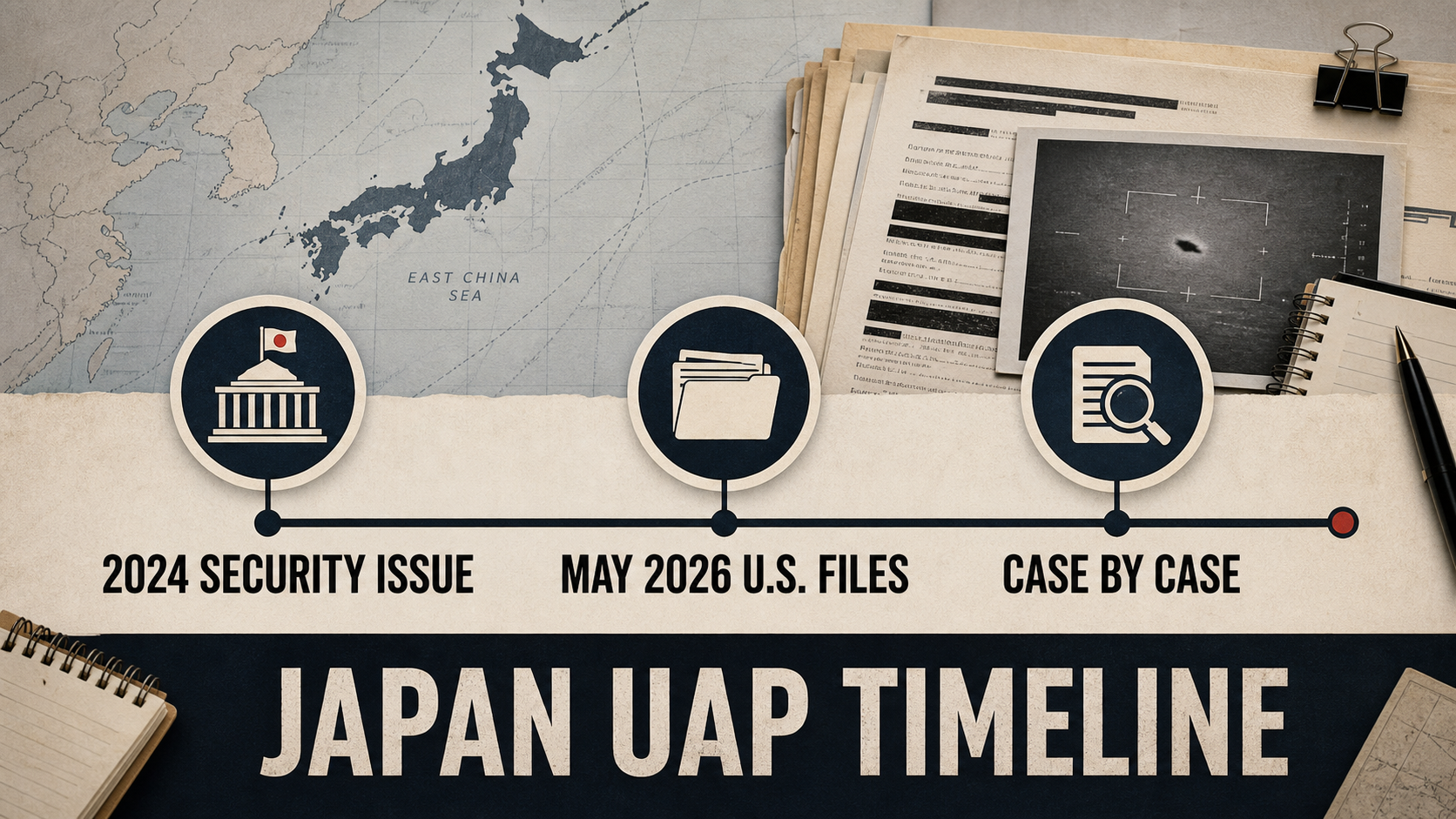
Japan's UAP story is short and cautious. Lawmakers began framing UAP as a security issue in 2024, the first U.S. PURSUE release arrived in May 2026, and Chief Cabinet Secretary Minoru Kihara answered in narrow terms. The May 28 proposal asks for a Cabinet-level coordination point.
In short
Japan's UAP story is not a disclosure promise. It is a short, cautious timeline.
- In 2024, Japanese lawmakers from the ruling and opposition parties began treating UAP as a security question.
- The U.S. Department of War published the first PURSUE tranche on May 8, 2026. Some Japanese reports said the material included UAP footage connected to Japan and waters around Japan.
- On May 11, 2026, Chief Cabinet Secretary Minoru Kihara was asked about the U.S. release.
- Kihara said he had reviewed the footage, that Japan would analyze it, and that any release of Japanese material would be judged case by case.
- On May 28, 2026, the cross-party parliamentary group handed Kihara a proposal asking the government to centralize UAP information collection and command functions in the Cabinet Secretariat.
Japan is not saying "everything will be released." It is saying the subject sits inside airspace, intelligence, alliance, and security questions.
Update: May 28, 2026
FNN reported that Japan's cross-party UFO/UAP parliamentary group handed Chief Cabinet Secretary Minoru Kihara a formal proposal. The proposal asks the government to centralize UAP information collection and command functions in the Cabinet Secretariat. It also calls for a better reporting environment and for stigma around reporting to be reduced.
That moves the parliamentary track from asking questions to asking for a government structure. It is not a Japanese file release.
Timeline
May 28, 2024: lawmakers frame UAP as a security question
Asahi Shimbun reported that lawmakers from ruling and opposition parties met in the Diet to discuss UFO/UAP from a national-security perspective. The planned group was described as the "Security-Oriented Parliamentary League for the Clarification of Unidentified Anomalous Phenomena." The stated reason was plain: leaving unidentified things unexamined can be a security problem.
The framing was not "aliens." It was whether unknown aerial activity could involve foreign drones, balloons, or other systems relevant to Japan's defense.
June 6, 2024: the parliamentary group is launched
TBS Cross Dig reported that the group was formally launched on June 6, 2024. The article said the group wanted the government to establish a dedicated body to deal with UFOs and other anomalous phenomena, and that roughly 80 lawmakers were expected to take part.
The stated reason: an unidentified object could turn out to be another country's advanced system, and a serious security issue.
June 2024: Niconico gives the group a public platform
Dwango announced a Niconico News special on "UFO and security" featuring Japanese politicians involved in the parliamentary group. The announcement tied the Japanese discussion to U.S. moves around AARO and said the group wanted Japan to build a comparable response structure.
The May 2026 question to Kihara did not come from nowhere. Japanese political and media actors were already treating UAP as a security topic.
March 2026: the group is still active
In March 2026, Yoshiharu Asakawa, listed as secretary-general of the parliamentary group, posted notice of a fourth general meeting at the House of Representatives Members' Office Building. Press coverage was open.
The parliamentary track was still active before the U.S. release.
May 8, 2026: the U.S. publishes the first PURSUE tranche
The U.S. Department of War announced the first release under the Presidential Unsealing and Reporting System for UAP Encounters, or PURSUE. The public portal describes the effort as a government-wide review and release process for unresolved UAP-related records and historical documents.
That first release included military reports, videos, photographs, and older records. Some Japanese media reports said the material included footage connected to Japan and waters around Japan.
May 11, 2026: Kihara is asked about the U.S. footage
At the May 11, 2026 Chief Cabinet Secretary press conference, Japanese media asked Minoru Kihara about the U.S. release and footage reported to involve Japan.
ABEMA summarized the question as asking whether Japan had been contacted in advance, whether Kihara had seen the footage, and whether the Japanese government would direct the Defense Ministry to release its own material.
TV Asahi reported Kihara saying he had checked the released footage and wanted to analyze it further. On whether Japan would release its own UFO-related material, TV Asahi reported him saying decisions would be made individually after weighing various factors.
The public line: review, analyze, decide case by case.
May 28, 2026: lawmakers hand Kihara a proposal
FNN reported that the cross-party UFO/UAP parliamentary group submitted a proposal to Chief Cabinet Secretary Kihara on May 28, 2026.
According to FNN, the group had 83 participating lawmakers. The proposal called for the government to centralize UAP information collection and command functions in the Cabinet Secretariat. It also called for a better reporting environment and for stigma around reporting to be reduced.
The proposal is structural: where reports go, who coordinates them, and how officials can report incidents without the subject turning into a joke.
What Japan has actually said
The public Japanese position is narrow.
Kihara did not announce a Japanese UAP archive. He did not promise a domestic version of PURSUE. He did not say Japan would publish every related record.
He acknowledged the released footage, said it would be analyzed, and kept disclosure conditional.
The conditional language matters because Japan's possible records would not be just "UFO files." They may include air-defense data, sensor data, alliance information, locations, platforms, or collection capabilities. Those are exactly the details that can make a file useful to outside researchers and sensitive to governments.
What is not established
Several claims are still ahead of the public record:
- that Japan has a large UAP archive ready for publication;
- that Japan will publish its own footage soon;
- that the U.S.-released Japan-area material has been independently validated by Japan;
- that any Japan-related clip shows something extraordinary;
- that case-by-case disclosure means a disclosure plan already exists.
None of those is established by the May 11 answer.
What to watch next
Specific moves would be:
- Japan identifying whether it holds records corresponding to the U.S.-released cases.
- A statement on whether any Japanese sensor systems collected related data.
- A redacted file, a date, a location, or an official explanation for why a record cannot be released.
Until then, the story is institutional. Japan's UAP discussion moved from a 2024 parliamentary security track into a 2026 government press-conference answer after the U.S. release. The May 28 proposal makes that institutional story more concrete: the parliamentary track is now asking the government to build a clearer collection and coordination point.
Related UAP Logbook notes
- Japan reviewed U.S. UAP footage
- AARO, PURSUE, and UAP file releases
- The war.gov UFO files
- DOW-UAP-PR34: Greece 2023 and the 90-degree-turns claim
Sources
- Government of Japan: Press Conference by the Chief Cabinet Secretary, May 11, 2026.
- TV Asahi: "日本周辺に謎の飛行物体 アメリカ国防総省“UFO”公開," May 11, 2026.
- ABEMA Times: "米国防総省公開の『UFO資料』に日本周辺で撮影された映像も," May 11, 2026.
- U.S. Department of War: PURSUE UAP portal and May 8, 2026 release announcement.
- Asahi Shimbun: "UFOは『安全保障上の問題』 与野党議員が会合," May 28, 2024.
- TBS Cross Dig: "UFOなど『異常現象』対応する専門機関を求める議員連盟が発足," June 6, 2024.
- Dwango / PR Times: Niconico News "UFO and security" program announcement, June 11, 2024.
- Yoshiharu Asakawa / Go2senkyo: notice of UAP parliamentary group fourth general meeting, March 24, 2026.
- FNN Prime Online: cross-party UFO/UAP parliamentary group proposal to Kihara, May 28, 2026. https://www.fnn.jp/articles/-/1051798