
note / May 15, 2026
Jeremy Corbell says UFO disclosure has started. The missing files are still the story
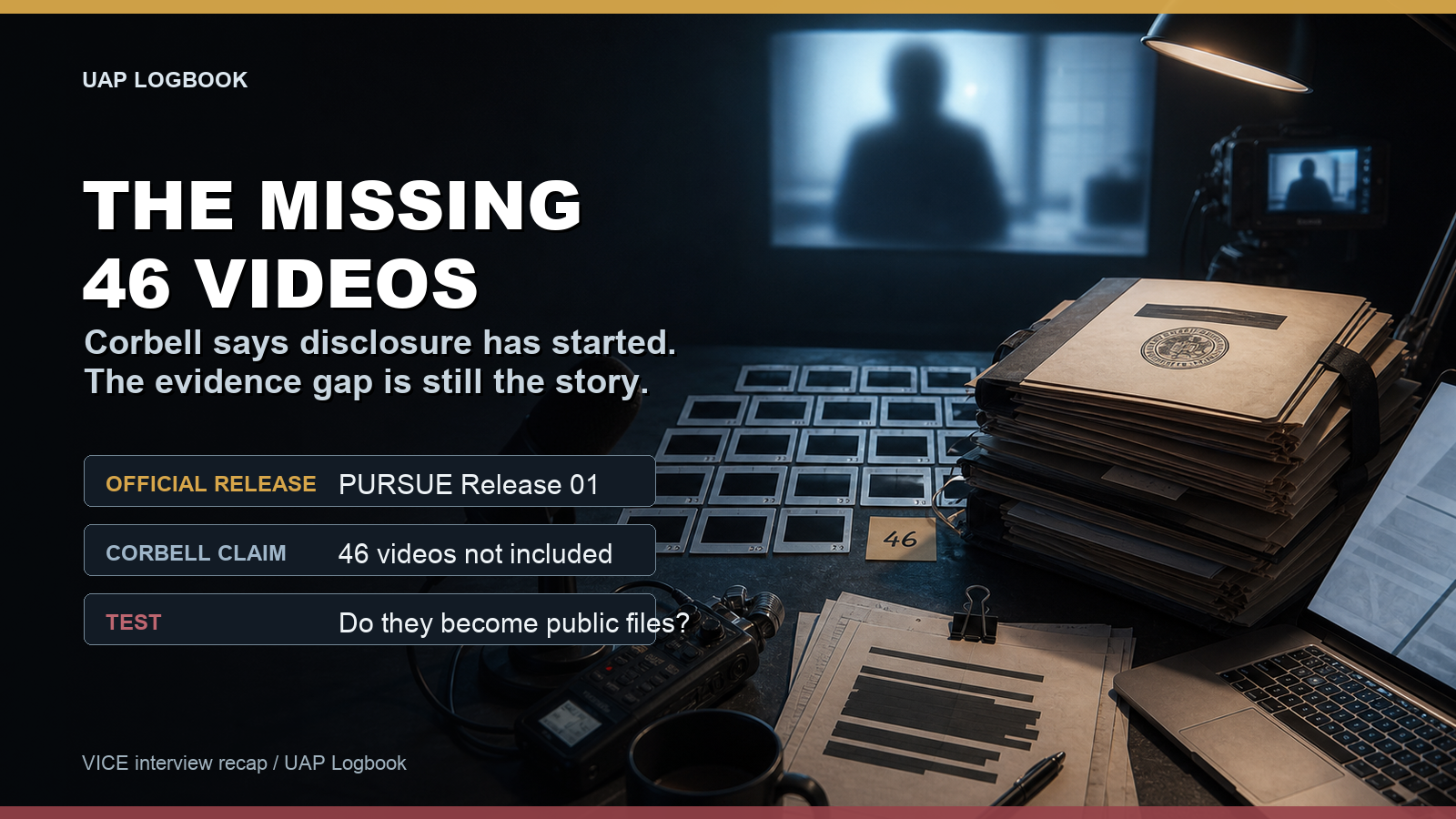
A new VICE interview frames the latest UAP release as the beginning of disclosure. The more useful question is whether the alleged 46 requested videos ever become public files.
video sourceVICE News: UFO Disclosure Has Started w/ Jeremy Corbell on Sleeping Dog
The interview
Jeremy Corbell returned to Shane Smith Has Questions for a long VICE News interview released on May 14, 2026. The headline framing is large: UFO disclosure has started.
The conversation covers the new U.S. UAP file release, Corbell's documentary Sleeping Dog, whistleblower testimony, alleged reverse-engineering programs, non-human intelligence claims, the Syria 2021 footage, David Fravor's Tic Tac encounter, David Grusch, and what Corbell expects in the next few months.
That is a lot of subject matter. The article-worthy part is narrower.
Corbell is not only reacting to what the government released. He is arguing that the important material is still missing.
What Corbell claims
Corbell says the latest U.S. file release was not a voluntary act of generosity, but a response provoked by congressional pressure, hearings, whistleblowers, and previous reporting. He presents the release as the start of a larger cycle, not the final product.
His most concrete recurring point is the alleged set of 46 videos. In the interview, Corbell says Congress specifically requested those videos from the government and that they were not included in the first release. He also says Sleeping Dog includes short glimpses of some of that material.
That is the useful claim to track.
Not "disclosure has started" as a mood. Not "biggest story in human history" as television language. The testable question is whether the alleged 46 videos become public records with source files, dates, platforms, sensor context, and analysis attached.
What the government release actually says
On May 8, 2026, the Department of War announced the initial release of UAP files under PURSUE, the Presidential Unsealing and Reporting System for UAP Encounters. The official release describes an interagency effort involving the White House, ODNI, DOE, AARO, NASA, the FBI, and other intelligence components.
The PURSUE portal frames the project as a government-wide effort to find, review, identify, declassify, and publicly release unresolved UAP-related records. It also says the work spans many decades and many records, including material that exists only on paper.
That makes the "first release" language important. A first tranche can be meaningful without being complete. It can also create a content cycle where every missing file becomes evidence of an imminent next drop.
That is where UAP stories get slippery.
What is new here
The interview does not prove the strongest claims in the UAP ecosystem. It does not independently establish recovered craft, non-human biologics, or reverse-engineering programs.
It does, however, sharpen the public checklist around the current release:
- Were 46 specific videos requested by Congress?
- Which office or committee requested them?
- Are the filenames or case identifiers public?
- Are any of those videos already represented in PURSUE Release 01?
- Will future releases include original files rather than clips or documentary glimpses?
- Will those files include dates, locations, sensor platform, range, and chain of custody?
That is a better frame than asking whether the interview felt exciting.
The documentary problem
Corbell says Sleeping Dog contains stronger material than the first government release. That may be true. It also creates an awkward evidence problem.
If the best public view of requested government footage is inside a documentary, then the public is still not evaluating the underlying records. It is evaluating an edited presentation of them.
That does not make the material false. Journalism often starts with partial access, protected sources, and edited evidence. But it does mean the next step is not applause. The next step is release of the underlying files.
A clip in a film can point to a record. It is not a substitute for the record.
The strongest and weakest parts
The strongest part of the interview is Corbell's focus on a specific missing set: the 46 videos he says were requested by Congress. Specific claims can be followed. They either surface, or they do not.
The weakest part is the familiar expansion from document-release politics into sweeping conclusions about non-human intelligence, recovered craft, biologics, and what certain government silos may know. Those may be the claims driving attention, but the interview itself does not turn them into independently checkable evidence.
That distinction matters. A government can release real UAP records. A journalist can have real sources. A video can be genuinely unresolved. None of that automatically proves the larger story people want attached to it.
Where this leaves it
The VICE interview is worth watching because it captures the current disclosure mood: pressure, confidence, salesmanship, impatience, and genuine uncertainty all moving at once.
For UAP Logbook, the takeaway is simple.
The practical question is whether the files surface with enough context to inspect them.
If the alleged 46 requested videos are released with original context, that is news. If they remain glimpses, promises, and references in interviews, that is also news, but a different kind.