
note / May 14, 2026
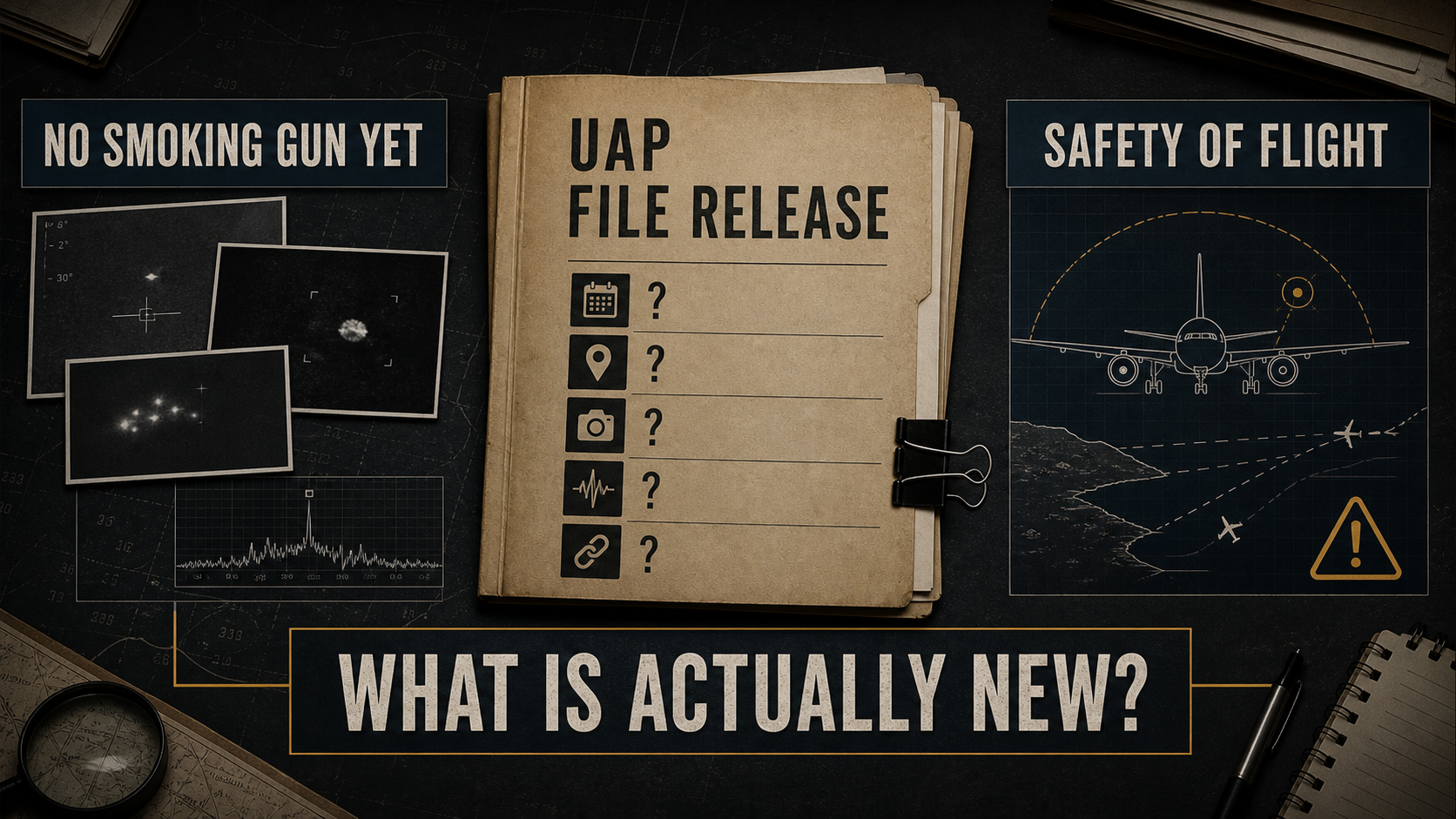
Kaku and Gallaudet react to the UAP file release: no smoking gun, but more data to argue over
A FOX 10 segment puts Michio Kaku and Timothy Gallaudet on the same problem: more UAP files do not automatically mean better evidence.
video sourceFOX 10 Phoenix: Retired admiral exposes 80-year government UFO cover-up
The segment
FOX 10 Phoenix's latest episode of Unknown is framed around an "80-year government UFO cover-up," but the useful material is less dramatic than the headline.
The 42-minute segment brings together two different versions of the current UAP conversation: physicist Michio Kaku treating the new file release as a potentially important data dump, and retired Rear Adm. Timothy Gallaudet arguing that military encounters have already crossed the threshold from curiosity into safety and national-security concern.
The episode is not a document release and it does not settle any specific case. It is useful because both guests point, in different ways, to the same problem: more files do not automatically mean better evidence.
Kaku: history, but not proof
Kaku calls the release historic and says it opens a new phase in which scientists and the public can examine a much larger body of official material.
He also adds the caveat that matters: there is no smoking gun yet.
In his view, the new files are a first step. They may give physicists and independent researchers more material to examine, but the current public data still has weak points. In particular, he highlights a familiar problem with many UAP videos: without distance, range, and telemetry, it is hard to know whether a movement is extraordinary or only appears that way.
Kaku discusses one of the star-like clips from the release. He says it looks like a bright star with points, but then appears to move left and right in a way a normal star should not. Still, he does not treat that as proof of alien technology. The limiting factor is the missing measurement context.
The physics talk gets speculative
The interview then moves into the physical implications of the reported maneuvers. Kaku says that if some objects are genuinely making the kinds of turns seen or described, a biological pilot could be crushed by the forces involved. He suggests that such objects, if real, may be drones or operate without occupants.
He also talks about air-to-sea movement, advanced propulsion, hyperdrive, quantum computing, and whether future tools could help analyze UAP data.
That section is the most speculative part of the interview. Kaku is careful at points, but the conversation moves quickly from released clips to advanced physics and hypothetical extraterrestrial technology.
The more grounded point remains simpler: if the public is going to evaluate a UAP clip, it needs the original file, sensor context, range, platform data, and enough surrounding footage to remove the easy ambiguities.
The Los Alamos deaths claim
Kaku also says he was recently shown documents about 11 senior scientists or security-cleared people who allegedly died or disappeared under unusual circumstances. He describes some as connected to weapons facilities, Los Alamos, the Jet Propulsion Laboratory, MIT, or advanced propulsion work.
He says one person had warned acquaintances that she might be targeted.
The segment does not provide the underlying documents on screen in a way that lets viewers verify the claim. For now, this remains a claim described by Kaku, not a case established by the interview itself.
Gallaudet: the Navy safety problem
The second half of the segment shifts to retired Rear Adm. Timothy Gallaudet.
Gallaudet returns to the USS Theodore Roosevelt / GoFast context. He says that when Roosevelt pilots were encountering UAP off the U.S. East Coast, the issue was treated as a safety-of-flight concern. In one case, he says, an object came between two F/A-18s at close range.
According to Gallaudet, an operations officer sent an email on the Navy secret network asking subordinate commanders if they knew what the objects were, with the GoFast video attached. He says the email was later wiped from his computer, which told him the subject was being handled above the Secret level.
That part of the story has become one of Gallaudet's recurring public claims: not that every interpretation is settled, but that the Navy had an operational safety issue and the information was not handled like an ordinary hazard report.
"U.S. tech demo" and the Tic Tac argument
Gallaudet also responds to the idea that the Tic Tac or similar incidents might have been U.S. technology demonstrations.
His argument is practical. If the United States had such a capability, he says, it would not publicly admit it at an unclassified level, and it would likely be used in real-world conflicts rather than kept as a mystery object buzzing Navy aviators.
He also points to pilot testimony, especially David Fravor, as a reason he does not accept the "U.S. tech demo" explanation casually.
This does not prove origin. It does explain why Gallaudet sees the incidents as unresolved and operationally serious.
The ocean angle
Gallaudet then moves into one of his frequent themes: the ocean.
If a non-human or unknown technology wanted to operate without being fully discovered, he says, the ocean would be an obvious place. Much of the ocean volume remains unexplored, and large parts of the seafloor remain unmapped.
That is a hypothesis, not a demonstrated location for UAP activity. But it is part of why Gallaudet argues that the Navy keeps appearing in the story. Ships, submarines, and carrier air wings are operating in the air-sea boundary where some of these reports cluster.
The "ringer" question
One of the better questions in the interview comes late: could some files in the release be ringers, recycled cases, or low-value material that distracts from better records?
Gallaudet says he does not know the government's intent, but he acknowledges the question. The issue is worth separating from the larger UFO debate.
A release can be real and still be strategically thin. A video can be official and still lack the context needed to evaluate it. A file can be newly released by one portal while already known from leaks, FOIA releases, or earlier reporting.
That is where the next useful work is: sorting what is actually new, what is recycled, and what contains enough metadata to matter.
Where this leaves it
The FOX 10 segment is not subtle, and some of its framing runs hotter than the evidence shown.
But inside the hype are two useful claims. Kaku says the release is historically important but not proof. Gallaudet says the Navy had real safety concerns and that some UAP data was handled above normal channels.
Both points can be true without turning every released clip into an alien craft.
The next question is not whether the files feel exciting. It is whether the release gives enough original data for anyone outside government to test the cases properly.
Sources
- FOX 10 Phoenix: Retired admiral exposes 80-year government UFO cover-up, published May 12, 2026.
- Timothy Gallaudet official site