News / May 21, 2026
Project Rubik’s Cube, Corbell, and Borland’s SCIF answer
At UFO Fest 2026, Jeremy Corbell asked Dylan Borland about Project Rubik’s Cube. Borland did not confirm the phrase. He pointed to a SCIF.
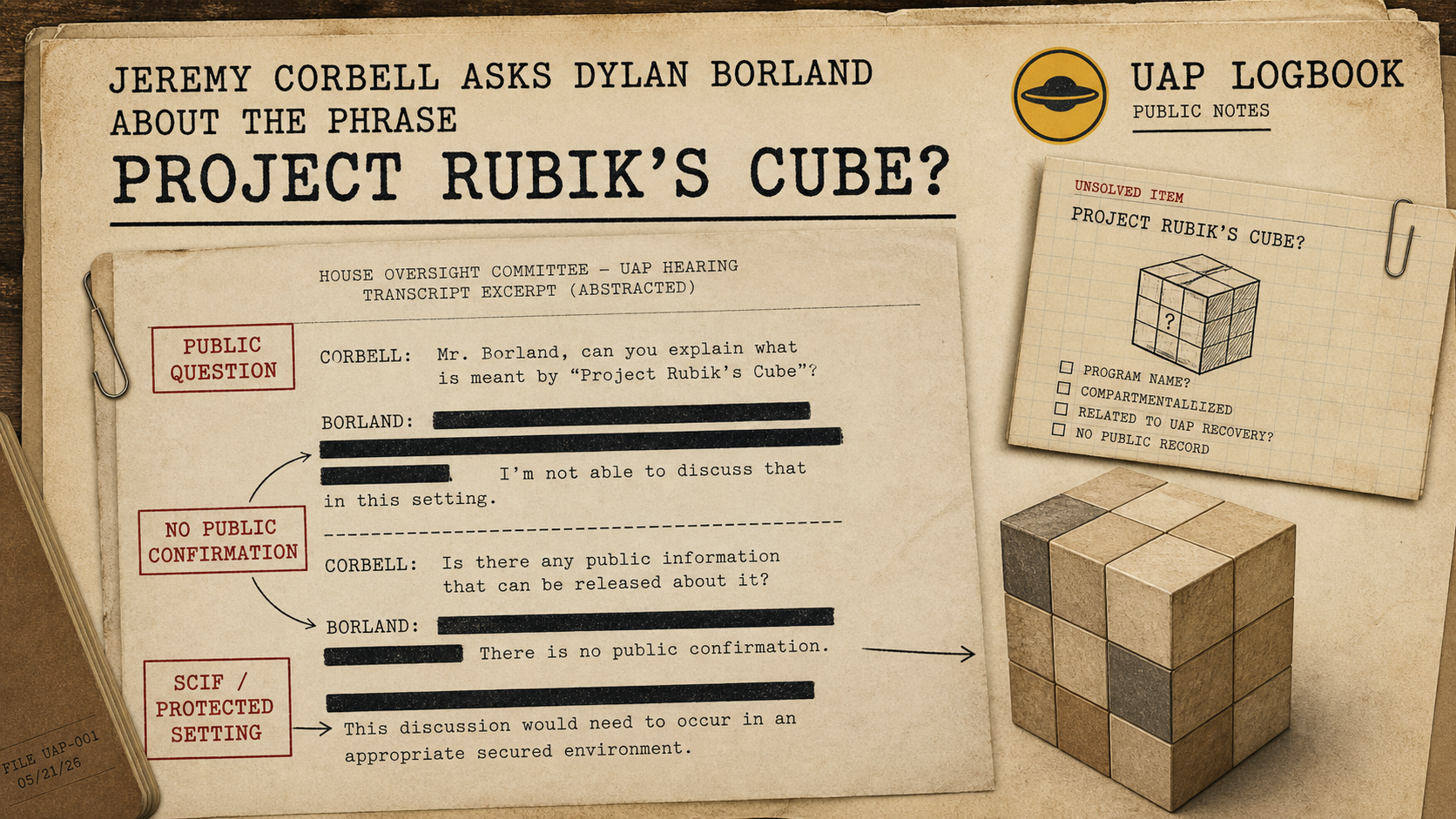
Jeremy Corbell put two words in front of Dylan Borland at a UFO Fest 2026 panel: “Project Rubik’s Cube.”
Borland did not repeat the name. He did not deny it. He pointed to the room he was not in.
“This isn’t a SCIF.” That is the line that carried the clip.
What happened
Highlight video from UFO Fest 2026 shows Dylan Borland on a panel with George Knapp and Jeremy Corbell.
Corbell asks Borland whether he testified to the Inspector General about a program identified as “Project Rubik’s Cube.”
Borland does not give a direct answer. In the available clips and community transcript summaries, he refuses to confirm or deny the phrase on a public stage. His point is procedural: he is not in a SCIF and is not going to prison for an answer that belongs in a protected channel.
A named phrase, a public stage, a witness who treats the answer as someone else’s question.
What the clip shows
It shows Corbell putting the phrase into public circulation. It shows Borland declining to discuss it outside a secure or legally protected setting.
It does not show what “Project Rubik’s Cube” is, whether the phrase is exact, whether Borland used it under oath, or whether Corbell has a document behind it.
Why the reaction matters
Borland’s reaction is the story.
A flat denial would have ended the clip. A clean confirmation would have made a different one. The answer that came out sits in the middle: no confirmation, no denial, and a clear signal that the public stage is the wrong room for it.
That has weight. It is still just an exchange on a stage.
Borland is one of several named witnesses in the current UAP disclosure cycle. The same news climate that put his name in front of Corbell has pushed other claims — like Hal Puthoff’s “four types” comment — from podcast to mainstream coverage. The path from clip to headline is now a familiar UAP route.
The SCIF point
A SCIF (Sensitive Compartmented Information Facility) is a secure room built for handling classified information at the highest sensitivity levels.
When a witness says a question belongs in one, three readings are possible: the material is sensitive, the witness is protecting himself legally, or the framing is being used to dodge a public answer.
The clip does not let the viewer pick between them.
Borland’s written testimony is already on the public House Oversight record — the same channel that holds hearings on AARO and PURSUE — but the SCIF-shaped answer here is a different gatekeeper than Congress. See the Congress and UAP disclosure topic hub for the wider witness pattern.
What would move it forward
- a public document using the name “Project Rubik’s Cube”;
- a hearing transcript or Inspector General record that names it;
- a protected-disclosure summary that can be released lawfully;
- corroboration from another named witness under oath;
- a clear statement from Borland or Corbell about what can be said publicly.
Until any of that surfaces, the cleanest label is a public non-answer with a name attached.
The phrase sits next to the Elizondo hybrids claim, the Puthoff four-types chain, and the other public labels the current UAP cycle is carrying.
Why this one matters
UAP stories tend to harden from phrase to legend quickly.
This one has a catchy name, a known media figure, a congressional witness, and a clipped public moment. That is enough to travel. It is not enough to verify.
For now, the story is small: Corbell asked, Borland would not answer in the room, and the phrase is moving anyway.
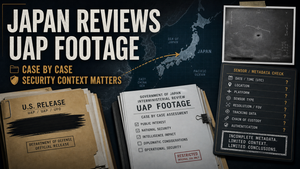
U.S. disclosure is now running in parallel with cases abroad — Japan’s Kihara is reviewing the same U.S.-released UAP footage and using a similar “case by case” language that keeps intelligence capabilities out of public view.
Sources
- The Outer Rim: UFO Fest 2026 panel highlights with Dylan Borland, George Knapp, and Jeremy Corbell
- Reddit transcript excerpt and discussion of the “Project Rubik’s Cube” exchange
- House Oversight: Restoring Public Trust Through UAP Transparency and Whistleblower Protection
- Dylan Borland written testimony to House Oversight, September 2025
- NIST glossary: Sensitive Compartmented Information Facility