
note / May 12, 2026
Tim Burchett lays out his UFO case on Joe Rogan
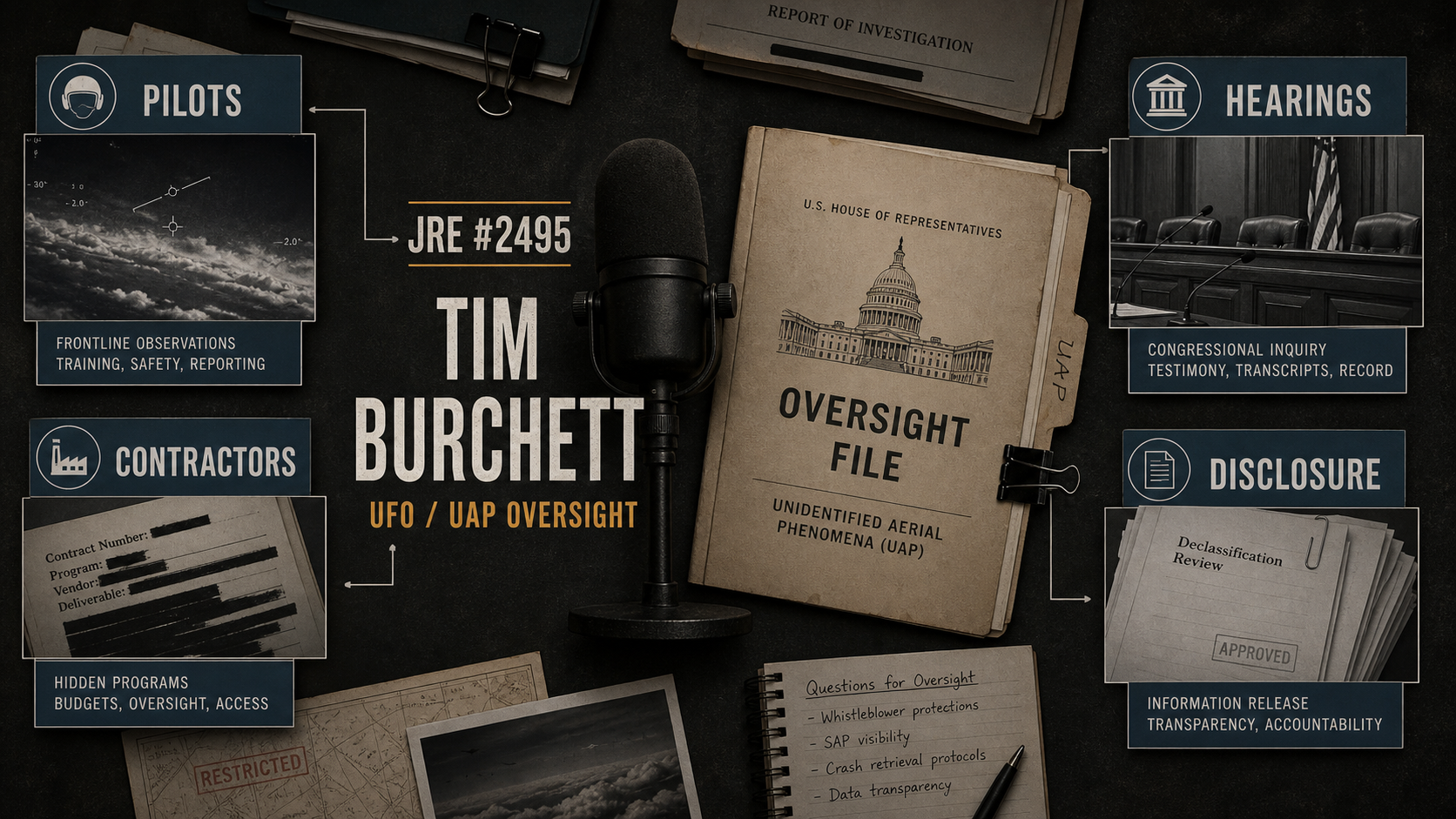
Rep. Tim Burchett spent much of his Joe Rogan interview on UFOs, congressional oversight, pilot reports, contractors, and why he thinks disclosure will be limited.
video sourceJoe Rogan Experience #2495 - Tim Burchett
The interview
Rep. Tim Burchett, the Tennessee Republican who has become one of Congress's more visible voices on UFO and UAP oversight, appeared on The Joe Rogan Experience for a long interview published on May 7, 2026.
The episode runs a little over two and a half hours and covers far more than UFOs. But the first hour, and several later sections, return repeatedly to disclosure, congressional hearings, military witnesses, alleged compartmentalization, private contractors, and rumors around underwater activity.
Burchett's position throughout the interview was blunt: he thinks the subject has been covered up for decades, he does not expect the government to release everything it knows, and he believes congressional oversight is being limited by classification, bureaucracy, and the movement of sensitive material outside ordinary government channels.
How Burchett says he came to it
Rogan opened by asking how Burchett came to the subject. Burchett said his interest began when he was a child reading books about UFOs at a local library. He said he followed the subject for years, but did not see anything himself until briefings he later received as a member of Congress.
He described his congressional involvement as something that grew after public comments and media appearances. According to Burchett, people began contacting him, including military and government-connected sources. He repeatedly framed the issue as less about belief in extraterrestrials and more about a lack of answers from government.
He also said he has little confidence that any president, including Donald Trump, would automatically know which questions to ask or which people to press. Burchett said the relevant information may be held in layers, with only a small number of people seeing the full picture.
Pilots and pressure not to report
One early section focused on military pilots. Burchett claimed that pilots who report unusual encounters risk consequences to their careers. He said he has been told pilots may be pulled from flight status, subjected to psychological evaluation, and put through lengthy debriefings that feel more like interrogations.
He described one case relayed to him in which a pilot allegedly tried to damage an onboard recorder after seeing something unusual, because the pilot did not want the event preserved in a way that could follow him professionally.
Burchett also discussed a trip to Florida with Rep. Anna Paulina Luna and former Rep. Matt Gaetz. He said they expected to be briefed on reports from pilots who had seen objects and had photographs. Instead, he said, the group was given a briefing on other serious military matters first and had difficulty getting to the UFO-related material.
His larger point was that information can be delayed, redirected, or filtered before members of Congress ever see it.
Footage and possible releases
Burchett said he hopes more footage will be released, including material he says lawmakers have seen and other material rumored to exist. But he also said he fears any release may be heavily sanitized.
One recurring theme was performance. Burchett and Rogan discussed objects described as moving in ways that do not fit conventional aircraft. Burchett referred to cases where objects reportedly show unusual movement and no obvious heat signature.
He connected that to broader questions about propulsion, energy, and why some technology, if real, would be disruptive to existing defense and energy interests.
Contractors and oversight
One of the more important parts of the interview came when Burchett talked about private contractors.
He said that if recovered material, craft, or biological evidence exists, he suspects it may have been handed to major contractors long ago. In his telling, that would put the most sensitive work at a distance from normal congressional oversight. He named no specific proof in the interview, but described a system where government can say it does not directly hold something while contractors or compartmentalized programs do.
Burchett suggested that contractors involved in missile defense, metallurgy, and propulsion would be likely places to look if such programs existed. He said this is part of why ordinary congressional requests may not reach the relevant material.
He also said he has been given places and addresses by sources, but argued that announced congressional visits would be ineffective because anything important could be moved before lawmakers arrived.
The House hearing
Burchett revisited the House hearing that brought witnesses such as David Fravor into public view. He described working with Luna and others to push for a committee hearing focused on UFOs rather than allowing the subject to be narrowed into a discussion of balloons or conventional aerial incidents.
He said the hearing drew unusually high attendance and that staff told him it was one of the most crowded committee sessions they remembered.
Rogan and Burchett both emphasized the role of military witnesses. Rogan mentioned Ryan Graves and David Fravor as examples of people whose careers and reputations make their claims difficult to dismiss casually. Burchett said he tells witnesses that people do believe them and that citizens have a right to ask questions of their government.
The Age of Disclosure discussion
Rogan brought up the documentary The Age of Disclosure, in which Burchett appears. The discussion turned to the idea that if secret reverse-engineering programs have existed for decades, they would have required funding. Rogan pointed out that this would raise questions about misappropriated funds, fraud, and whether Congress had been misled.
The conversation also touched on the idea of amnesty for people involved in hidden programs. Rogan was skeptical of that argument, suggesting that the promise of UFO information could be used to excuse ordinary financial misconduct. Burchett did not reject the concern, but kept returning to oversight: if money has been spent on programs the public is told do not exist, Congress should know where it went.
In that same section, both men expressed dislike for the term UAP. Rogan said he preferred UFO because it was the older and clearer phrase. Burchett agreed that the rebranding felt like misdirection.
Compartmentalization
Burchett argued that some officials assigned to handle the issue may genuinely know little. He described attending an intelligence-related session where officials responsible for the UAP issue appeared unable to answer questions about specific incidents.
His explanation was compartmentalization. In his view, people can be placed in official oversight roles without being read into the most sensitive programs. That lets them deny knowledge honestly, while leaving the deeper information elsewhere.
Rogan used the same section to ask whether Trump might release more information. Burchett said he thinks Trump wants the public to know more and may be less tied to the usual Washington structure, but he still did not suggest that full disclosure is guaranteed.
Underwater claims and stranger material
Near the end of the interview, the conversation moved into underwater sightings and more speculative claims.
Burchett described being told by an admiral that sightings were occurring around several of the world's deepest ocean areas. Rogan asked whether that meant actual underwater bases had been observed. Burchett said the briefing did not establish that; he described it more as sightings associated with deep-water areas and acknowledged that the United States may not have the capability to inspect some of those places directly.
The discussion then moved into claims attributed to Gaetz about a whistleblower alleging an alien-human hybrid program. Both Rogan and Burchett treated that material cautiously. Burchett said he did not believe every claim that comes across his desk and warned that outlandish material can be used to make the entire subject look ridiculous.
Burchett also said he hears from many people with dramatic stories, some of whom may be sincere, some of whom may be grifting, and some of whom may simply be wrong.
What Burchett says he wants
Despite the stranger claims later in the episode, Burchett repeatedly tried to return the issue to spending and oversight.
His basic argument was that Congress should ask what money is being spent on, who controls the relevant programs, and why lawmakers cannot get straight answers. He said the issue should not depend on whether someone believes in aliens or flying saucers. If government money is being spent on programs that officials publicly deny, he said, that alone is enough reason for Congress to investigate.
Rogan's role in the conversation was mostly to let Burchett talk, then press on the implications: whether secret programs would imply fraud, whether amnesty is a convenient escape hatch, whether some claims are too bizarre to accept without evidence, and whether the language shift from UFO to UAP obscures more than it clarifies.
The result was not a new document drop or a new verified case. It was a long-form statement of Burchett's current view: the subject is real enough to demand oversight, the official channels are not giving Congress the full picture, and any future disclosure is likely to be partial, filtered, and fought over.
Source
- Joe Rogan Experience #2495 - Tim Burchett, PowerfulJRE, published May 7, 2026.