
Explainer / May 25, 2026
What is PURSUE? The UAP records release program explained
PURSUE is the new U.S. government release pipeline for unresolved UAP records. It matters because it centralizes files that were previously scattered across agencies, archives, and public releases.
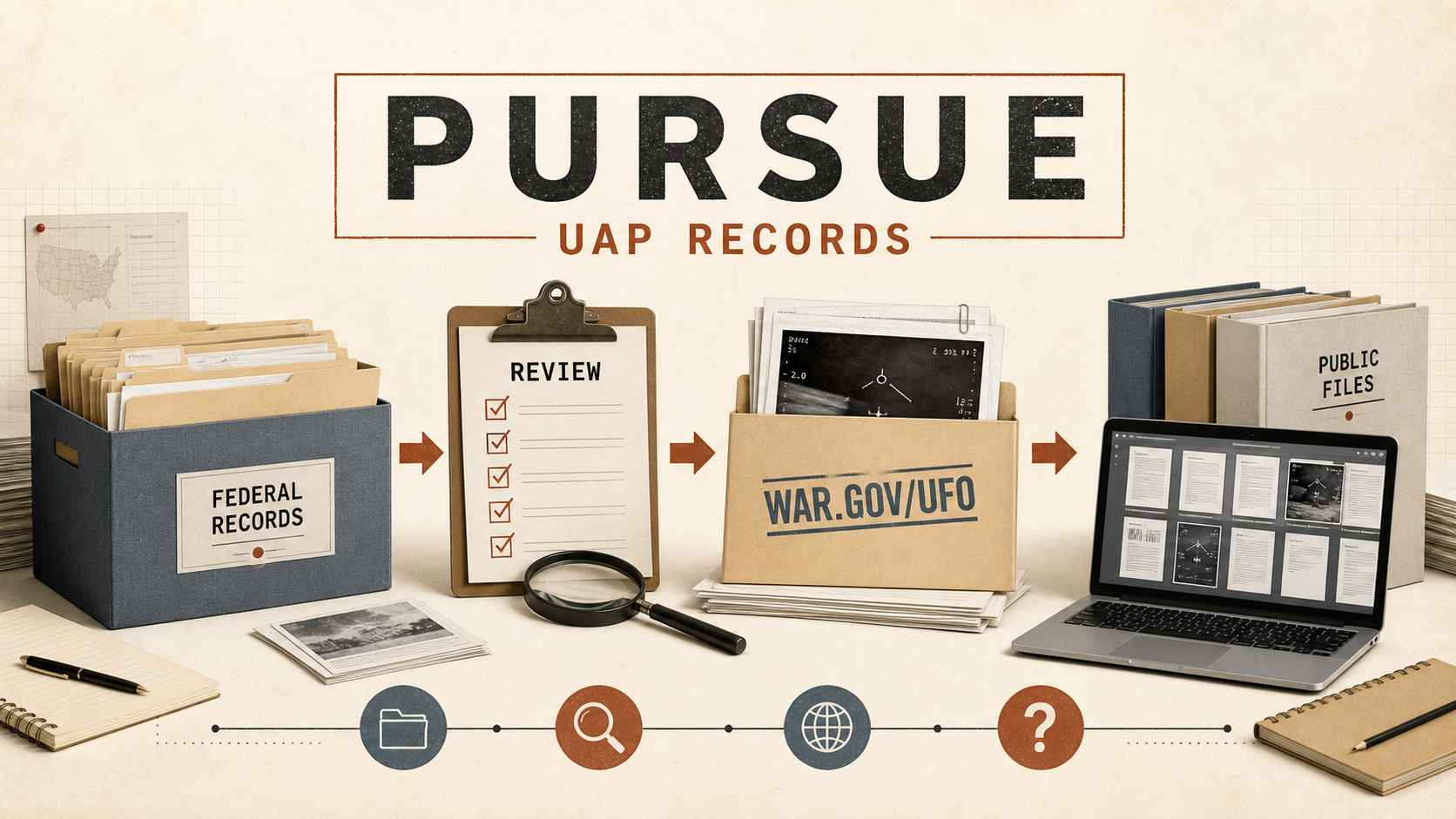
PURSUE is the new public doorway into the U.S. government's UAP file releases.
It stands for Presidential Unsealing and Reporting System for UAP Encounters. The public home is war.gov/ufo, where the Department of War is posting declassified and historical records related to unresolved UAP cases.
That makes PURSUE useful, but also uneven. Some records arrive with more context than others.
It is best read as a release pipeline: a way to see what records are being put on the table, not a final judgment on what each case was.
What PURSUE is
The Department of War describes PURSUE as a government-wide effort, overseen by DOW with support from the Office of the Director of National Intelligence, to find, review, identify, declassify, and publicly release unresolved UAP-related records and historical documents in federal possession.
The public portal says the first tranche was released on May 8, 2026. Release 02 followed on May 22, 2026. The Department says more material will be posted on a rolling basis as records are discovered and declassified.
The records are mixed by design: PDFs, videos, images, audio, historical documents, intelligence fragments, military reports, NASA material, FBI files, and agency records that do not all have the same evidentiary weight.
That mix is the point. PURSUE is less like a finished report and more like a public shelf where different kinds of records are being placed as they clear review.
What unresolved means
The key word on the portal is unresolved.
On the PURSUE page, the Department says the materials archived there are unresolved cases, meaning the government is unable to make a definitive determination on the nature of the observed phenomena. It also says that can happen for different reasons, including lack of sufficient data.
In practice, unresolved can mean several things. The object may be genuinely hard to explain. The public file may be missing metadata. The clip may be cropped. The sensor context may be thin. The original event record may not be public.
That leaves room for interesting cases. It also leaves room for ordinary explanations that cannot be tested from the released material alone.
What PURSUE does not do
A PURSUE listing tells us that a record has entered the public release set. The next question is what context came with it.
Some labels preserve dramatic public or uploader language. Some descriptions are careful. Some files are fragments. A title, by itself, is not the whole case record.
Some PURSUE videos are interesting because they preserve a trace of a classified-network upload or a congressional request. Some are interesting because they connect to known public events, such as the Lake Huron shootdown. Some are weak as visual evidence but useful as examples of how UAP labels move through official systems.
Once the file is public, the work shifts to provenance, metadata, comparison, and chain of custody.
Why the portal still matters
Before PURSUE, UAP records were scattered across agency reading rooms, FOIA releases, old PDF bundles, hearing exhibits, AARO pages, NASA material, FBI files, and private mirrors.
PURSUE gives the public a single official surface to inspect. That has value even when a file is visually unimpressive.
It lets researchers compare titles, agencies, release dates, incident dates, media types, descriptions, and missing context. It also makes edits and gaps more visible. When a record changes, disappears, gets renamed, or receives a better description, that change becomes part of the story.
For UAP Logbook, that is the durable part: the ability to track what the government actually put on the table.
How to read a PURSUE record
The first check is the record type. A PDF narrative, a mission report, an image, a NASA audio excerpt, and a short infrared video do different jobs.
The second check is provenance. Who created the record? Which agency released it? Is the original file available, or only a derivative? Does the public record include date, platform, sensor, location, chain of custody, or a reason the case stayed unresolved?
The third check is the label. PURSUE titles can preserve dramatic public or uploader language. A title such as “instant acceleration” or “UAP” should be read alongside the description, the file, and any available metadata.
The fourth check is what would settle it. Some cases need original video. Some need sensor metadata. Some need a full incident report. Some need a mundane comparison: balloon, drone, aircraft, satellite, reflection, tracking loss, or image artifact.
Where this leaves it
PURSUE is a real public records development.
It is not disclosure in the cinematic sense. It is also not nothing. It is a system for releasing unresolved UAP-related records in tranches, with enough structure that outside readers can begin sorting the material.
The next thing to watch is not just Release 03. It is whether future tranches bring better provenance: original files, clearer metadata, stronger chain-of-custody notes, and explanations for why each case remained unresolved.