News / May 22, 2026
PURSUE Release 02: ODNI orb file, Sandia green fireballs, and missing videos
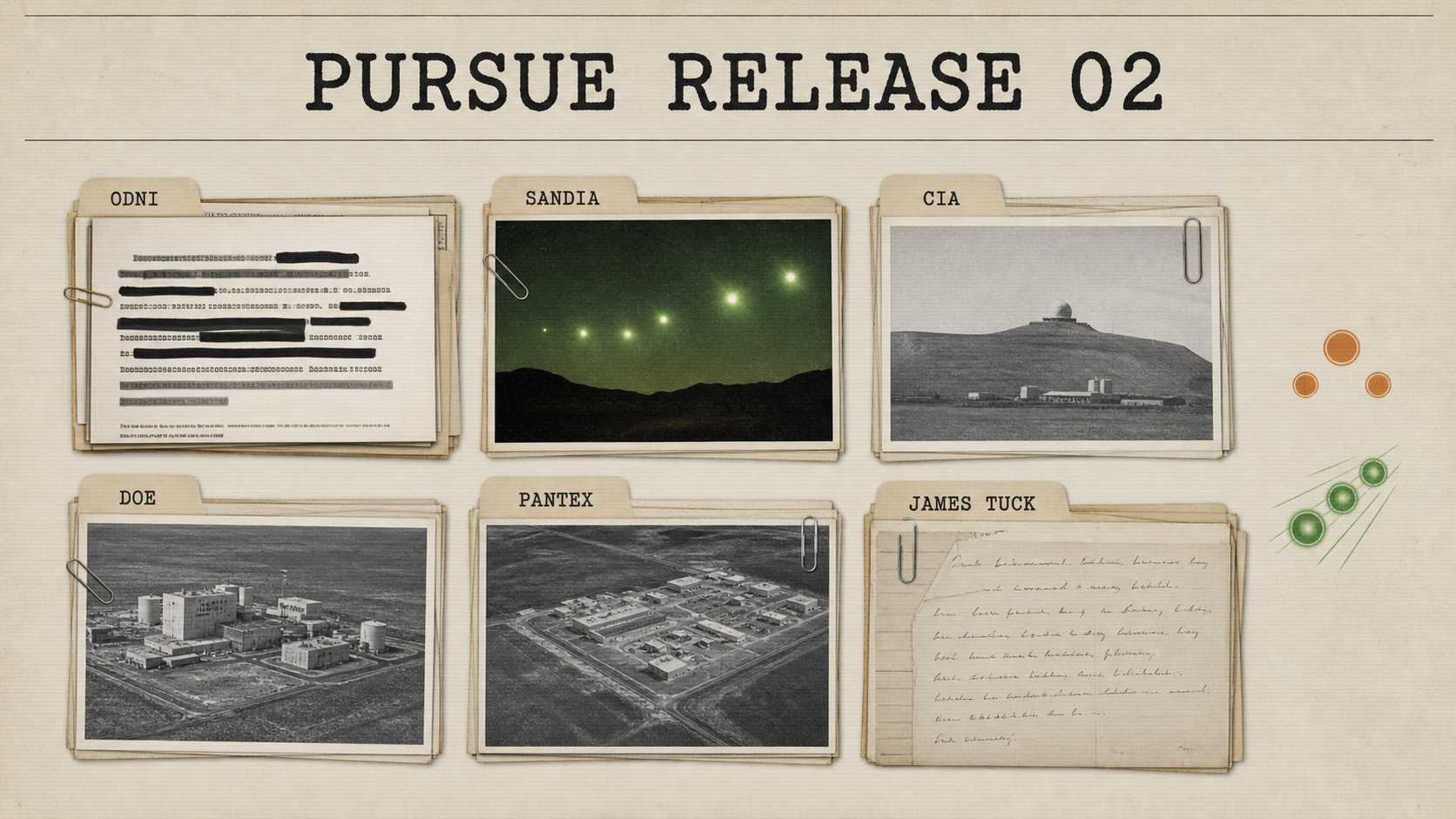
PURSUE Release 02 is bigger than six PDFs. The document bundle has a late-2025 ODNI orb narrative, Sandia green-fireball files, CIA Sary Shagan material, DOE/Pantex fragments, and a separate 5.6 GB video/audio download still waiting for a full pass.
The new bundle
The U.S. government's PURSUE portal has a second UFO/UAP file release dated May 22, 2026.
The public document bundle I reviewed contains six PDFs. That is only part of the release. The war.gov page also lists a separate Release 02 Videos download at 5.6 GB, and ABC/CBS reporting describes a larger batch with dozens of videos and several audio files.
This is a first pass on the six-PDF document bundle, not a complete review of every Release 02 file.
The strongest new item inside the document bundle is ODNI-UAP-D001, a two-page narrative by a senior U.S. intelligence officer describing a late-2025 helicopter search on a test range, radar tasking, FLIR/NVG observations, orange orbs, and apparent activity near fighter jets.
What was in the document bundle
| File | What it contains | Why it matters |
|---|---|---|
| ODNI-UAP-D001 | A late-2025 narrative from a senior U.S. intelligence officer describing orange orb encounters during a helicopter search on a test range. | This is the freshest and most operationally specific item in the batch. |
| DOW-UAP-D017 | A 116-page Sandia correspondence file with 1949-1950 material on green fireballs, Project Grudge, Los Alamos discussion, and sensitive installations. | This is the historical backbone of the release. |
| CIA-UAP-D001 | A 1973 intelligence information report on the Soviet Sary Shagan weapons testing range, including a witness account of a green circular aerial phenomenon. The visible CIA report number is FIRK-311/01638-77. | It connects an old UAP-like observation to a strategic weapons-test setting. |
| DOE-UAP-D001 | Two pages labeled as Pantex unidentified object incident imagery, including a ground surveillance radar tower image and Sandia-enhanced images. | Interesting, but incomplete without the full incident report context. |
| DOE-UAP-D002 | James Tuck correspondence touching on simulated atomic-bomb demonstrations, atmospheric vortices, the Condon study, and UFO commentary. | Mostly context material, not a clean incident record. |
| DOE-UAP-D003 | A Pajarito Astronomers meeting notice for a talk titled "Why Should a Scientist be Concerned about UFO's?" | A small cultural/scientific-history fragment, not evidence by itself. |
The missing video/audio pass
The official PURSUE page lists Download Release 02 Videos [5.6gb]. That means the six PDFs are only the document side of the release.
ABC reported that Friday's release included more than 50 previously classified videos and other documents. CBS/AOL described the release as 64 files: six PDF files, seven audio files, and 51 video files.
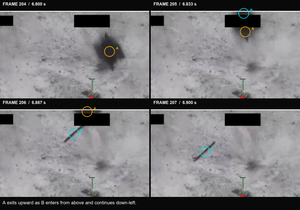
The items now needing a separate UAP Logbook pass include at least one video labeled Syrian UAP instant acceleration, described by ABC as infrared-sensor footage from a U.S. military platform in 2021 and uploaded to a classified network in 2024. That title also matches one of the videos requested by House UAP investigators in March 2026.
A local first-pass review of the downloaded video bundle found 57 MP4 containers. Several are audio records packaged as waveform videos. The strongest immediate article candidate is the apparent Syrian instant-acceleration item, because the released file appears to be an edited examination video with title cards, enhancement notes, slow-motion sections, and inverted/zoomed processing.
Until that video/audio bundle is reviewed directly, the document-bundle conclusions below should not be treated as a full Release 02 inventory.
The ODNI narrative
The ODNI file describes a late-2025 mission involving a senior U.S. intelligence officer, a colleague, and two pilots departing a Joint Operations Center in a helicopter. The mission was to investigate loud thuds in mountains on a test range after several nights of UAP reports.
The team searched remote mountain areas for debris or objects that might explain reported orb-like sightings. The narrative says they repeatedly inspected debris on the ground and judged it to be remnants from rockets or other projectiles from weapons testing.
The account then moves into the UAP portion: the Joint Operations Center reported radar hits, ground teams reported a hot low object on FLIR, and the helicopter crew used NVG, FLIR, and unaided sight.
The reported observations include:
- a ground-team FLIR report of an object moving low and fast, then splitting into two;
- a large cave entrance observed during the search;
- radar detections used to redirect the helicopter;
- numerous orange orbs seen against a mountain backdrop;
- two large orange-white orbs close to the helicopter, followed by additional orbs forming a brief T-shaped arrangement;
- similar orange orbs seen above fighter jets transiting the airspace.
The report is striking because it is recent, attributed to a senior intelligence officer, and includes multiple observation modes in the narrative: radar tasking, ground FLIR reports, NVG observations, and naked-eye observation.
It is also incomplete as a public evidence package. The narrative says no photos were taken by the officer. The release does not include the radar tracks, FLIR video, cockpit video, coordinates, timestamps, range safety logs, or the full debrief material that would let outsiders test the account independently.
The Sandia file
The largest document in the release is DOW-UAP-D017, a Sandia general correspondence file. It is not one tidy UAP case. It is a thick historical packet around base security, unusual lights, green fireballs, reports near sensitive installations, and early military attempts to understand what was being seen over New Mexico and nearby areas.
The file includes a 1949 Los Alamos conference report on the green fireball problem. Names appearing in the extracted text include Edward Teller, Lincoln LaPaz, Richard Mandelkorn, and Los Alamos personnel. The discussion treats the phenomenon as serious enough to deserve organized observation and technical analysis.
The notable thread is not "aliens." It is concern. The correspondence repeatedly frames the issue around unexplained luminous phenomena near sensitive military and government installations.
The file also preserves the technical uncertainty of the period. Some analysis argues that the green fireballs did not fit ordinary meteor behavior neatly: unusual color, low apparent paths, lack of sound in some cases, timing patterns, and location concentration. At the same time, the material remains historical correspondence and interpretation, not a modern resolved case file.
The CIA Sary Shagan report
The CIA file is a 1973 intelligence information report on the Soviet Sary Shagan weapons testing range. Most of the report concerns range facilities, missile-related information, warhead checkout, and rumors of laser research.
The PURSUE file label is CIA-UAP-D001. The scan itself also carries the visible CIA report number FIRK-311/01638-77.
The UAP-relevant portion appears near the end. A former Soviet source reports seeing a bright green circular object or mass in the sky near Site 7 in late summer 1973. The account says the green circle widened and that additional green concentric circles formed before the color disappeared. The source had no explanation and no resulting rumors were reported.
This is a small item, but it fits the release pattern: UAP-like observations in proximity to weapons ranges and military technical activity.
The Pantex problem
DOE-UAP-D001 may become the file people click first, because it is labeled as a Pantex unidentified object incident image. The released PDF, however, contains only two pages: one identified as an image from a ground surveillance radar tower and another as Sandia National Labs enhanced images of the object.
I did not find a separate Pantex incident number in the released fragment. The visible public identifiers are the PURSUE file label DOE-UAP-D001 and the page sequence: page 5 of 6 and page 6 of 6.
That is not enough to evaluate the event. The public release does not include the full incident report pages around those image pages, the time sequence, camera details, object path, distance, weather, sensor settings, or final assessment.
So the Pantex item is interesting, but it should be treated as a flag for follow-up, not as a finished public case.
What this release does not settle
- It does not provide the underlying ODNI radar or FLIR data.
- It does not provide photographs or video for the late-2025 orb narrative.
- It does not provide enough Pantex context to evaluate the released images.
- It does not resolve the Sandia green fireball history.
- It does not create one clean chain from historical green fireballs to modern orange orbs.
- This first pass does not yet evaluate the separate 5.6 GB Release 02 video/audio bundle.
What it does provide is a useful new cluster: modern operational narrative, old weapons-range archives, and several fragments showing how UAP-adjacent material sits inside intelligence, energy, and defense records.
What makes Release 02 useful
Release 02 is not just another recycled internet clip. It is a government file release with document IDs, agencies, dates, and extractable text. That makes it usable.
The ODNI narrative will draw attention inside the document bundle. The Sandia file may be the more durable research object. The Pantex item is the obvious missing-context problem.
The bigger unfinished job is the video/audio bundle. The next useful step is a second pass: identify every Release 02 video and audio record, match them against the March 2026 congressional request where possible, and separate official descriptions from online interpretation.
For the document bundle, the follow-up list remains straightforward: the full Pantex incident report, ODNI sensor records, range logs, coordinates, timestamps, and any assessment that explains whether these observations were resolved, unresolved, or still under review.
Sources
- PURSUE UAP portal, accessed May 22, 2026.
- Department of War: second PURSUE UAP file release announcement, published May 22, 2026.
- PURSUE Release 02 document bundle, downloaded May 22, 2026: CIA-UAP-D001, DOE-UAP-D001, DOE-UAP-D002, DOE-UAP-D003, DOW-UAP-D017, ODNI-UAP-D001.
- ABC/ABC7: Pentagon releases more declassified UFO files, including intelligence officer's account of seeing "orbs", published May 22, 2026.
- CBS/AOL: Pentagon releases second batch of UFO files, with more videos, published May 22, 2026.