
News / Jun 20, 2026
Antimatter is the perfect UFO fuel until you try to store it
Antimatter sounds like the perfect engine for a UFO story. CERN and NASA make the real version more interesting: production is tiny, storage is brutal, and the radiation problem does not go away.
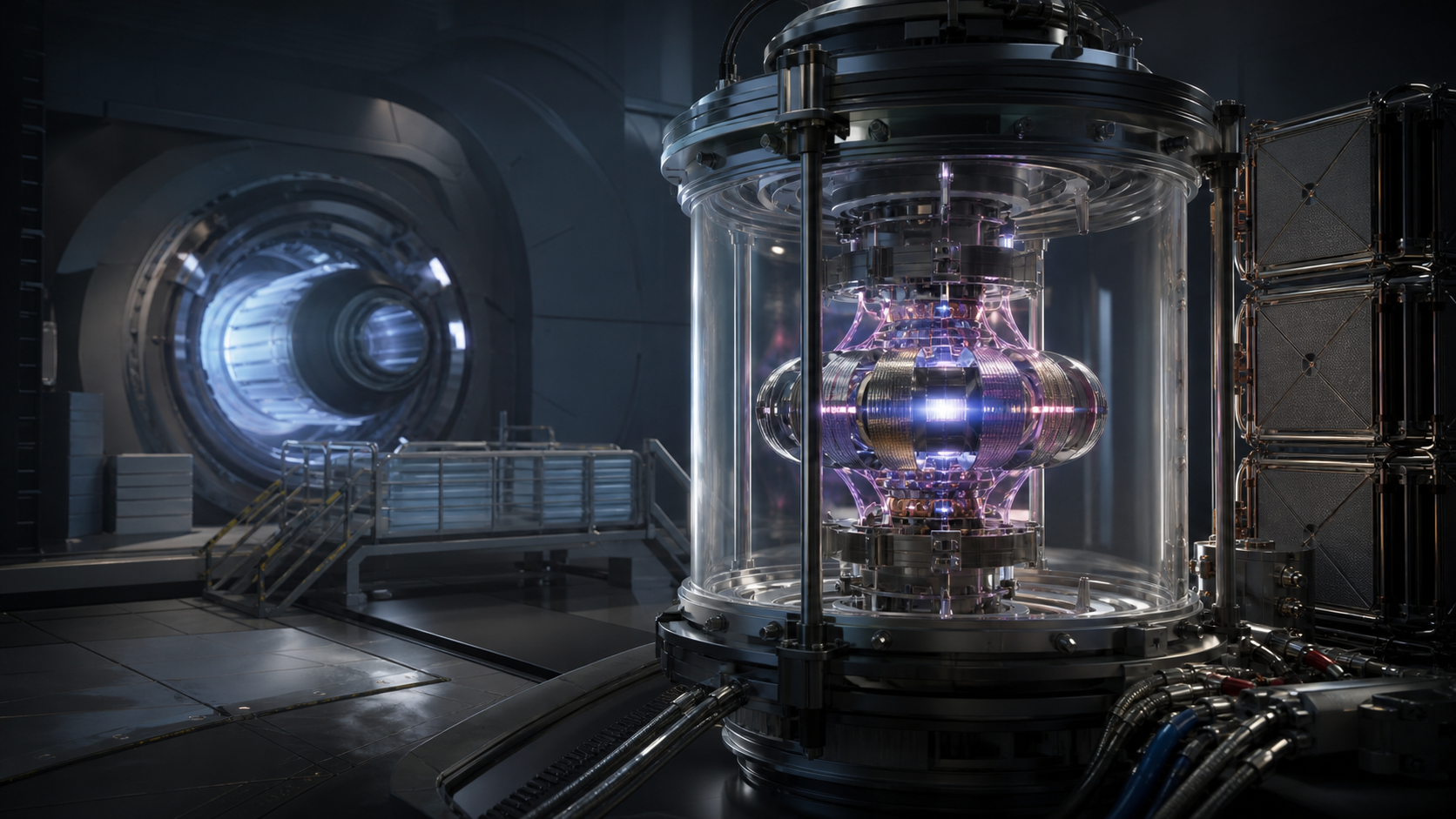
Antimatter is the fuel UFO stories were always going to find. It sounds clean. It sounds dangerous. It sounds like the kind of power source a secret program would whisper about while everyone else is still arguing over jet fuel and batteries.
The real physics is stranger and a lot less convenient.
It is not folklore
Antimatter exists. CERN makes it. NASA has published and archived serious advanced-propulsion studies that treat matter-antimatter annihilation as a possible way to push spacecraft farther and faster than chemical rockets can manage.
That is why the word lands so hard in UFO culture: it has a lab address.
When a particle meets its matching antiparticle, both annihilate and convert their mass into energy carried by particles and radiation. That single fact is why antimatter will always have a propulsion afterlife. Tiny tanks, impossible range, a craft that goes where ordinary rockets cannot: the concept is almost too elegant.
The number is the hook. One gram of antimatter, annihilating with one gram of ordinary matter, would convert about two grams of mass into energy. By Einstein's equation, that is roughly 1.8 × 10¹⁴ joules.
In less laboratory language, that is on the order of 43 kilotons of TNT, or about 50 gigawatt-hours of energy. It is roughly the yearly electricity use of several thousand U.S. homes, packed into the mass of a paperclip's worth of material and its matching gram of ordinary matter. In gasoline terms, the raw energy is in the neighborhood of more than a million gallons.
That is not a spacecraft design. It is the raw energy ledger. A real engine would still have to capture, direct, shield, cool, and survive the products of that annihilation.
Then the engineering wakes up.
The factory problem
How much antimatter can anyone actually make?
CERN's Antimatter Factory delivers hundreds of millions of antiprotons per hour to experiments. That sounds like a lot. It is not. CERN says that even if one ran the facility continuously for a year and trapped everything in an ideal scenario, the resulting antihydrogen would still represent only a vanishingly tiny mass.
The energy is tiny too. CERN puts a year of total antiproton production in everyday terms: roughly enough energy to light a 100-watt bulb for a few seconds.
NASA's advanced-propulsion literature is equally sobering. A NASA Technical Reports Server presentation describes current collider-facility antiproton production as low and expensive, on the order of nanograms per year with extremely high cost. Even optimistic dedicated-factory scenarios still leave a brutal gap between what is possible and what a propulsion system would need.
In a UFO story, a reactor appears in one sentence. In engineering, the fuel supply asks for a factory.
The bottle problem
Antimatter cannot sit in a regular tank. If it touches ordinary matter, it annihilates.
CERN describes storage as an isolation problem. Charged antiparticles can be held in electromagnetic traps under extreme vacuum, but particles with the same charge repel one another, so scaling up means larger traps and more field energy.
Neutral anti-atoms such as antihydrogen are trickier still. They can be trapped magnetically because antihydrogen is slightly magnetic, but only in vanishingly small amounts by propulsion standards.
NASA's propulsion concepts get speculative fast when they reach high-density storage: solid antihydrogen, frozen microcrystals, magnetic bottles, electrostatic levitation. The same presentation flags solid antihydrogen as a critical area that still needs a lot of work.
That is the part UFO shorthand skips. "Antimatter engine" sounds compact. The storage system may be the thing that eats the spacecraft.
The radiation problem
Annihilation does not produce clean forward thrust.
Depending on the reaction, the products include gamma radiation, pions, muons, electrons, positrons, neutrinos, and energetic fragments. Some can be directed. Some are harder to capture. All of them bring shielding, heat, and vehicle-mass problems along for the ride.
NASA's vehicle-design checklist for antimatter concepts reads like a small infrastructure project: storage during launch and acceleration, magnet requirements, radiation shielding, thermal radiators, structural support, payload placement away from the radiation source, additional propellant, number of launches, and in-space assembly.
That is not a magic engine. That is an entire architecture.
Why UFO stories love it anyway
Antimatter does something useful in a UFO story before it explains anything.
It gives a witness account a power source. It gives a saucer story an engine room. It makes fast, silent movement sound less like a description and more like a technology leak.
That is why antimatter belongs near element 115, zero-point energy, gravity control, and vacuum energy. The words are not fake. That is exactly the point. The problem is the jump from word to hardware.
Bob Lazar's S-4 story used element 115 in that role. The reactor claim gave the alleged craft a mechanism: a fuel, a field, an assignment to reproduce the propulsion effect. Those details made the story feel engineered. Element 115 later received a real periodic-table name as moscovium. That did not verify Lazar's reactor.
Antimatter can do the same trick with a cleaner pedigree. It is real. It is famous. It is extreme. A headline can put it beside a UFO and make the claim feel as if it has passed through a lab.
The lab sources say something narrower.
Antimatter is physically powerful. It is also hard to produce, hard to store, hard to meter, hard to shield, and hard to turn into useful thrust. The real version does not erase the engineering problem. It multiplies it.
The word is real. The jump from word to hardware is the whole problem.
What would actually make a claim stronger
An antimatter propulsion claim needs more than a dramatic noun. The useful questions are specific: What is the storage method? Which particle species? What is the containment field? How much antimatter? What is the annihilation rate, the thermal management, and the radiation signature?
For a recovered-materials claim, the useful evidence would be residues, activation products, lab analysis, chain of custody, and a reason to connect the sample to an annihilation system rather than to ordinary contamination or handling.
For a flight-performance claim, the first questions would be trajectory, sensor geometry, platform data, acceleration, atmosphere, conventional propulsion, and whether the observation actually requires an exotic engine.
The word should arrive last. If a case genuinely needs antimatter to explain it, the measurements will force the conclusion. If antimatter shows up first, it is doing narrative work.
The useful answer
Could antimatter power a spacecraft in principle? Yes. That is exactly why NASA studies exist.
Does that make it an explanation for UAP performance claims? No.
The gap between those two answers is the whole article. Antimatter is one of the most powerful fuel ideas physics gives us. It is also one of the least forgiving. The moment a UFO story uses it casually, the story has inherited a factory, a trap, a radiation shield, a heat problem, a magnetic nozzle, and an accounting ledger it cannot pay.
That does not make antimatter boring.
It makes it better than the myth.
Related UAP Logbook reading
- The UFO claims hiding inside physics words
- Bob Lazar's S-4 story
- Charles Buhler on force, not energy
- The Navy UFO patents did not disappear
- Garry Nolan says UFO metals need lab work. Oak Ridge tested one famous sample