News / Jun 11, 2026
Garry Nolan says UFO metals need lab work. Oak Ridge tested one famous sample
One famous specimen reached a national laboratory. The result was not what believers wanted.
Garry Nolan has become one of the names people reach for when the UFO debate turns from lights in the sky to metal on a lab bench. The Stanford pathologist has spent years arguing that unusual materials tied to aerial events deserve serious scientific attention: better instruments, documented chain of custody and isotope analysis.
That argument is reasonable. What happened to one of the most famous public alleged UFO samples is a separate story.
One specimen did reach Oak Ridge National Laboratory through the U.S. government's All-domain Anomaly Resolution Office. The lab tested it. The origin claim did not survive.
What Nolan is actually arguing
Nolan's position is narrower than "alien metal has been found."
In a 2022 paper in Progress in Aerospace Sciences, Nolan and longtime UAP researcher Jacques Vallee argued for improved methods to analyze unusual materials with possible relevance to aerospace forensics: isotope ratios, comparison baselines and instrument standards.
A March 2026 Sol Forum interview showed Nolan presenting new test results on alleged UAP materials, still pushing the same methodological case.
The paper does not claim non-human technology. It argues for methods that could separate genuinely anomalous materials from contamination, industrial history and misidentification.
What Oak Ridge tested
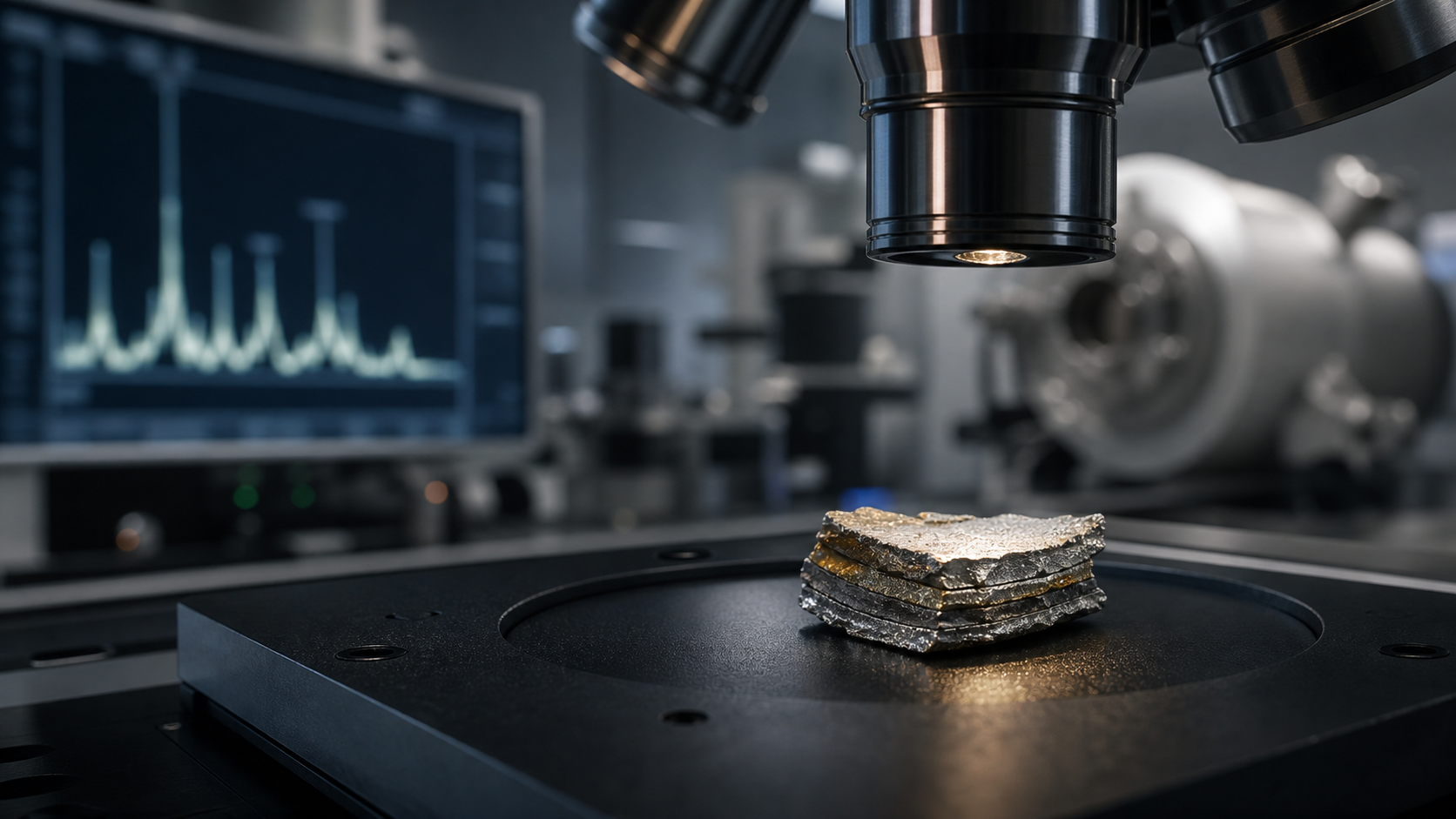
The specimen AARO sent to Oak Ridge is the layered magnesium-zinc-bismuth material tied to the "Art's Parts" story: alleged UFO debris that circulated through UFO media and private hands for years before landing at To The Stars Academy.
TTSA placed the material into a formal setting in 2019, announcing a Cooperative Research and Development Agreement with the U.S. Army. Its SEC filings described acquired materials for its ADAM Research Project as coming from unidentified aerial phenomena.
Those filings did not prove anything about origin. They showed the claim had moved from UFO media into corporate paperwork and a government-linked research path.
The result
Oak Ridge described a layered specimen containing magnesium, zinc, bismuth, lead and trace elements. One prominent claim was that it could function as a terahertz waveguide, a structure capable of guiding electromagnetic waves at terahertz frequencies.
Oak Ridge did not find that.
AARO's supplement assessed the specimen as terrestrial in origin, consistent with mid-20th-century magnesium alloy research, and unsuitable to function as a terahertz waveguide. The available chain of custody did not support a non-terrestrial origin.
The sample was real. The lab was real. The famous claim did not hold.
What that does and does not settle
The Oak Ridge finding covers one specimen tied to one public material story. It does not resolve every case Nolan and Vallee have discussed. The Council Bluffs and Ubatuba samples involve separate histories, separate chains of custody and separate lab questions.
That distinction matters in practice. Public conversation tends to collapse all UFO metal claims into one debate. The science does not work that way. Each sample needs its own recovery documentation, its own baseline comparison and its own result.
What the public has not seen is a sample with a clean, documented recovery chain that establishes a non-human origin.
What it has seen: named researchers calling for serious materials science, a company placing alleged UAP debris into government-facing paperwork, and one famous specimen reaching a national lab.
Oak Ridge's answer was not what the UFO community hoped for. But it is exactly the kind of answer that makes the field harder to dismiss and harder to oversell.
If alleged UFO metals are going to matter, they have to survive the lab. So far, the most public one did not.
Related UAP Logbook notes
- Garry Nolan on CBS: Spielberg's Disclosure Day and the metals nobody can explain
- Robert Bigelow's UFO machine had a contract number
- Salvatore Pais put UFO-adjacent physics into Navy patents
- Elizondo, UFO files, and the 1940s non-human materials line
- David Grusch and the Immaculate Constellation gap
- Bob Lazar's S-4 story
Sources
- The Sol Foundation: "New UAP Materials Tests: What the Results Reveal | Dr. Garry Nolan", Sol Forum, 2026.
- The Sol Foundation white papers page, including its material-science briefing lane.
- To The Stars Academy press release: CRADA with the U.S. Army Combat Capabilities Development Command, October 17, 2019.
- To The Stars Academy SEC filing, including ADAM Research Project material-purchase language.
- AARO / Oak Ridge National Laboratory: Analysis of a Metallic Specimen synopsis.
- AARO supplement to ORNL's analysis of a metallic specimen.
- Nolan, Vallee et al.: Improved instrumental techniques, including isotopic analysis, applicable to characterization of unusual materials with potential relevance to aerospace forensics, Progress in Aerospace Sciences, 2022.