
Main Article / Jun 21, 2026
Area 51 is a test range, not a single mystery
Area 51 is not just a UFO myth. The strongest public record points to a long-running test range for secret aircraft and defense systems. That does not close every exotic door. It explains why the door keeps attracting people.
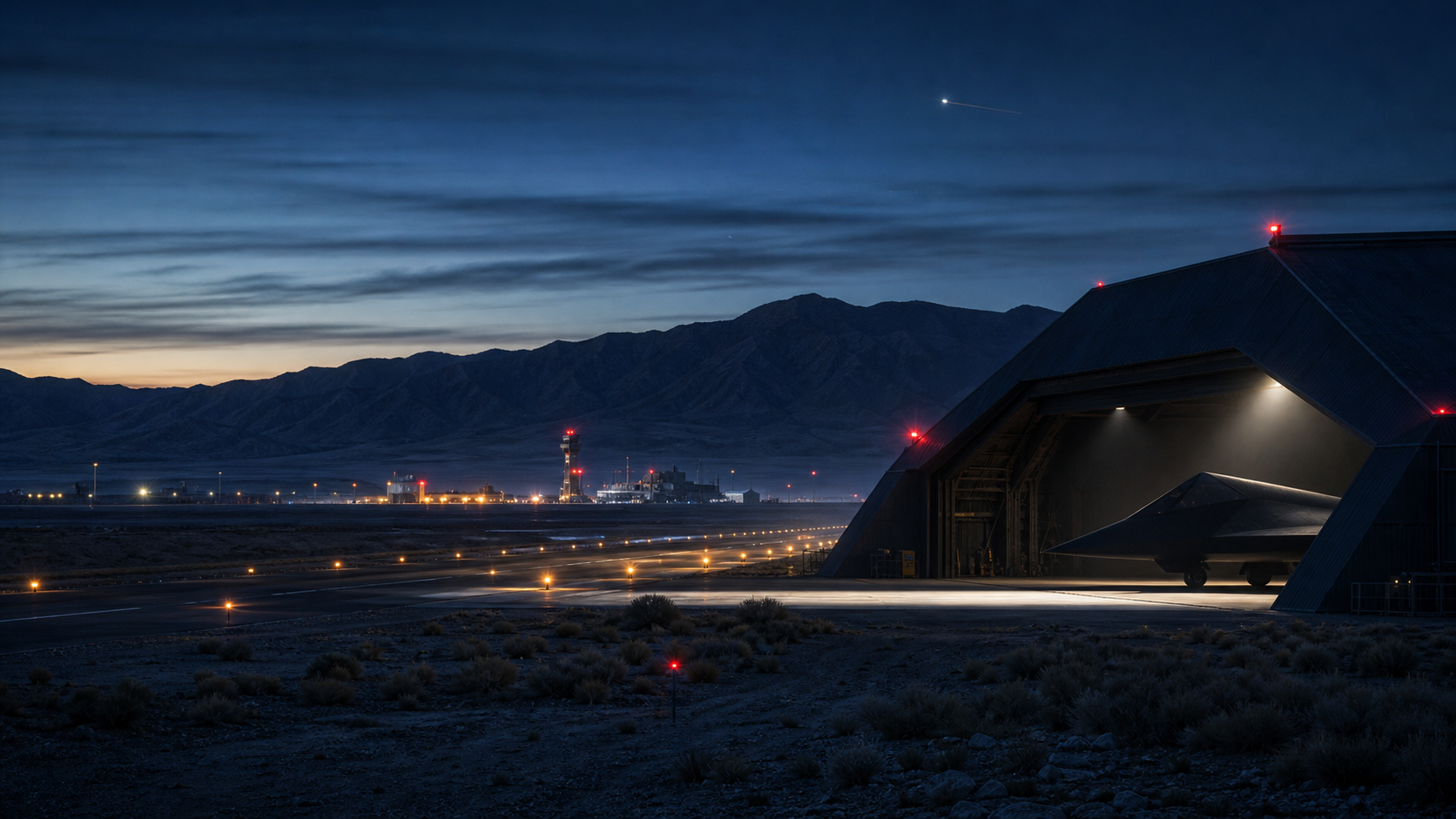
Area 51 works best as a reporting subject when it is treated as infrastructure, not as a riddle.
The strongest public record points to a long-running system for testing secret aircraft and related defense capabilities at Groom Lake. The UFO story survives because classified aerospace work often looks impossible from the outside, especially before the public has a name for what it is seeing.
That does not close every exotic door. It changes the question. Area 51 is less useful as an "aliens or no aliens" box than as a working test range that creates secrecy, partial sightings, rumor, and eventually history.
The core function
The cleanest baseline is public and old.
The CIA says Groom Lake was selected in the 1950s as a remote site where the U-2 could be tested safely and secretly. Project officials spotted the dry lakebed near the Atomic Energy Commission's Nevada Proving Ground, and the site was pulled into the government's Nevada holdings with President Eisenhower's approval.
The same CIA account says the A-12 OXCART, the aircraft that led toward the SR-71 world, first flew from Groom Lake in 1962. Those details matter because they give Area 51 a practical function: move aircraft and systems from design to test to operational understanding before the public has language for what it is seeing.
That is already strange enough. Area 51's documented history includes aircraft that sounded impossible before they became aviation history.
Why the location matters
The geography does part of the security work.
Groom Lake sits inside the Nevada Test and Training Range, behind desert distance, controlled access, warning signs, restricted roads, mountain ridges, dry lakebeds, and controlled airspace. A test article can move from hangar to runway to range without entering ordinary public space.
Nellis Air Force Base describes the wider Nevada Test and Training Range as the largest contiguous air and ground space available for peacetime military operations in the free world. Its public fact sheet says the range includes 2.9 million acres of land, 5,000 square miles of restricted airspace, and another 7,000 square miles of military operating area shared with civilian aircraft.
That setting matters more than most mythology. When a secret program is paired with a remote landscape and a giant operating range, the result is not just concealment. It is a structure that reduces accidental visibility while increasing the chance that the few things seen from outside will be misunderstood.
Why UFO stories attach to it
The most durable explanation for Area 51's public mystique is not extraterrestrial. It is black aviation.
Aircraft developed in secret tend to appear at unusual hours, at unfamiliar altitudes, and in shapes or flight profiles that outrun public expectation. From outside the fence, a real object can be observed and still be misidentified.
That pattern has historical support. The CIA has said early high-altitude U-2 flights helped generate UFO reports because the aircraft operated where normal aircraft were not expected. That does not explain every UFO story. It does explain why secret aircraft and UFO culture share a border.
The public has already watched that cycle happen: rumor, odd sightings, secrecy, aviation analysis, declassification, then a real aircraft with a real program name. The question is not whether Area 51 produces mystery. It is what kind of mystery it produces.
What can be said carefully
The public record does not establish that Area 51 houses recovered non-human craft. It also does not support treating every claim as equally plausible.
AARO's 2024 historical report says it found no empirical evidence that the U.S. government or private companies have been reverse-engineering extraterrestrial technology. That is the current official baseline.
Still, "not proven alien technology" is not the same as "nothing exotic happens there."
In this context, exotic can mean advanced propulsion work, low-observable design, sensors, autonomous systems, electronic warfare, materials, countermeasures, or platforms that remain unnamed in public. That narrower point is worth keeping because it fits the site's actual history.
If something stranger than ordinary aircraft testing exists, Area 51 is the kind of place where the infrastructure would make sense. It has the range, the hangars, the contractors, the security culture, the airspace, and the habit of keeping tomorrow's hardware off today's public map.
What it does not have, in public, is the record that proves the strongest UFO version.
Why Lazar still matters
Bob Lazar did not create Area 51's secrecy, but he helped turn it into a mainstream UFO address.
His 1989 claims, reported by George Knapp, gave the public a specific story shape: not just hidden aircraft, but alleged work on recovered craft near a place adjacent to the known base world. He named S-4. He gave the rumor a map point.
Those claims remain unproven. Their importance is cultural and editorial. Lazar attached a speculative alien-retrieval narrative to a real landscape of secrecy, which made the story easy to retain and hard to retire.
That is why Area 51 still works as a UFO keyword. It is not just a base. It is the place where the known secret and the alleged secret sit close enough together that the public keeps asking which one it saw.
The visibility problem changed
Area 51 is also a story about what can still be seen legally from outside.
For years, civilian observers used distant public viewpoints, radio monitoring, long-lens photography, satellite imagery, and patient field observation to piece together fragments of activity. That observation culture matters because Area 51 is not only hidden. It is watched.
That equation changed again in 2026. The Bureau of Land Management approved a temporary closure of about 22,987 acres south of State Highway 375 and west of Alamo, Nevada. The closure took effect on March 25, 2026, and BLM said it would last at least one year or until conditions are reassessed. Dreamland Resort says the closure blocks Tikaboo Peak, the famous long-distance public viewpoint toward Groom Lake.
Less public sight does not prove a new secret program. It does make weak claims harder to test and strong observations more valuable.
The practical result is simple: as legal visibility shrinks, the mythology grows.
What the place is for
The shortest defensible answer is this: Area 51 is where the United States can test things before the public knows how to describe them.
That has already included aircraft once dismissed as implausible and later folded into documented aviation history. It may include current aircraft and systems that will restart the same cycle: first rumor, then grainy shape, then aviation analysis, then silence, then a name years later.
That framework explains much of the legend without claiming to solve every UFO report. It is more useful than the usual binary because it matches the known purpose of the site while leaving room for highly advanced work that is still classified.
Both things can be true at once: the best public evidence points to classified aerospace and defense testing, and classified aerospace work can still be deeply exotic before it becomes history.
Better questions
The productive questions are not "aliens or not?" They are more concrete.
What changes in satellite imagery over time? Which public viewpoints remain legal and useful? Which aircraft shapes or signatures are captured by credible observers? Which contracts, environmental filings, or declassified records appear years later? Which dramatic claims fail to produce anything that can actually be checked?
That is the stronger frame for the subject. Area 51 is less useful as a yes-or-no mystery box than as a system that generates secrecy, partial sightings, rumor, and eventually history.
Related UAP Logbook reading
- The public map around Area 51 just got smaller
- The Area 51 stealth jet sighting in the thermal frame
- What is Reveille Peak? The Area 51 viewpoint after Tikaboo
- Area 51's UFO origin story has a new dispute
- Bob Lazar's United Nuclear kept the Area 51 story attached to hardware
Sources
- CIA: Area 51 and the Accidental Test Flight.
- National Security Archive: The Secret History of the U-2 — and Area 51, August 15, 2013.
- National Archives: The Central Intelligence Agency and Overhead Reconnaissance: The U-2 and OXCART Programs, 1954-1974.
- Nellis Air Force Base: Nevada Test and Training Range fact sheet.
- Bureau of Land Management: Temporary public safety closure, March 2026.
- Dreamland Resort: Tikaboo Peak map and closure note.
- AARO: Historical Record Report, Volume 1, March 2024.