
Short Note / Jun 30, 2026
The CARET drones looked like a leak from the future
The CARET drones did not look like a classic flying saucer case. They looked like a leak from a design department nobody was supposed to know existed.
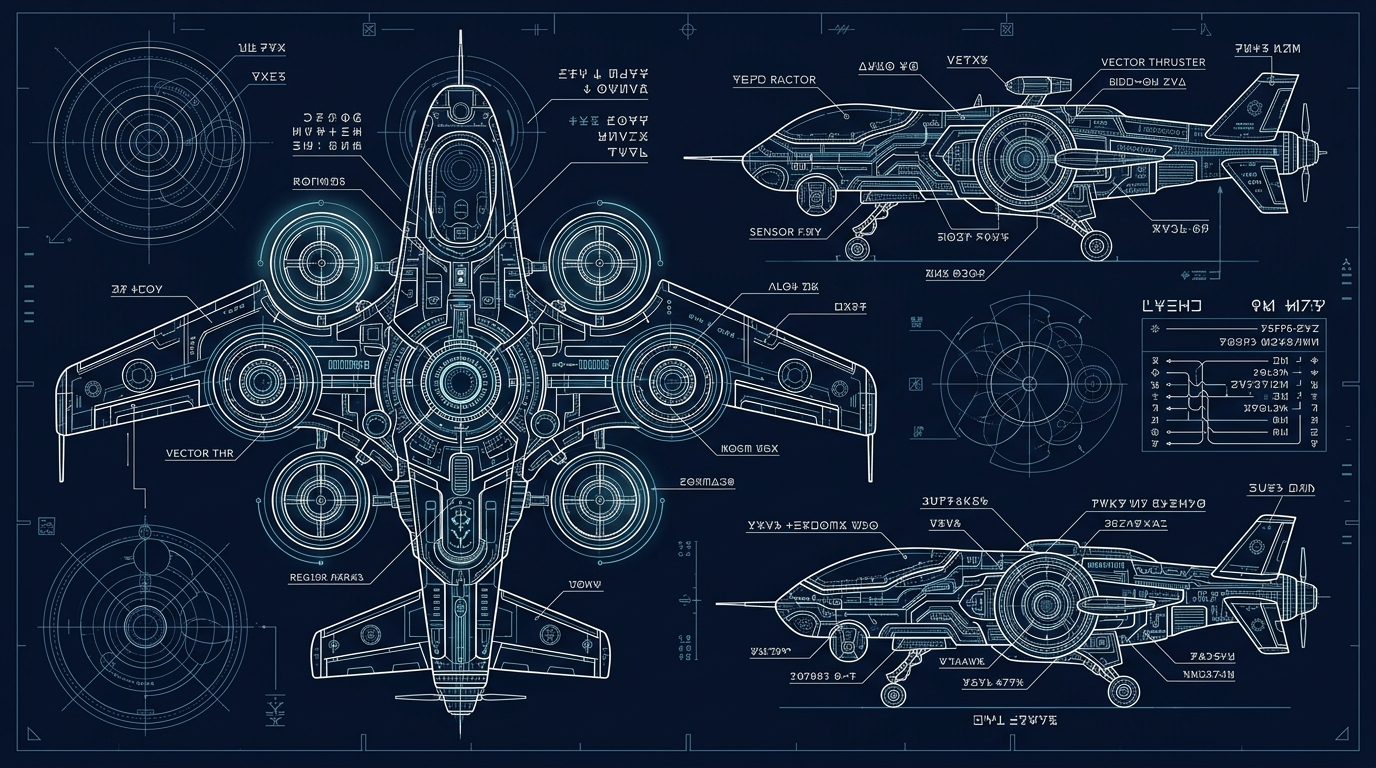
The CARET drones did not look like a classic flying saucer case.
They looked like a leak from a design department nobody was supposed to know existed.
The first photographs appeared on Craigslist in spring 2007 — witnesses from Bakersfield, Lake Tahoe, and Capitola reporting strange aerial objects with trailing appendages and geometric surfaces. The photos alone were unusual. What came next was not.
In June 2007, an anonymous source calling himself "Isaac" posted a multi-document package to the web, picked up and amplified by Linda Moulton Howe and Coast to Coast AM. Isaac claimed to have worked in the 1980s at a classified facility in Palo Alto he called PACL — the Palo Alto CARET Laboratory — as part of a reverse-engineering program called Commercial Applications Research for Extraterrestrial Technology. The package included technical diagrams, a field guide, and a complete writing system.
That last part is the thing the headline version of the story usually drops.
It was not just a photo
The CARET documents included a Linguistics Analysis Primer — a multi-page document that described the symbols covering the drones not as decorative glyphs but as functional blueprints. Isaac's claim was stranger than "alien spacecraft." It was that the symbols were a programming language, that the hardware executed its own instructions by having them written on its surface, and that a human reader looking at the right pattern long enough was reading a machine.
That is why CARET attracted a different kind of analyst than most UFO photographs. People did not just argue about the images. They attempted to decode the alphabet. Nick Pelling, the cryptography historian behind Cipher Mysteries, wrote about the symbols in 2009 and noted that they closely resemble formatted technical gibberish — plausible-looking, internally structured, but not resolving into any decipherable system.
The symbols were designed to invite analysis. That is the design choice that made CARET durable.
The package, not the object
The CARET story moved in the mid-2000s internet, before today's AI image flood but deep enough into the web that a claim could become a collaborative investigation overnight. People compared images, copied diagrams, examined the alphabet, and argued over whether the material was a viral art project, a staged disclosure, a design exercise, or something more exotic.
Two CGI analysts argued early that the drone photographs were computer-generated. A later Reddit thread contended that the most cited CGI debunk was itself methodologically flawed. Neither side produced an author.
Nobody has ever claimed to have made the CARET documents. Nobody has ever been identified as Isaac. The case is officially unresolved.
That is not a triumph for the exotic explanation. It is a record of how a sufficiently dense artifact can survive reanalysis simply by never producing a confession.
Why it belongs now
CARET is useful to revisit because it sits precisely between old UFO hoaxes and the current image problem.
Older cases needed a model, a photograph, a typed memo, or a television segment. CARET showed how a digital UFO claim could be more ambitious: not one image, but a cluster of artifacts that invited readers to become analysts. A world with internal rules. A technology with its own grammar. A source who knew enough to know what he could not say.
Today, AI images can produce polished mystery on demand. CARET came before that, but it understood the same pressure point: give people enough texture and they will start building the file around it.
The drones are not the only story.
The interface is.