News / Jun 07, 2026
The CIA's UFO fringe file starts with psychoweapons panic
A CIA/STARGATE file puts UFO-contact panic beside psychoweapons, hypnosis, MKULTRA, television, and Soviet bioenergy claims. The file does not solve UFOs. It opens another drawer.
This CIA UFO story does not start with a saucer.
It starts with a Soviet press item about psychoweapons.
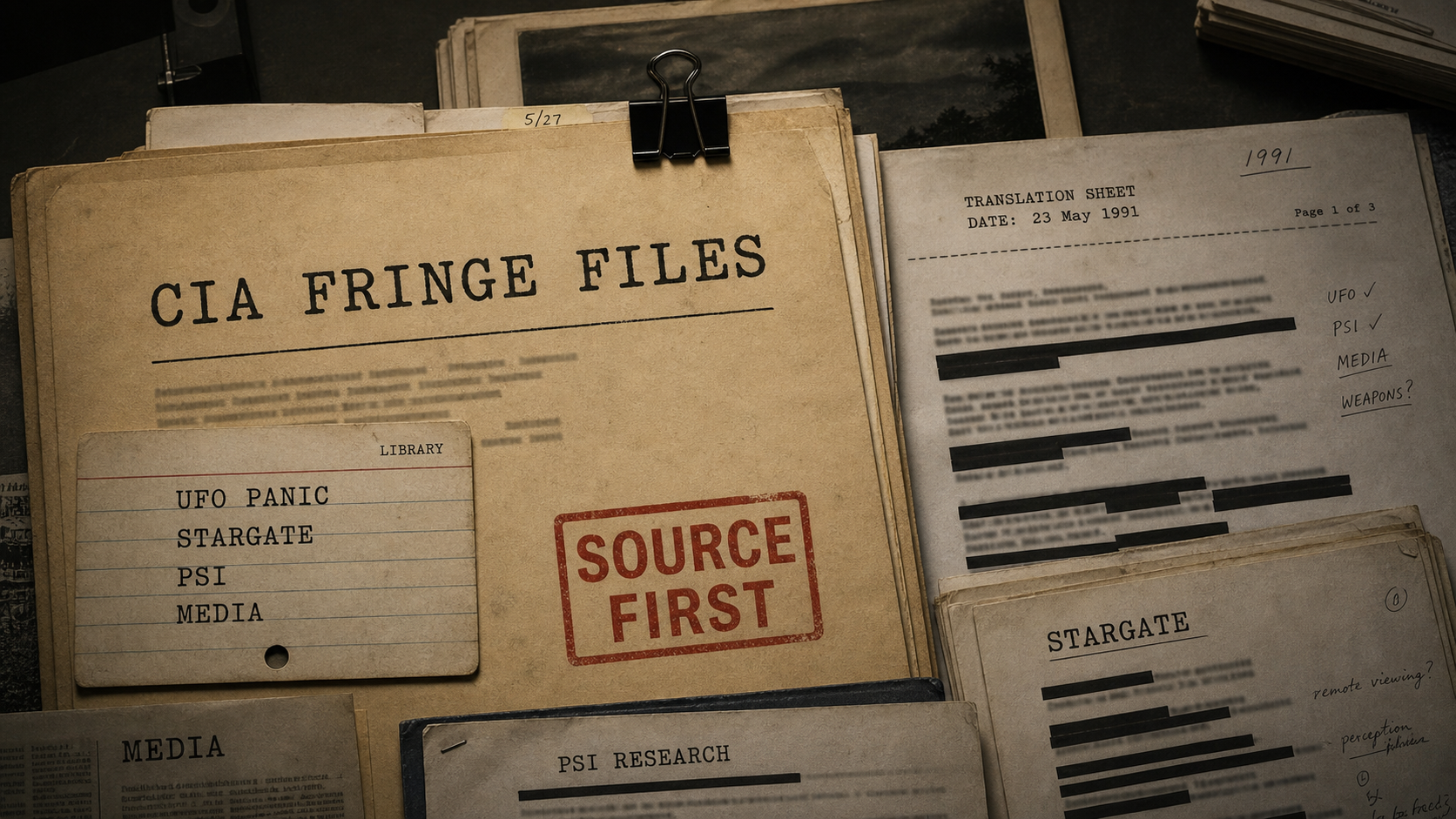
The title is already enough to make the file feel unstable: "Specialist's Suggestions for Combating Phobia Over Psychoweapons." The document sits in the CIA's STARGATE material, translated from a 1991 Russian source. It moves through a very particular late-Soviet atmosphere: MKULTRA, brainwashing, hypnosis shows, technical mind weapons, public fear, television, and bioenergy claims.
Then UFOs enter the file.
Vladimir N. Volchenko, deputy chairman of the Soviet committee on Bioenergy Information Processing (Bioenergoinformatika), points to UFO-contact panic as one example of psychological danger amplified by television. He writes:
"The runaway UFO psychosis spawned by television is another example... From letters and in the course of personal conversations, my colleagues on the Bioenergoinformatika committee and I have established numerous cases of psychosis on topics of contacts with unidentified flying objects."
A U.S. intelligence archive preserved a late-Soviet text where UFO belief, media panic, hypnosis, and psi-weapon anxiety all touch the same page.
The file is not about an object
Most UAP records ask the same basic questions: What was in the sky? Who saw it? Was there radar, video, or physical trace? Was it a balloon, drone, satellite, sensor error, or something still unresolved?
This file is different. It is not trying to identify an object. It is watching an idea move through people.
The Soviet text treats UFO-contact panic as part of a wider fear system. Television matters. Public belief matters. Claims about bioenergy and technical weapons that could affect the human mind matter. UFOs do not only travel as sightings. They travel as rumors, psychiatric labels, intelligence problems, media events, and adversary fears.
The CIA archive kept a copy of that too.
Why it sits near STARGATE
STARGATE is usually treated as the CIA's psychic-spy rabbit hole. Half true.
The CIA says its remote-viewing research began in 1972, ended at the agency in 1977, moved to the DIA, and later came back for review in the 1990s. The final outside evaluation found enough unusual results to keep the argument alive, but not enough reliability for intelligence use. Gateway Process, Monroe Institute, out-of-body consciousness: that story has been heavily covered.
The UAP angle is not Gateway. It is the paperwork around it.
Inside the STARGATE collection, UFOs appear not only as flying-saucer reports. They also appear as bibliography, translation, fringe-science context, and public-belief material. One CIA Reading Room document includes an abstract for Illo Brand's 1975 paper, "The spectrum of UFO sightings," from Zeitschrift für Parapsychologie und Grenzgebiete der Psychologie.
Brand argued for a spectrum built from 50,000 computerized cases before deciding whether the phenomenon was mainly physical or parapsychological.
The sharp word is parapsychological. Not because it settles the subject. Because it shows where some UFO thinking had gone by the time those abstracts landed in a U.S. intelligence collection. UFOs were no longer only an air-defense problem. They were being argued over as witness psychology, anomalous experience, and statistical pattern.
The older CIA UFO problem
The normal CIA UFO history is already on the table.
In Gerald K. Haines's official CIA history, the Agency's early interest begins where you would expect: Cold War air defense, Soviet capabilities, radar reports, public panic, and the chance that UFO reports could be used for psychological warfare. By the early 1950s, the CIA was not only asking what the objects were. It was asking what the reports did. Could they clog an air-warning system? Could rumor produce panic? Could enemy deception hide inside noise?
By the late 1970s and 1980s, Haines writes, some in the CIA and the Intelligence Community shifted interest toward parapsychology and psychic phenomena associated with UFO sightings, while the Agency maintained a conservative scientific view and had no formal UFO project. The narrower reading: the subject did not disappear. It changed folders.
What to pull next
This is a first article, not the whole series. The documents described here are publicly available in the CIA Reading Room; the STARGATE collection runs to thousands of pages.
The next pass goes deeper into that shelf, pulling the full trail around Brand's UFO-spectrum abstract, related parapsychology-journal entries in the same batch, the Bioenergoinformatika translation and its source context, Kenneth Kress's CIA history of parapsychology in intelligence, the 1995 remote-viewing evaluation, and records linking UFO groups to foreign intelligence concerns.
The working question stays narrow: when UFOs leave air defense, where do they go?
In these files, the answer is not aliens. It is psychology, media, psi research, adversary paranoia, and the administrative need to put fringe material somewhere.
Sources
- CIA Reading Room: "Specialist's Suggestions for Combating Phobia Over Psychoweapons," document CIA-RDP96-00792R000600450008-5.
- Black Vault mirror of CIA-RDP96-00792R000600450008-5.
- CIA Reading Room: "The spectrum of UFO sightings" abstract in STARGATE collection, document CIA-RDP96-00792R000700660006-3.
- Black Vault mirror of CIA-RDP96-00792R000700660006-3.
- CIA: Ask Molly, "Did CIA Really Study Psychic Powers?".
- CIA Reading Room: STARGATE collection.
- Gerald K. Haines, "CIA's Role in the Study of UFOs, 1947-90".
- CIA PDF of Haines article.
- CIA: "Take a Peek Into Our X-Files".
- The Black Vault: Central Intelligence Agency UFO Collection.
- Popular Mechanics: Gateway Process coverage.