Main Article / Aug 03, 2026
Colares and Operação Prato: the medical files, the field dossier, and the lights over the Amazon
In the autumn of 1977, residents of the Brazilian island town of Colares reported narrow light beams striking them at close range and leaving paired puncture marks, burns, and in some accounts permanent hair loss. The Brazilian Air Force sent a small team under Captain Uyrangê Hollanda. The 500-page field dossier that followed stayed classified for 27 years.
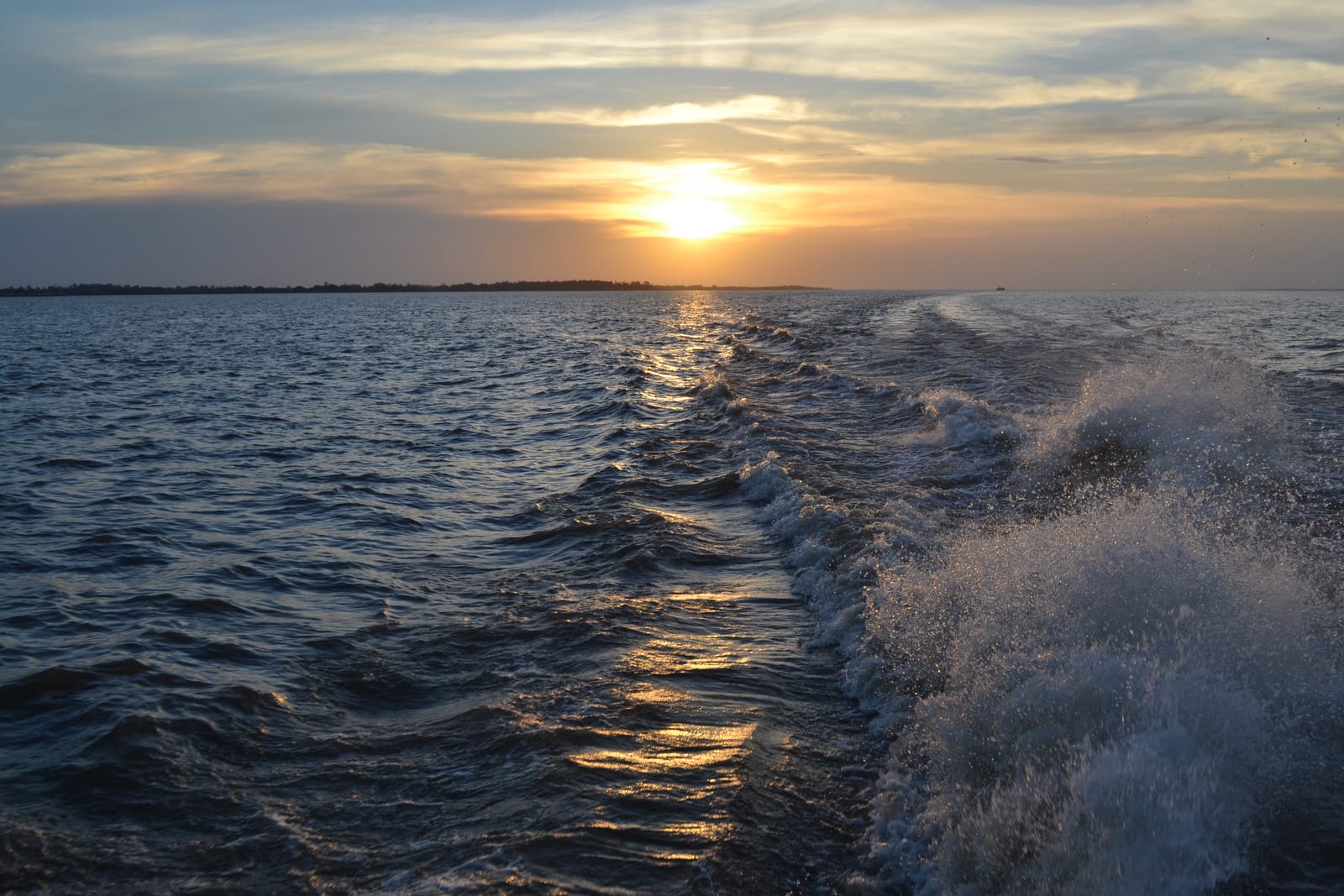
In October 1977, a fisherman walked home from the river on the island of Colares, a small settlement at the mouth of the Amazon in the Brazilian state of Pará. He remembered a light, low and close, the size of a window. He remembered the heat. The next morning, he found two small puncture marks on his chest and a patch of skin already turning black. Within weeks, dozens of neighbours carried the same marks. By November, the local physician had treated dozens of them, and the mayor had asked the Brazilian Air Force for help.
The investigation that followed ran for about four months and produced a field dossier of roughly 500 pages, several hundred photographs, and about 16 hours of motion-picture footage. Almost all of it sat in classified Brazilian Air Force storage for 27 years before the first parts of it surfaced in public archives. The medical injuries were never publicly resolved.
The 1977 UFO wave on Colares
Colares sits on an island in the Baía do Guajará, just south of where the Amazon meets the Atlantic. In the early months of 1977, reports of strange lights began moving up the rivers and coast of Pará state, but they converged with unusual intensity on Colares and a chain of small fishing villages around it. Residents described narrow, concentrated beams of light that arrived at close range, struck people, typically on the chest or neck, and left small, paired puncture marks followed by weakness, dizziness, headaches, and a sense of having been drained of blood. Locals called the phenomenon chupa-chupa — the sucker.
The injuries were consistent across dozens of unrelated patients. The local physician, Dr. Wellaide Cecim Carvalho, was the only doctor serving the region's health unit, and she worked through the autumn of 1977 documenting what she saw. In a statement that later circulated widely, she wrote that the victims, men and women of varying ages, presented with lesions to the face or thoracic area. "The lesions, looking like radiation injuries, began with intense reddening of the skin in the affected area," she wrote. "Later the hair would fall out and the skin would turn black. There was no pain, only a slight warmth." Two small puncture marks were visible inside the burned area. Blood tests showed reduced red-cell counts and hemoglobin levels consistent with acute anemia.
In her professional assessment, Dr. Carvalho described the injuries as resembling radiation burns more than any conventional thermal, chemical, or electrical mechanism. The rural health unit had no equipment capable of measuring radiation, so definitive identification of the causative agent was not possible from her records. In interviews given in the 1990s and 2000s, she said the Air Force had asked her to tell patients their injuries were hallucinations. "This is what the Air Force always asked me to say," she said. "It did not happen any kind of mass hysteria or visual hallucinations."
Local accounts through the flap put the number of seriously injured at around 35, with roughly 80 residents treated in total across the period. Two deaths were attributed to the encounters in local memory, but no public record ties them directly to the lights.
The Air Force arrives
By October, the mayors of several Pará municipalities had appealed to the regional air command, the 1º COMAR in Belém, for help. On 20 October 1977, the Brazilian Air Force launched a field operation under the code name Operação Prato — Operation Saucer. The strategic commander was Brigadier Protásio Lopes de Oliveira. The operational lead on the ground was Captain Uyrangê Bolivar Soares Nogueira de Hollanda Lima, an intelligence officer from 1º COMAR, working with a small team that included Sergeant João Flávio de Freitas Costa as rapporteur, photographers, and a second-in-command.
The team deployed to Colares with cameras, tape recorders, a theodolite, and sketchbooks. According to the mission texts, the first phase ran from 20 October to 11 November 1977, followed by a shorter second phase from 25 November to 5 December 1977. Additional investigative activity continued into 1978 and was folded into regional intelligence reporting. The official mission log, later summarized in a 1979 consolidated report, lists 130 separate UAP observations recorded by the team across Pará state during this period, of which 82 fall in 1977 and 48 in 1978. A wider 284-entry Resumo Sintético-Cronológico compiled by 1º COMAR covers the entire Pará flap and includes both UAP sightings and conventional objects such as satellites. A cross-check of dates and times between the two records produces a 99.2 per cent match, with only one of the 130 entries lacking a corresponding Resumo entry — a point used by Brazilian researchers as an internal consistency check on the operational log.
What the field team actually recorded
According to archival summaries and the MUFON-Pratt briefing later compiled from Brazilian sources, the team's principal field dossier, compiled under Sgt. Freitas Costa, runs to roughly 500 pages of witness statements, sketches, maps and object classifications. The photographic dossier is concentrated in the 1977 wave period and contains several hundred stills. About 16 hours of motion-picture footage was shot in Super-8 and Super-16 formats. One of the most-cited entries, Registro 076, documents a 17 December 1977 incident at Fazenda Jejú in Pará, in which the team recorded a reported landing and two 40-by-40-centimeter ground impressions inside a 2.5-meter circle. The original negatives and most of the film stock remain in Air Force custody; the printed photographs and the operational register were transferred to the Arquivo Nacional in 2010 and are accessible through its SIAN system.
The 130-entry observation register gives a fairly consistent picture of what the team and other military and civilian witnesses described. Objects were typically classified as "corpo luminoso", "luminous body". Apparent sizes ranged from 30 centimetres to about 3 metres. The most common shape was an inverted plate or saucer with a pointed lower vertex, often described as cylindrical or near-conical, and on several occasions as giving the impression of a metallic surface. Colours shifted during the encounter: yellow to reddish-yellow on the upper section, with a focused blue or blue-green light below. A second recurring form was a barrel or drum with a thin tube and an angled beam of light. Distances to the witness were commonly reported at a few hundred metres, altitudes of 20 to 200 metres, and movements silent and lateral. One early entry (22 October 1977, 20:15) records a body at 1,200 metres altitude moving at supersonic speed, with no sound heard on the ground. Most of the registered observations are simply dated, located, sketched, and classified by the team.
The team deployed with an investigative, rather than adversarial, mandate. The medical sub-team attached to 1º COMAR, with meteorologists and aerospace technicians among them, produced a coherent if inconclusive dataset on patient injuries. The operation was terminated abruptly in early 1978 without a public conclusion, and the team was recalled. The 1979 consolidated report, drafted by Hollanda himself, recorded the bottom line as "nothing conclusive was obtained about the supposed phenomena" and noted that there were no signs of extraterrestrial presence; it offered no alternative medical or environmental explanation for the burn pattern Dr. Carvalho had documented. Brazilian researchers and BBC reporting both note that the Air Force has never published an alternative account of the injuries.
Hollanda's own statements, given in a long 1997 filmed interview to Brazilian ufologist Ademar José Gevaerd and colleagues, contradict the mission's published conclusion. In 1997, Hollanda said his team had in fact filmed and photographed luminous objects maneuvering at low altitude over the Baía do Sol, that he had personally watched these objects at treetop height, and that he was convinced the phenomena were real, technological, and not of human origin. He described objects making movements that, in his words, were impossible for any technology known to him.
Twenty-seven years of classification
For most of the 1980s and 1990s, Operação Prato was officially denied. Brazilian researchers, led by Gevaerd, pressed the Air Force through the 1990s. On 20 May 2005, Gevaerd and a small group of ufologists were invited to meetings at CINDACTA and the Brazilian Aerospace Defence Command (COMDABRA) in Brasília, where they were allowed to examine about 110 photographs and 160 documents from Operação Prato. The classified files, however, were not released to the public at that point.
The first formal declassification came in 2010, when the Air Force transferred 1,562 pages of UAP-related material to the Arquivo Nacional in Brasília, where they joined the "Arquivo X" collection maintained by the Núcleo do Acervo do Regime Militar. The transfer was certified on 13 May 2010 by the Centro de Documentação e Histórico da Aeronáutica under Despacho nº 149/5EM/1908 of 8 February 2010, and Defence Minister Nelson A. Jobim confirmed the policy in an Ofício 4225-GM/Aspar-MD dated 19 April 2010 responding to Requerimento de Informação 4470/2009 from Deputy Chico Alencar. The Operação Prato file is one of several batches in the wider Fundo Objeto Voador Não Identificado (OVNI) at the Arquivo Nacional, now digitised and accessible through the SIAN system. Additional material surfaced in 2017.
Researchers and the Brazilian press have described the Fundo OVNI as the largest publicly accessible military UAP archive in the Americas, currently several thousand pages. Within it, Operação Prato remains the single most-cited case.
Brazilian UFO researchers have alleged that Colonel Uyrangê Hollanda's death on 2 October 1997, two days after his filmed 1997 interview, was suspicious, though no official autopsy or primary investigative finding has been released to corroborate this.
What the public record still does not show
The 2010 transfer released the 130-entry operational log, the bulk of the team's printed photographs, and the witness material that accompanied them. What remains in Air Force custody are the original negatives, the 8mm and 16mm film stock, and the photographic appendix to the field dossier. For the residents of Colares, the record is also uneven. Dr. Carvalho's clinical notes survive in summary form; her individual case files for the 35 most consistent presentations, the ones that match the radiation-burn pattern, are referenced in the consolidated report but not in the public digital archive.
What the public archive now contains, and what it does not, frames an unresolved gap. The physician's clinical file describes a coherent injury pattern, with onset and symptoms that did not match any conventional cause she had seen in her practice. The military's own 1979 report records 130 logged observations of luminous objects, with shapes, colours and flight characteristics that the team filed by hand, but concludes only that "nothing conclusive was obtained". No alternative medical, environmental or technical explanation has been published in the declassified file to account for Dr. Carvalho's pattern of burns, puncture marks and acute anaemia. The Globo podcast Operação Prato, released in September 2024, returned the case to Brazilian public attention for the first time in more than a decade and prompted a new round of witness interviews; the case remains officially closed and the original film stock un-released.
Sources
- "Operação Prato," Wikipédia, a enciclopédia livre (Portuguese), accessed 2026-08-03.
- "Operation Plate," Wikipedia (English), accessed 2026-08-03.
- Gary P. Pratt, "Operação Prato," MUFON briefing document hosted on The Black Vault, accessed 2026-08-03.
- "Colares and Operation Prato," UFOMYST case file, accessed 2026-08-03.
- "Colares 1977 to 1978: From UAP flap to military investigation and filled hospital beds," UAPedia, accessed 2026-08-03.
- Vivien Ishaq, "Inventory 01/2010," Centro de Documentação e Histórico da Aeronáutica, certified 13 May 2010 (Arquivo Nacional, Fundo OVNI).
- Brazilian Ministry of Defense, Ofício 4225-GM/Aspar-MD, 19 April 2010, response to Requerimento de Informação 4470/2009 (Dep. Chico Alencar, PSOL/RJ).
- Gilberto Sales, "Operação Prato: O que a Aeronáutica Revelou no Dossiê?", gilbertosales.com.br, accessed 2026-08-03.
- Estadão, "Aeronáutica libera documentos sobre aparição de óvnis," 2008/2010 reporting on the Arquivo X transfer to the Arquivo Nacional.
- Project: Unredacted, "Operation Prato: Brazil's Official UFO Investigation," accessed 2026-08-03.
- Disclosdex, "Operation Prato: 1977 Brazil UFO investigation," accessed 2026-08-03.
- "Operação Prato 1977-1978 — Registro de relatos com fotos," archived field-report scans on SlideShare, accessed 2026-08-03 (primary register entries cited for object description).