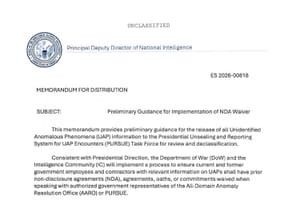
Main Article / Aug 02, 2026
NASA's UAP research after the 2023 Independent Study: a director, a 1,600-case gap, no program line
Three years after the 36-page UAP report, NASA has a named director, no dedicated program line, and a follow-up story shaped by AARO's 1,652 cases, a new AARO director, and a confirmation saga that ended in December 2025.
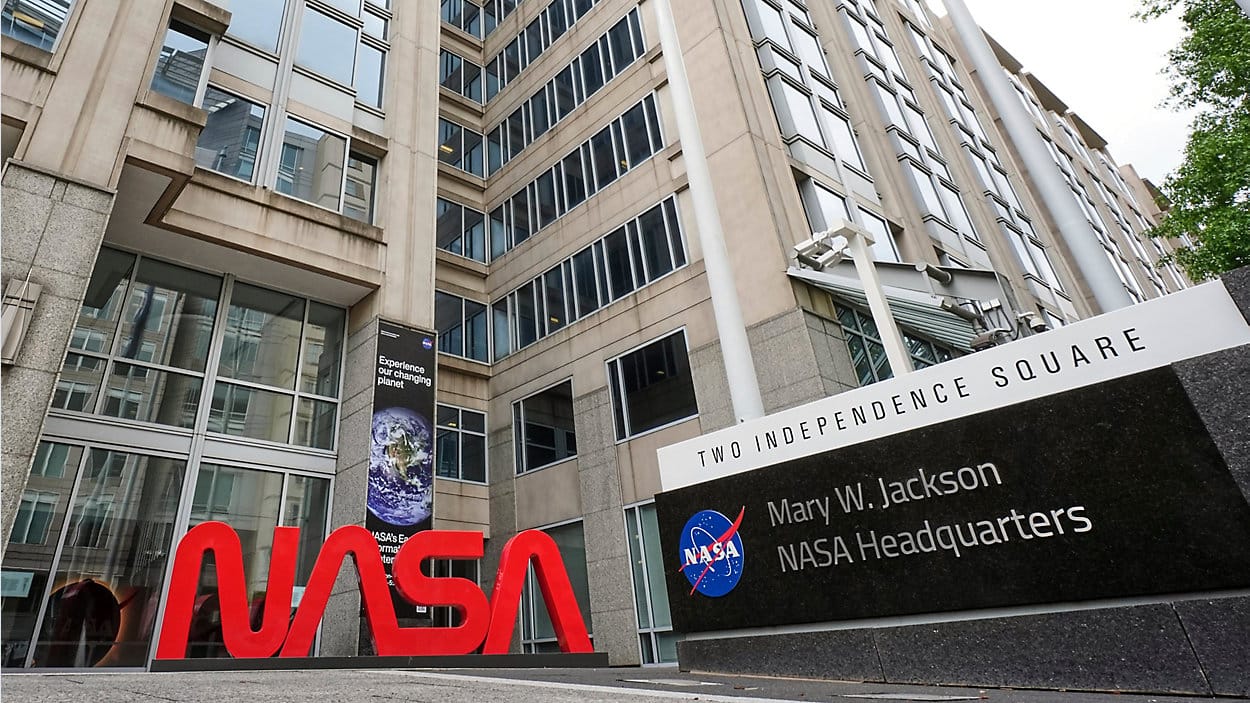
On the morning of 14 September 2023, four people sat at a long table in the Mary W. Jackson Building in Washington and announced, in a single sentence each, what NASA intended to do about unidentified anomalous phenomena. The agency's administrator, Bill Nelson, said NASA had appointed a Director of UAP Research who would build the agency's contribution to the U.S. government's UAP effort. The chair of the study team that had produced the report, David Spergel, said the team had "no evidence to suggest that UAP are extraterrestrial in origin." Dan Evans, the NASA official who had run the study, said the agency was committed to doing the work "transparently."
More than two years later, that work is, in formal terms, one named civil servant, a publicly described data plan, and a list of recommendations that have not produced a dedicated program line or a budget item. The UAP director's name was not made public at the briefing. It was released later the same day, after reporters including SpaceNews and the BBC pressed for it, and the name was Mark McInerney, a long-time NASA Goddard employee in the Flight Projects Directorate who had been embedded, before the briefing, with the All-Domain Anomaly Resolution Office at the Pentagon.
What has followed, between the autumn of 2023 and the summer of 2026, is the story this note tries to lay out: a 36-page roadmap that is still the only public NASA UAP product, two AARO annual reports and one AARO historical record that filled in the Pentagon side of the file, a turnover at AARO itself, a confirmation saga at NASA that ran through a withdrawal, and a sitting NASA administrator on a podcast in June 2026 saying the agency has "captured imagery it cannot currently explain."
What the 36-page report said
The report the four officials were discussing was the output of the UAP Independent Study Team, which NASA commissioned in June 2022 and which met for the first time in early 2023. Sixteen scientists and former officials served on the panel under David Spergel, then the president of the Simons Foundation. The team's mandate was narrow: not to evaluate the unknown cases, but to produce a roadmap for how NASA could help the rest of the government study them. The full report, with eight recommendations, was made public on 14 September 2023 at science.nasa.gov/uap.
The team's bottom line was a quote, repeated several times in the document, that has shaped U.S. government language on the subject ever since: "To date, in the peer-reviewed scientific literature, there is no conclusive evidence suggesting an extraterrestrial origin for UAP." The rest of the report walked the reader through how that finding was reached.
The most-cited limitation was data quality. "At present, analysis of UAP data is hampered by poor sensor calibration, the lack of multiple measurements, the lack of sensor metadata, and the lack of baseline data," the panel wrote. Almost every UAP case in the U.S. record had been collected by sensors that were not built for the purpose, on platforms that were not coordinated with one another, and without the contextual information (sensor type, manufacturer, observing mode, time, location, atmospheric conditions) that a scientific analysis would need.
The recommendations that followed were technical. NASA should use its existing and planned Earth-observing satellites to look for the local environmental conditions around reported UAP events. NASA should develop or acquire a crowdsourcing system, in the report's words "a smartphone app that captures images, sound, and other sensor data from multiple observers at once." NASA should encourage calibrated, multispectral and hyperspectral data collection across the federal government. And NASA should help the field reduce the social cost of reporting, the "stigma" that the panel's chair said in the briefing was "in part a consequence of the environment in which the observations are made."
The director the agency did not want to name
The headline announcement on 14 September 2023 was the appointment of a Director of UAP Research. NASA did not initially name the person. The agency's spokesperson cited two reasons. The first was that NASA wanted to "work across the whole of government" and had to coordinate the announcement with partners. The second, given by Dan Evans in the briefing room, was that some members of the Independent Study Team had received harassment during the study, and that in some cases it had "risen to actual threats."
Reporters covering the briefing asked NASA to identify the new director. The agency declined, until late in the afternoon, when SpaceNews and the BBC noted publicly that it was not clear what authority NASA had to withhold the name of one of its own civil servants. By the end of the day, the agency reversed the decision and identified the director as Mark McInerney, a long-time NASA employee based at the Goddard Space Flight Center in Greenbelt, Maryland, where he works in the Flight Projects Directorate.
McInerney had, by the time of the briefing, already spent months working with the All-Domain Anomaly Resolution Office. A May 2023 Five Eyes Forum on UAP, organized by AARO's first director, Sean Kirkpatrick, included both McInerney and Dan Evans. A 2023 NASA FOIA log, released to a private researcher and published by the agency the following year, shows McInerney scheduled to attend the forum on NASA's behalf and Dan Evans confirming, in a 19 May 2023 email with the subject "FVEYS Meeting," that he would "say a few words for sure." McInerney's role at the time was described by Evans in the May 2023 public meeting as that of "a tremendous expert on large-scale curation of data and an employee of NASA's Goddard Space Flight Center who really runs the show when it comes to our Earth-observing assets." That description, in substance, prefigured the UAP directorship he was given three months later.
What was said, and what was not, about money
Two practical questions followed the appointment: how much would the new UAP effort cost, and from which NASA budget line. The agency declined to answer either. Nicola Fox, NASA's associate administrator for science, told the briefing that the spending levels were tied to preparations for future budget proposals and were "not something we discuss openly."
The Independent Study Team had been similarly constrained. In the May 2023 public meeting, Dan Evans said, "It's also important to say going forward now that NASA has not established a program relative to UAP, and as a result there's no associated programmatic funding." That language has not been publicly revised since. NASA's overall budget for fiscal year 2024 was set at $24.875 billion, a reduction of roughly 2 percent on the prior year, and the fiscal year 2025 request of $25.384 billion does not carve out a UAP-specific line. The agency's work on the topic has, on the open record, continued to be funded out of the Science Mission Directorate's general research budget, and the dollar figure has not been broken out.
What that budget is being used for, in practice, is partly described in the report and partly described in the briefing. The data side, the panel said, should be open. "This study relies on open data," Spergel said. "Everything we use at NASA is open and anyone can look at these records, so I invite you to visit our open data portal at data.nasa.gov." On the analysis side, the agency has pointed at its existing experience with multispectral satellite imaging, exemplified by the launch in February 2024 of the PACE (Plankton, Aerosol, Cloud, ocean Ecosystem) observatory, which carries the hyperspectral Ocean Color Instrument and which NASA opened to the public on 11 April 2024, and at the artificial-intelligence and machine-learning techniques the agency already uses to find Earth-science anomalies. No NASA-built UAP smartphone app has appeared since the report. No NASA UAP-specific dataset has been released.
What the Pentagon published, in two parts, before the third year was out
NASA's UAP work sits next to, but is not the same as, the All-Domain Anomaly Resolution Office. AARO was established in July 2022, fourteen months before the NASA study report, inside the Department of Defense. The NASA Independent Study Team explicitly worked with unclassified material only, and the report repeatedly says so: the team could "freely collaborate with academia, with industry and with international partners" precisely because it was not constrained by classification.
The AARO case load is the larger of the two. By the time of the May 2023 public meeting, AARO was tracking roughly 800 UAP cases, up from 650 in early 2023. Between 50 and 60 new reports were being filed per month, once a long backlog of older reports had been entered into the system. The agency's own characterization, repeated by Kirkpatrick in the briefing, was that the overwhelming majority of cases are explainable as aircraft, balloons, drones, weather, or instrument artifacts. Between two and five percent of the cases, he said, "display signatures that could reasonably be described as anomalous."
Two AARO documents published over the following year changed the numbers. The first was the FY2023 Consolidated Annual Report on UAP, issued jointly by ODNI and DoD on 18 October 2023 (the report's information cut-off was 30 April 2023). The second, and more substantial, was the FY2024 Consolidated Annual Report on UAP, published on 14 November 2024 by AARO under its new director, Dr. Jon T. Kosloski. The information cut-off for that report was 1 June 2024. As of 24 October 2024, AARO had 1,652 UAP reports in its holdings. 757 had been added in the reporting period, of which 485 were new incidents and 272 were older incidents (2021-2022) entered into the system late. AARO resolved 292 cases to "common or naturally occurring phenomena," with 21 cases flagged as requiring further study because of "anomalous" signatures. The agency has found, Kosloski said, "no verifiable evidence of extraterrestrial beings, activity or technology." None of the cases resolved pointed to advanced capabilities or breakthrough technologies. None of the observers reported adverse health effects.
Alongside the annual report, AARO published Volume I of its Historical Record Report on 8 March 2024. The 63-page document, dated February 2024, reviewed every official U.S. Government UAP investigatory effort since 1945, including Project Sign, Project Grudge, Project Blue Book, the Condon Report, AAWSAP/AATIP, and the UAP Task Force. AARO found no evidence that any U.S. investigation, academic study, or official review panel had confirmed that a UAP sighting represented extraterrestrial technology. AARO also found no empirical evidence for the claim, central to the 26 July 2023 testimony of former NGA officer David Grusch before the House Committee on Oversight and Accountability, that the U.S. Government and private companies had reverse-engineered extraterrestrial craft or recovered "non-human biologics." AARO traced the modern version of that claim to a "consistent group of individuals" tied to a cancelled DIA effort and to a proposed-but-never-approved DHS special-access program called KONA BLUE. Grusch, the former Army colonel Karl Nell, and several members of Congress publicly disputed AARO's methodology and conclusions.
The two director changes
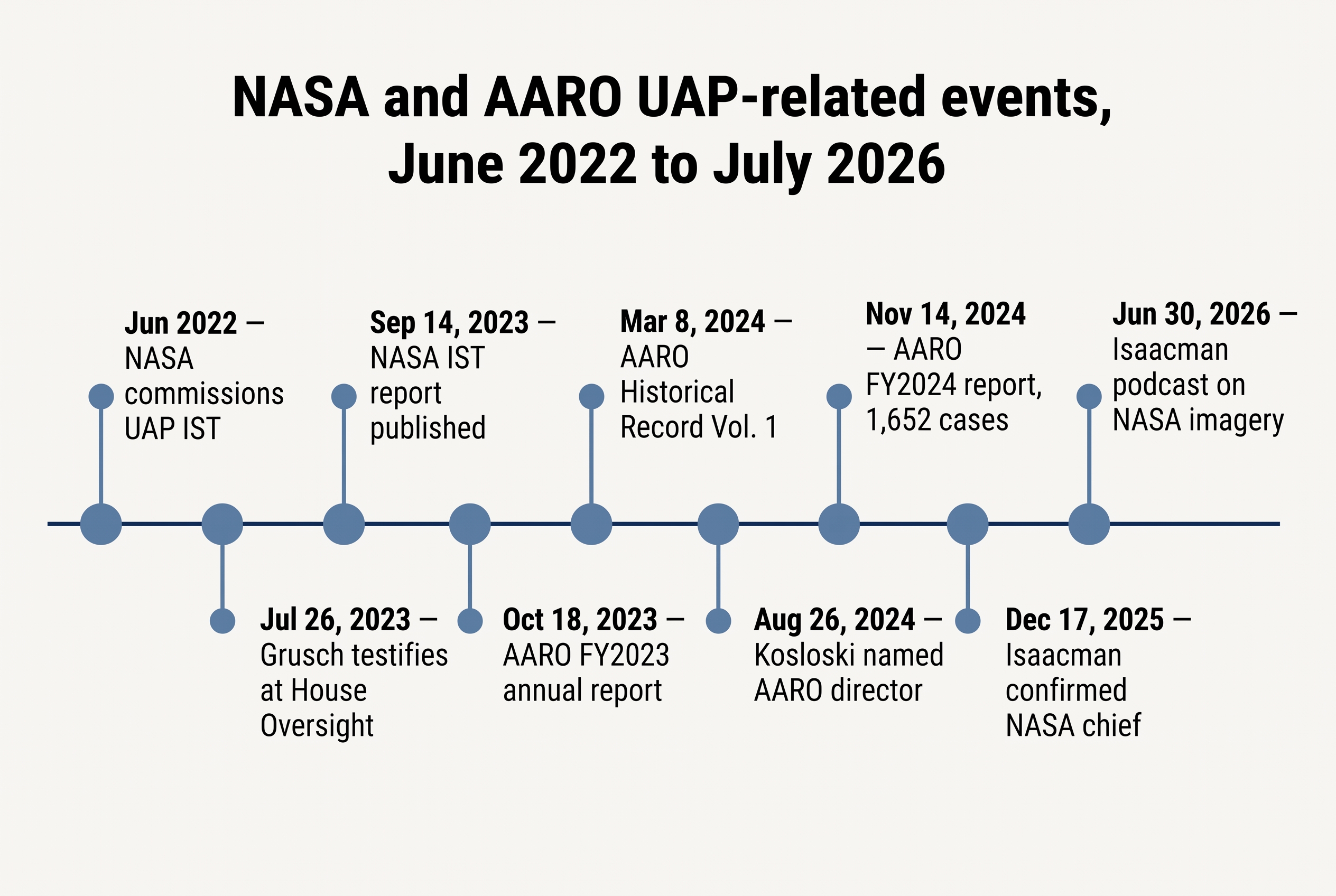
Two personnel changes over the same year redrew the question outside NASA. The first was at AARO. On 26 August 2024, the Department of Defense named Dr. Jon T. Kosloski, then a senior researcher in the National Security Agency's Research Directorate, as AARO's new director, replacing acting director Timothy Phillips. Kosloski, a physicist and electrical engineer with a doctorate from Johns Hopkins, had spent more than two decades at NSA in optics, computing, and cryptanalytic mathematics; he told reporters in his November 2024 press roundtable that he had taken the job because it was "a tough scientific problem." AARO's founder and first director, Sean Kirkpatrick, announced his retirement on 8 November 2024, a month after the FY2024 annual report was filed.
The second was at NASA itself, and it took longer. On 4 December 2024, the then-president-elect Donald Trump announced that he would nominate Jared Isaacman, the founder and CEO of Shift4 Payments and commander of the Inspiration4 and Polaris Dawn private spaceflights, as the next NASA administrator. The nomination was the first time a president-elect had named a candidate for the post before taking office. It was formally submitted on Inauguration Day, 20 January 2025. Isaacman cleared the Senate committee on 30 April 2025, by 19 votes to 9. On 31 May 2025, the White House withdrew the nomination; the official reason was a "thorough review of prior associations," but multiple outlets, including Ars Technica and Axios, reported that the timing was tied to the public breakdown of the Trump–Elon Musk relationship rather than to any new fact about Isaacman himself. Transportation Secretary Sean Duffy became acting NASA administrator in July 2025. Trump renominated Isaacman on 4 November 2025. The Senate confirmed him on 17 December 2025, by 67 votes to 30, and he was sworn in the following day at the Eisenhower Executive Office Building by U.S. District Judge Timothy Kelly.
Eighteen days after Kirkpatrick's retirement was announced, and six months after the FY2024 annual report was filed, Isaacman appeared on a podcast hosted by Jack Gordon, titled "I Let Flat Earthers Talk to the Head of NASA." The interview aired on 30 June 2026. Asked whether the U.S. Government had recovered "non-human" craft or material, Isaacman repeated a version of the AARO position: that no evidence had been made public, and that any claim of that kind would require extraordinary evidence. Asked separately whether NASA had captured imagery it could not explain, he said it had, and added that he was "pretty confident" the agency would release more material in the coming months. The line became the most-quoted UAP statement by a NASA administrator since Spergel's September 2023 briefing.
What changed between September 2023 and the present
What changed is the appointment of a single person. Mark McInerney is still the Director of UAP Research, and the 14 September 2023 briefing is still the most recent substantive NASA public statement on the subject. NASA's open-data position is unchanged: the agency points at data.nasa.gov, the AARO annual reports, and PACE's hyperspectral data release. No NASA UAP smartphone app has appeared. No NASA UAP-specific dataset has been published. The agency has not held a second public UAP meeting in the Spergel-report style. No NASA UAP director has spoken on the record about the work of the office he leads.
What has filled the gap is the private sector. Enigma Labs, the New York-based startup whose app, an augmented-reality "Shazam for the sky," was singled out in the 14 September 2023 press cycle as an example of the kind of crowdsourcing tool the NASA panel had in mind, said in 2026 that its user base had filed more than 50,000 sighting reports and sent more than 560,000 sighting alerts. The company has, in parallel, a working relationship with AARO that began in January 2023, when a Sean Kirkpatrick-led Pentagon delegation attended a NASA UAP summit at which Enigma gave a presentation; the contents of the meeting are still largely redacted in the public FOIA file. AARO's FY2024 annual report does not list Enigma as a formal data partner. NASA has not named one either.
What has also filled the gap is the political process. The House Oversight hearing at which Grusch testified on 26 July 2023 is the proximate cause of the AARO Historical Record Report. The Schumer–Rounds UAP Disclosure Act, attached to the Fiscal Year 2024 National Defense Authorization Act and ultimately stripped in conference, is the proximate cause of the UAP Records Collection now being assembled by NARA. The Trump administration's stated intention to publish the third tranche of declassified UAP files on 12 June 2026 through the PURSUE initiative is the proximate cause of the recent material on which Isaacman, in his 30 June podcast, was asked to comment. NASA's own UAP research program is, in this picture, one input to a much larger political story, not the driver of it.
Three falsifiable expectations on the open record
Three items can be checked against the open record in the next reporting cycle.
The first is a NASA-built or NASA-acquired UAP crowdsourcing system. The 14 September 2023 report treated this as one of the most actionable of its eight recommendations, and 33 months later there is no public NASA product, no public NASA contract, and no public NASA timeline for one. Enigma's 50,000 reports and 560,000 alerts are, in the meantime, the closest the U.S. open-source data set has come to what the panel described.
The second is a substantive public statement by Mark McInerney. The agency's own UAP director has not given a press conference, sat for a podcast, or filed a public blog post about NASA's UAP work since the 14 September 2023 announcement. The other three people at the table that day (Nelson, Spergel, Evans) have all made follow-up statements on the record. The fourth has not.
The third is the next AARO annual report, which by statute is delivered to Congress each year and which has become the closest thing the U.S. Government publishes to a UAP caseload census. The FY2023 report, dated 18 October 2023, covered 8 months and 800 cases. The FY2024 report, dated 14 November 2024, covered 13 months and 757 new reports, with a total of 1,652. A FY2025 report, due in autumn 2025, has not been publicly released as of the writing of this note. If and when it is, it will be the next data point on whether the AARO caseload has continued to grow and whether the resolution rate has held.
Sources
- NASA, UAP Independent Study Team Final Report, 14 September 2023 — science.nasa.gov
- NASA, NASA to Release, Discuss Unidentified Anomalous Phenomena Report (press release M23-115), 8 September 2023 — nasa.gov
- NASA TV, Unidentified Anomalous Phenomena Independent Study Report (press briefing), 14 September 2023 — YouTube
- NASA TV, Public Meeting on Unidentified Anomalous Phenomena, 31 May 2023 — YouTube
- Rev.com, transcript of the NASA UAP Independent Study Team public meeting, 31 May 2023 — rev.com
- Rev.com, transcript of the 14 September 2023 NASA UAP report briefing — rev.com
- ODNI / DoD, FY2023 Consolidated Annual Report on Unidentified Anomalous Phenomena, published 18 October 2023 — dni.gov
- AARO, Report on the Historical Record of U.S. Government Involvement with Unidentified Anomalous Phenomena (UAP), Volume I, dated February 2024, published 8 March 2024 — media.defense.gov
- DoD / AARO, FY2024 Consolidated Annual Report on Unidentified Anomalous Phenomena, information cut-off 1 June 2024, published 14 November 2024 — dni.gov
- Dr. Jon Kosloski, Director, AARO, media roundtable on the FY2024 Consolidated Annual Report, 14 November 2024 — war.gov
- Dr. Jon T. Kosloski, AARO biography — aaro.mil
- Dr. Jon Kosloski, Statement for the Record, Senate Armed Services Committee, Open Hearing, November 2024 — aaro.mil
- DefenseScoop, "The 'truly anomalous': New AARO chief unveils Pentagon's annual caseload analysis," 14 November 2024 — defensescoop.com
- NASA Office of Inspector General, 2024 FOIA log, entry 23-00905-F-HQ (Five Eyes UAP Forum, May 2023) — nasa.gov
- NASA Science, PACE mission page — science.nasa.gov
- Earth Observatory, "PACE (Plankton, Aerosol, Cloud, ocean Ecosystem) Mission" — eoportal.org
- Wikipedia, "Jared Isaacman" (with citations to Reuters, SpacePolicyOnline, NBC, Space Review) — en.wikipedia.org
- SpaceNews, "NASA releases independent report on UAP research," 14 September 2023 — spacenews.com
- BBC News, "Nasa's UFO report: What we learned from UAP study," 14 September 2023 — bbc.com
- DefenseScoop, "Pentagon office developing new sensors to better detect UFOs," 31 May 2023 — defensescoop.com
- SpacePolicyOnline, "Isaacman Confirmed as 15th NASA Administrator," 17 December 2025 — spacepolicyonline.com
- Reuters, "White House Withdraws NASA Nominee Jared Isaacman Amidst Surprise and Uncertainty," 31 May 2025 — reuters.com
- The Space Review, "Isaacman's second chance," 10 November 2025 — thespacereview.com
- Congressional Research Service, NASA Appropriations and Authorizations: Fact Sheet, updated 24 July 2024 (R43419) — crsreports.congress.gov
- European Parliament, question for written answer P9_RE(2023)002375 on ESA and UAP research, 2023 — europarl.europa.eu
- The Black Vault, "FOIA Response Reveals Contact Between AARO and Enigma Labs" (FOIA 23-F-0711), 3 July 2025 — theblackvault.com
- Enigma Labs company page, "About Enigma" — enigmalabs.io
- Jack Gordon, "I Let Flat Earthers Talk to the Head of NASA," podcast, 30 June 2026 — YouTube
Related UAP Logbook notes
- AARO UAP files hub — the Pentagon side of the same record.
- Isaacman confirms: NASA has captured imagery it cannot explain — the June 2026 podcast statement by the current NASA administrator, and what the full transcript says.
- Congress and UAP disclosure hub — the legislative record, the Grusch hearing, and the UAP Disclosure Act.