
News / Jun 29, 2026
East Germany didn't believe in UFOs. Its security files did.
"Three cases from the GDR UFO file — Halle 1985, Schmiedeberg 1985, and Neuenhof bei Eisenach 1988 — show how a security state handled reports it officially did not believe in. Andreas Müller's 2021 book is the first systematic reading of the Bundesbeauftragter records on the subject."
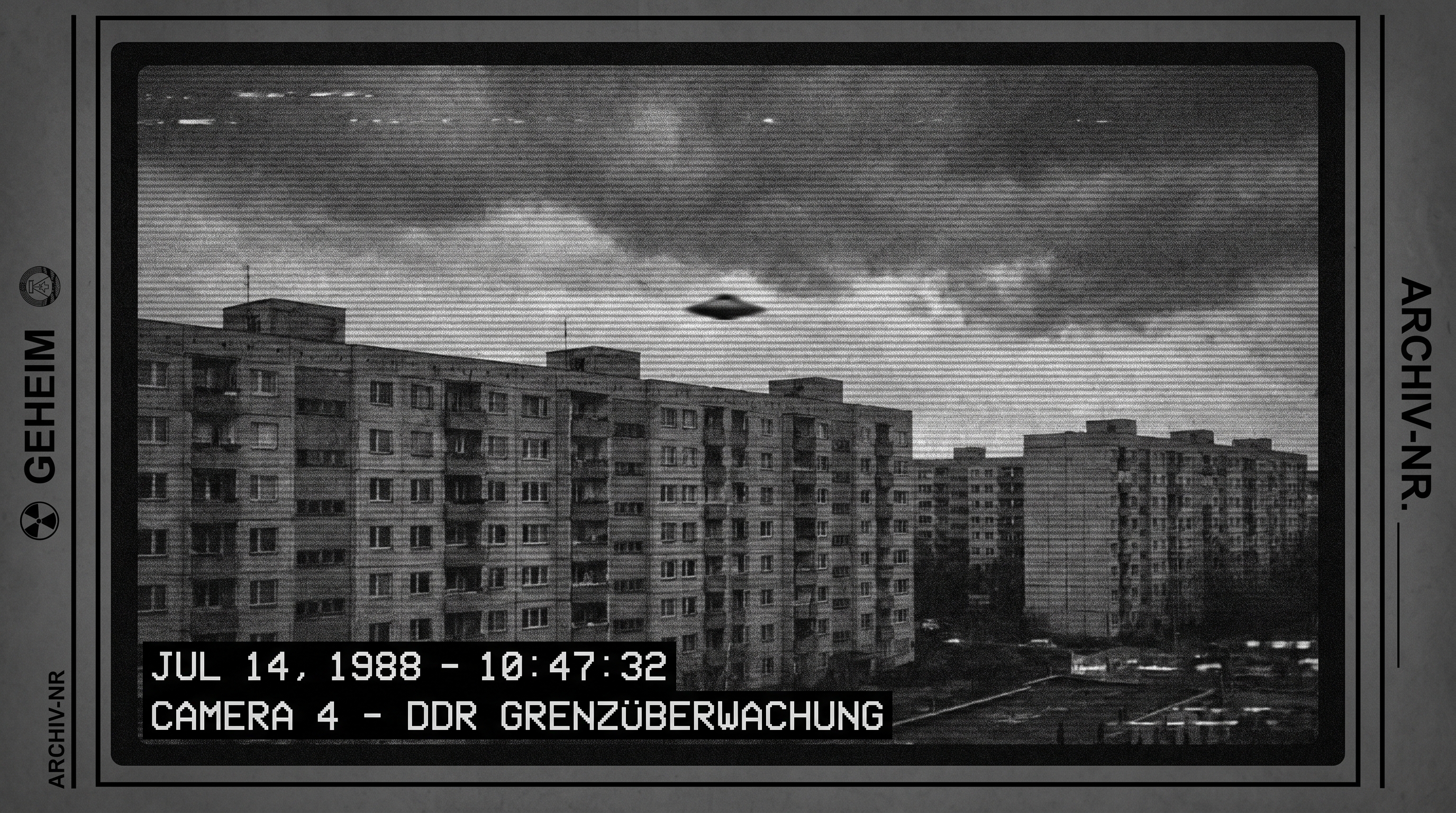
The East German security state officially did not believe in UFOs. Its internal paperwork tells a more interesting story.
In at least three documented cases between 1985 and 1988, the Ministry for State Security — the Stasi — opened and worked a UFO file. The cases do not add up to a cover-up or a secret program. They add up to something more mundane and more useful: a record of how a state treats reports it has decided, in advance, not to take at face value.
The first systematic reading of those files is the 2021 book Deutschlands UFO-Akten: Über den politischen Umgang mit dem UFO-Phänomen in Deutschland, by the German anomaly researcher Andreas Müller. Müller is not an academic historian; he runs grenzwissenschaft-aktuell.de, Germany's longest-running UAP news portal, and has been documenting German UFO case files since the 1990s. The book is the window; the archive behind it is the BStU — the federal commissioner for Stasi records — whose holdings have been accessible to researchers and citizens since 1992 and are now administered by the Bundesarchiv.
Müller is the researcher who brought the three cases below into public view. The files themselves have been public record for three decades.
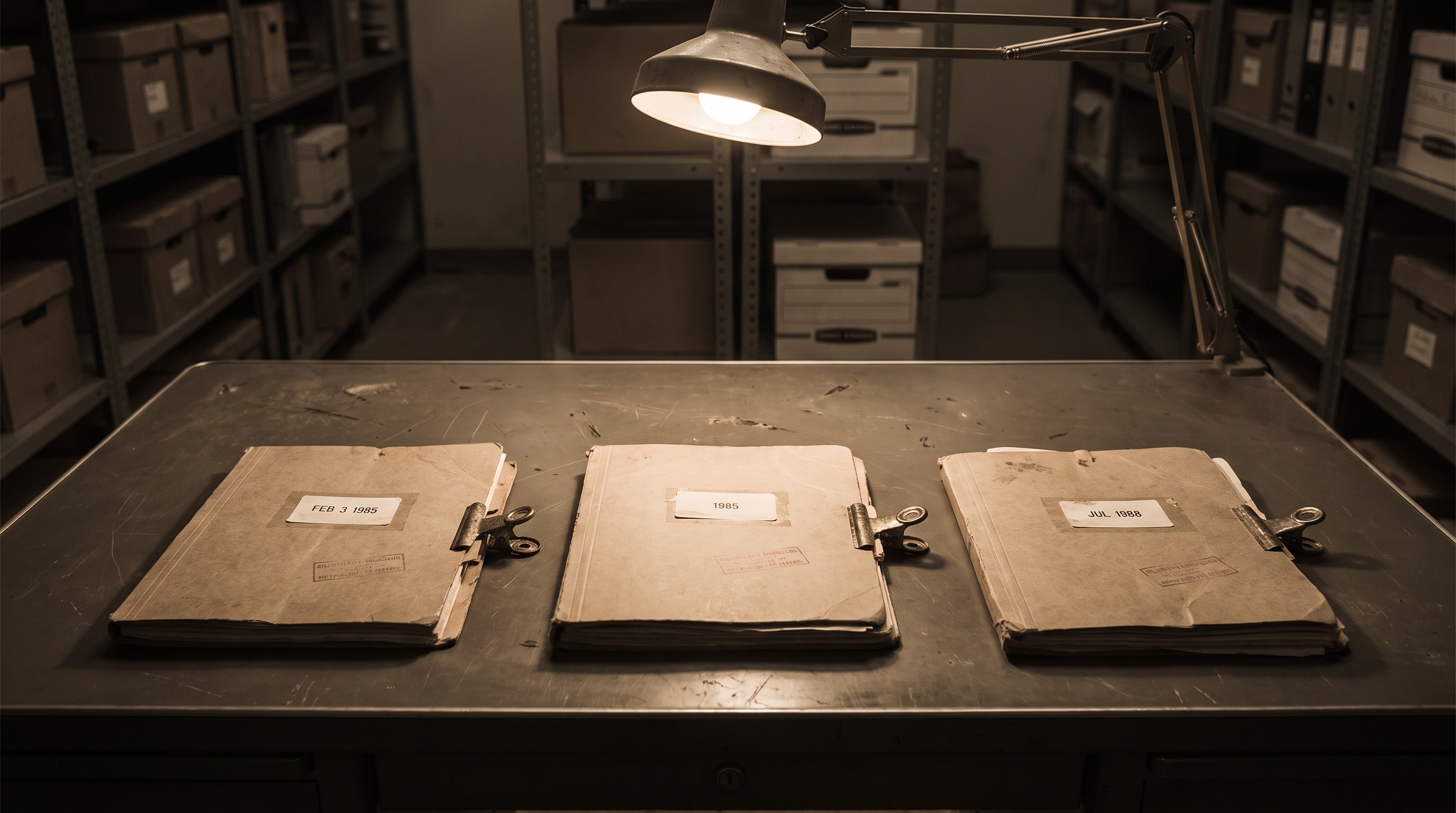
The three cases
Halle, February 3, 1985
The strongest case in the file is also the most ordinary. Between 11:40 p.m. and midnight on a winter night in Halle an der Saale, five Volkspolizei employees independently reported unusual objects in the sky from four different places in the city. Not one witness, not one window. Five police employees. Four locations.
One witness said the object had burst. The Stasi sent personnel to the Halle-Wörmlitz area to search for debris. The MfS also contacted experts at Martin Luther University Halle-Wittenberg. The investigation produced no object. Two days later, West German press reports pointed to an ordinary sky explanation: one or two identifiable meteorites moving south to north shortly before midnight.
The case resolves toward a meteor. The DDR response does not. Witnesses inside the police, a debris search, a university consultation, no recovered object. A late-winter night report entered the security apparatus, brushed against astronomy, and came back smaller.
Schmiedeberg, Erzgebirge, 1985
Schmiedeberg sits in the Ore Mountains on the Saxon side of the inner-German border. In 1985, multiple witnesses observed what was later filed in the security record as a "silent, oval-pulsating object" — described in the file as a "nicht zuordenbare optische Erscheinung," an unassignable optical phenomenon. Neither the National People's Army, the weather service, nor the Stasi could explain it.
The case has the thinnest public paper trail of the three. What is known comes mostly from the file title and the institutional fact that it was opened at all. A reconstruction later appeared in a YouTube documentary, "UFO in Sachsen 1985 — Die vergessene DDR-Akte," which traced what could be reconstructed from BStU-housed material. The story is mostly absence: a file that exists, a phenomenon that did not resolve.
Neuenhof bei Eisenach, July 1988
Neuenhof is a village in Thuringia, west of the former inner-German border. On a night in early July 1988, several citizens reported a large ball- or balloon-shaped object and multiple smaller lights in the sky. The Stasi's Kreisdienststelle Eisenach — the local county office — took over the investigation, questioned the witnesses, and ran a field examination.
The case is the one that shows the Stasi's institutional instincts in plain view. The first working hypothesis was not "extraterrestrial." It was Republikflucht per balloon — an escape attempt. East Germany had a recent memory of exactly this. In September 1979, two families had crossed the border in a homemade hot-air balloon in one of the most famous escapes of the late GDR. A balloon in the Thuringian sky in 1988, for a local Stasi office, was not a UFO problem first. It was a border problem first.
The Republikflucht theory did not hold. Witnesses described the object as rising slowly with a slight serpentine motion; the field check found no balloon, no payload, no launch site. The Stasi then closed the file on a more ordinary candidate. Astronomically checked, the night held a bright, late full moon — or a moon just past full — and the sight line fit. The official explanation became the moon. The principal witness disagreed. The investigation was filed.
Müller, who found the Neuenhof file in the BStU archive, told Bild in March 2024 that he considered the moon explanation implausible — "It would be quite odd if adults in the countryside, who had presumably seen the full moon countless times, didn't recognize it as such. That sounds rather unlikely." He used the publicity to call for additional witnesses.
What the Stasi actually did with these files
The pattern across the three cases is not a UFO investigation in the sense Western readers expect. The Stasi did not collect witness testimony as evidence of something unknown. It collected witness testimony as evidence of something the state already had a frame for: airspace, borders, military installations, public order, possible foreign object or activity, possible Republikflucht.
That is the institutional fact underneath Müller's book. UFO sightings in the GDR did not enter a separate UFO program because there was no UFO program. They entered the Stasi's general-purpose reporting apparatus, the same one that handled balloon sightings from West Germany, propaganda drops, and stray aircraft. The cases became files because the state had an institutional reason to write them down — not because the state had an institutional reason to investigate them as phenomena.
This is also why the public posture and the file posture diverge. East German press treated UFO reports from Western countries as a curiosity, sometimes with an ironic edge, and within the framework of ideological suspicion — the sighting as evidence of an "antisocialist worldview." That public posture was not the operational posture. The operational posture treated a cluster of police reports as a state problem to be managed, not as a metaphysical question to be debated.
What Müller's book proves and what it doesn't
Müller's 2021 volume is the first systematic attempt to read the BStU UFO material in the wider German context — including Austria and Switzerland — and to make it public. It traces how German ministries and intelligence services, across decades and across both states, recorded aerial reports. The book is useful. It also has limits that matter for any reader using it as primary evidence.
- The book documents the existence of files. It does not document the existence of objects. The reports Müller cites are witness statements and the institutional responses to them; the underlying phenomena remain what the witnesses described them to be.
- The Halle case resolves toward a meteor in the West German press and the DDR file does not surface a competing physical trace. The likely explanation is ordinary, even if the official resolution did not satisfy the witnesses.
- The Schmiedeberg case is the weakest on the public record. The file title is documented; the underlying incident is reconstructed mostly by a later documentary. A reader treating it as a resolved case is reading past the evidence.
- The Neuenhof case is the cleanest institutional story. Müller's reconstruction shows the Stasi moving from Republikflucht suspicion to a moon explanation, with one witness still disagreeing. The case is also the one where Müller himself disagrees with the official resolution.
The book is at its strongest as a study of how an ideological state treated reports it officially did not believe in. It is weaker as evidence that the reports were correct.
East Germany, West Germany, and the UFO scene
The contrast with the West is part of why the DDR file is interesting.
In West Germany, UFO research was carried by private and semi-private organizations — CENAP, the GEP, the Deutsche UFO/IFO Forschungs-Gemeinschaft, and a small number of regional groups. There was no equivalent of Project Blue Book, but there was a civilian research network, an active literature, and an argument between skeptics and witnesses that ran through magazines and conferences.
None of that existed in any public form in the GDR. The institutional channel for an unusual aerial report was not a civilian research network but the security organs. There was nowhere else for a serious report to go. That makes the DDR file trail look unusually dense for the size of the country, and it makes the cases it contains look unusually thin in the way they were resolved — because the institution that held them was not built to investigate phenomena. It was built to manage risk.
What stays
Three DDR UFO files now sit inside Müller's reconstruction of the Bundesbeauftragter archive. Each one tells the same story in a different shape: the Stasi taking the report seriously enough to write it down, taking it seriously enough to investigate, and taking the explanation back out of the file once the institutional reason for the report had passed.
The file on Halle is the most concrete. The file on Schmiedeberg is the most silent. The file on Neuenhof is the one where a witness's disagreement with the moon still sits inside the institutional record.
None of these is a cover-up disclosure. None of them is proof of anything in the sky. They are three records of how an ideological state treated reports it had decided, in advance, not to take at face value. The pattern is the story. The objects were the Stasi's problem for a few months and then they were not.
Sources
- Andreas Müller, Deutschlands UFO-Akten: Über den politischen Umgang mit dem UFO-Phänomen in Deutschland — mit Betrachtungen auch zu Österreich und der Schweiz, Books on Demand, 16 November 2021, 452 pp.
- MDR Geschichte, "UFO-Sichtungen in der DDR" — Halle 1985, Thuringia cases, and the wider DDR UFO record.
- Saarbrücker Zeitung, "Was einen Saarbrücker Forscher an Ufos fasziniert," 3 December 2021 (Müller profile piece).
- Andreas Müller / grenzwissenschaft-aktuell.de, "UFO-Sichtung 1988 in Neuenhof, Thüringen: Zeitzeugen gesucht!" — primary write-up of the Neuenhof case and the call for additional witnesses.
- Bild, "Vor 38 Jahren in Thüringen gesichtet: Die Stasi-Akte über das DDR-Ufo," 11 March 2024.
- YouTube, "UFO in Sachsen 1985 — Die vergessene DDR-Akte" — reconstruction of the Schmiedeberg file.
- Andreas Müller, Wikipedia entry (German), confirmed biography.
- Bundesbeauftragter für die Stasi-Unterlagen (BStU) / Bundesarchiv, archive reference for the underlying files.
- East Germany balloon escape (1979), Wikipedia — context for the Republikflucht working hypothesis in the Neuenhof case.