
News / Jun 28, 2026
The East German flying saucer reached the CIA as a clipping
A refugee from East Germany said he and his daughter saw a landed object near Haselbach. The CIA kept the story as unevaluated foreign-document information.
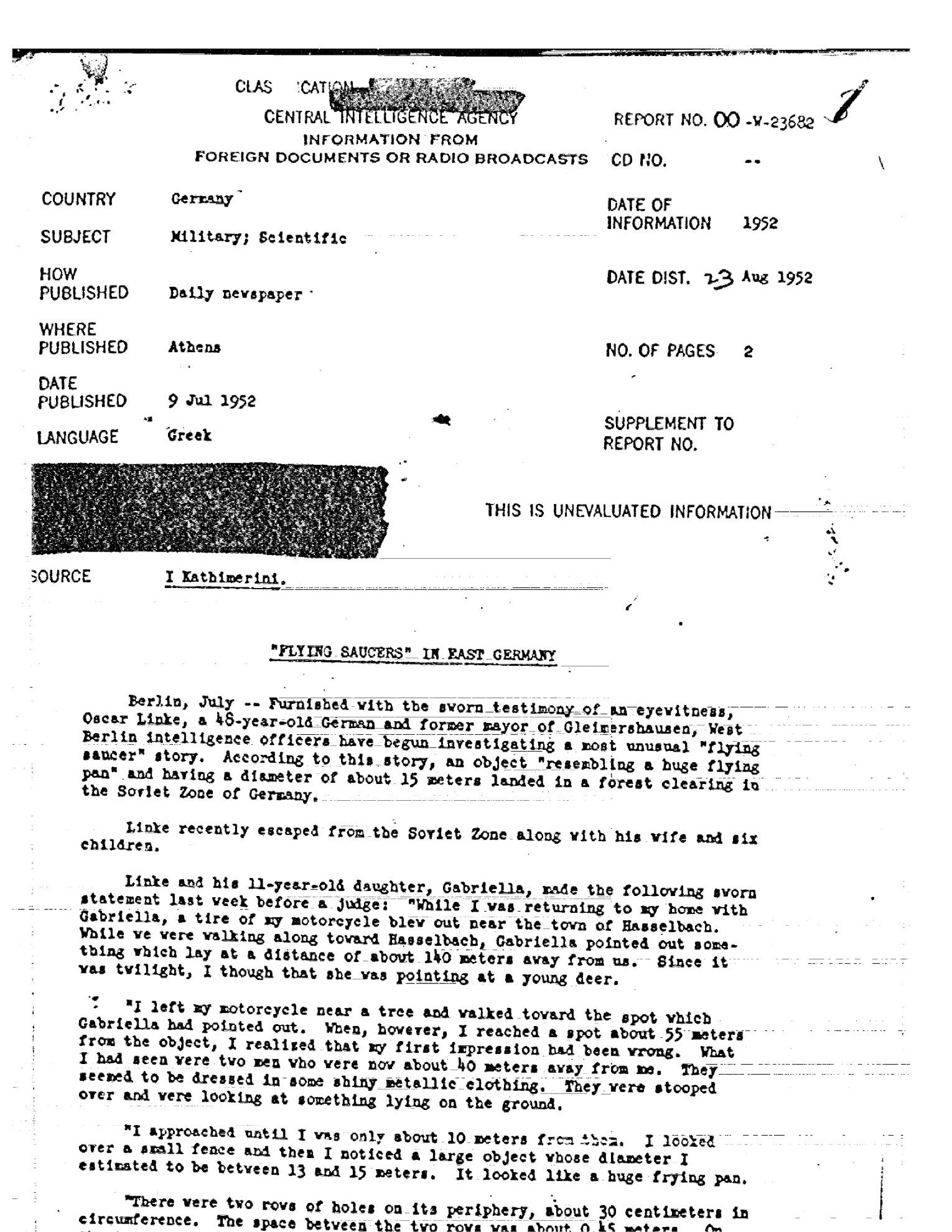
The CIA page does not begin with a spacecraft. It begins with a form.
Country: Germany. Subject: military; scientific. How published: daily newspaper. Where published: Athens. Date published: July 9, 1952. Language: Greek. Source: I Kathimerini. Report number: 00-W-23682.
Then the title appears in capital letters: "Flying Saucers" in East Germany.
The page is the kind of object that makes historical UFO stories difficult to sort. It is official and second-hand at the same time. The CIA kept it. The form is real. The text below it says the information was unevaluated. The story itself came through a newspaper chain, built around a refugee's sworn statement after he had left the Soviet Zone.
That refugee was Oskar Linke.
The claim near Haselbach
According to the report, Linke was a 48-year-old former mayor of Gleimershausen who had recently escaped from the Soviet Zone with his wife and six children. He said the sighting happened on June 17, 1950, while he was returning home with his 11-year-old daughter, Gabriele. A motorcycle tire had blown out near Haselbach. They were walking when Gabriele pointed toward something at a distance.
Linke first thought she was pointing at a young deer.
The story then turns into the kind of scene that keeps an old case alive. Linke said he approached and saw two men in shiny metallic-looking clothing standing near something on the ground. He described a large object with an estimated diameter of 13 to 15 meters. It looked to him like a huge frying pan. The MDR's later historical summary describes the same object as shiny, roughly 15 meters across and 2.5 meters high, with a form compared to a hot-water bottle.
The details matter less because they prove anything than because they show why the file traveled. It has a named witness, a named child witness, a specific village area, a claimed landing, figures in metallic suits, and an object shape that fits the early 1950s flying-saucer vocabulary almost too well.
It also has the Cold War built into the route.
A Soviet Zone story moves west
The report says West Berlin intelligence officers had begun investigating the story after receiving Linke's sworn testimony. That is the first context to keep on the table. This was not only a UFO story. It was an East-West story.
In 1952, a strange aerial object reported from the Soviet Zone did not arrive in the West as folklore alone. It could be read as aircraft, secret weapons, Soviet technology, psychological rumor, refugee testimony, or a press item worth filing. The CIA form used the category "military; scientific." It did not use the language of wonder.
The agency's own top line is blunt: information from foreign documents or radio broadcasts. The report did not say the CIA had interviewed Linke. It did not say the agency had confirmed a landed craft near Haselbach. It preserved a translated foreign press item that itself rested on a sworn account.
It shows how the early saucer panic did not respect national borders. A story told by an East German refugee could move into a Greek newspaper, then into a CIA reporting form, then into the wider American UFO archive. By the time modern readers meet it, the story often feels like one clean case. The file shows a chain.
The DDR problem
The German side makes the case stranger.
MDR's history desk notes that the DDR did not develop an official public UFO culture in the way the United States did. UFOs were often treated ideologically as irrational Western phenomena, a kind of technical religion from the capitalist world. At the same time, East German security and military files did contain individual reports of unusual objects when they touched airspace, border security, or state institutions.
That makes the Linke case sit outside the normal DDR frame. It is not a Stasi UFO investigation. It is a refugee story from the Soviet Zone that becomes visible through Western intelligence paperwork. East Germany is the scene, not the filing institution.
MDR also notes that Linke reportedly said he had not heard the phrase "flying saucer" until he reached West Germany. By 1952, the phrase was already global. Films, newspapers, and postwar military anxiety had given people a language for odd aerial events. That does not make Linke's story false. It does mean the vocabulary reached the case after the event, through the world that filed it.
The edge of the file
The first page of the CIA report is doing two opposite things at once. It gives the story institutional durability. It also limits what can be claimed from it.
The file has a number. It has a source. It has a distribution date. It has a newspaper origin. It has the caution line: unevaluated information. That line is not decoration. It is the boundary of the case.
Linke's account is specific. It is memorable. It is unproven.
The object is not only the claimed saucer near Haselbach. The object is the route by which a village-edge story from the Soviet Zone became a CIA document with a title too sharp to ignore.
The file is real. The object remains Linke's statement.
Related notes
- The 1561 Nuremberg sky battle became a UFO file
- The 1665 Stralsund air battle stayed in the UFO archive
- The CIA UFO archive does not start where people think
- The December 1947 flying-disc memo