News / Jun 08, 2026
The 1665 Stralsund air battle was a sermon in the shape of a plate
The 1665 Stralsund air battle is one of the oldest documented UFO cases: six fishermen, a sky full of warships, and a round plate hovering over a church.
On April 8, 1665, at about 2:00 PM, six herring fishermen were working the Baltic near Stralsund, then Swedish Pomerania. What happened next is either one of the oldest documented UFO cases in European history, or a very good story about how fear travels faster than facts.
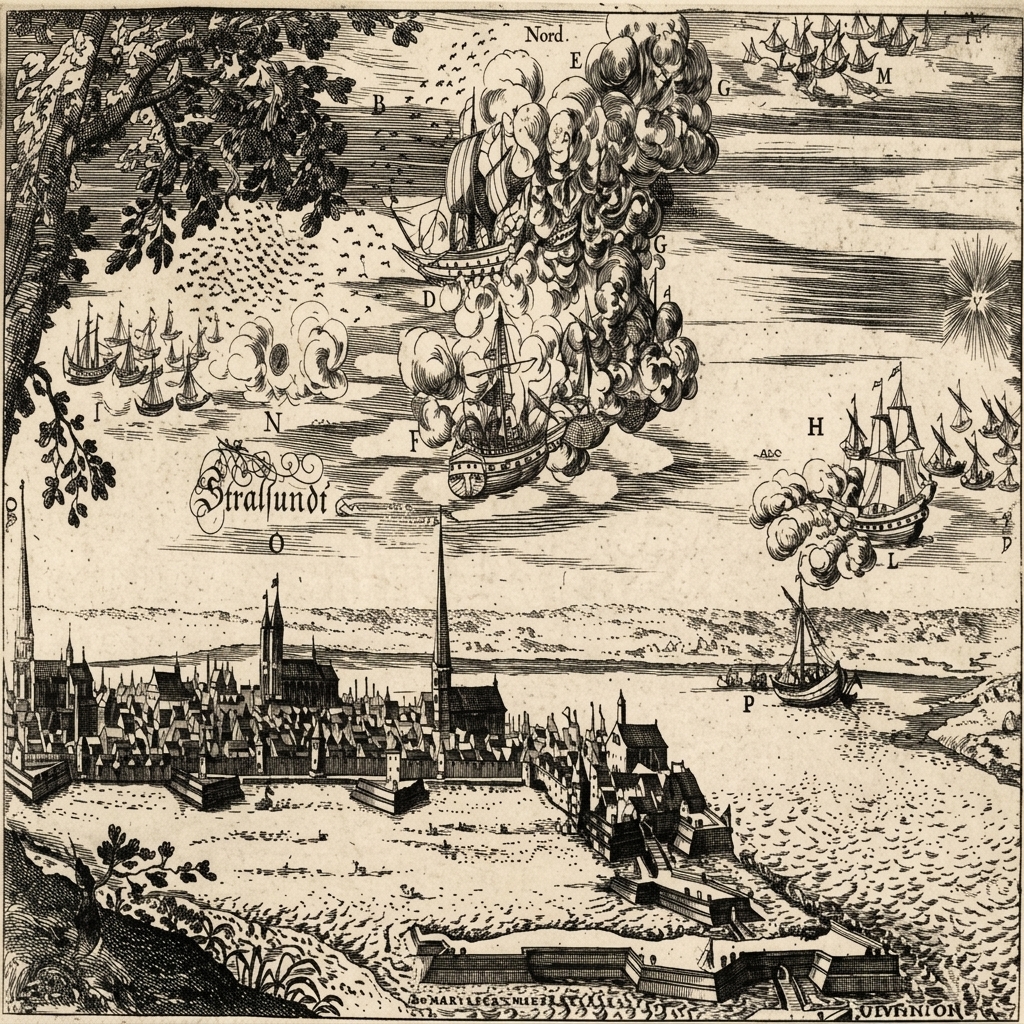
The fishermen described flocks of birds that became warships. The warships fought. There was noise, simulated smoke, the whole theater. Then, as dusk came in, the ships disappeared and something else took their place: a flat, round object — described variously as a plate or a man's hat — hovering over the spire of St. Nicholas Church until evening.
They fled. The next morning, they reported trembling limbs and joint pain. Whether that was shock, illness, or something else, nobody recorded.
The Printers Take the Sky
The fishermen didn't write any of this down. The printers of Northern Europe did.
Broadsheets started circulating within weeks. In 1680, fifteen years after the fact, Erasmus Francisci compiled the most detailed version in Der wunder-reiche Überzug unserer Nider-Welt — complete with a now-famous engraving of the plate hanging over the Stralsund skyline. The Berlin Kunstbibliothek thought the media angle interesting enough to mount a dedicated exhibition around it: UFO 1665: The Air Battle of Stralsund.
Like the 1561 Nuremberg sky battle, this one survived because it was commercially useful. Woodcuts were news, warning, and entertainment simultaneously. The moral framing — repent, God is watching — was in the copy before the ink dried.
A Blackboard of War
The Second Anglo-Dutch War had just begun. Real naval battles were happening on the North Sea. Plague was a background hum. When the fishermen said "ships in the sky," they were speaking the vocabulary of everything they were already afraid of.
Nobody in 1665 was thinking alien spacecraft. The Baroque sky wasn't empty space — it was where God left messages. The broadsheets interpreted accordingly.
The Silence in the City
There is a basic gap in the Stralsund record: the city itself stayed quiet.
St. Nicholas is not a remote outpost; it stands in the middle of Stralsund. If a dark, disk-shaped object hovered over the spire for hours in the afternoon light, it would have been visible to thousands of residents, merchants, and soldiers. Yet, no municipal diaries, letters, or official records from the city's elite mention the event on April 8.
The story relies entirely on the account of the six fishermen. It is a reminder of how early UAP reports functioned—not as widely corroborated observations, but as single-source testimonies that grew in detail once they hit the printing presses of neighboring towns.
What It Probably Was
A few natural candidates:
Fata Morgana — cold Baltic air bends light, projects distant ships above the horizon, makes them hover and stack. It's the most cited explanation and it fits most of the visual description.
Starling murmurations — dense flocks that shift like smoke or waves. Less convincing for the plate shape, but plausible for the "warships" phase.
Parhelia — ice crystal halos near dusk can produce flat, glowing discs. Worth considering for the plate specifically.
None of these explain the physical symptoms the next day. That gap is either psychosomatic stress, a coincidental illness, or the part of the story nobody can close.
Where It Sits Now
The Stralsund case keeps appearing in historical international UAP timelines because the core description is unusually plain: a flat circular object, stationary, over a fixed landmark, multiple witnesses, documented within living memory of the event. Strip the Baroque framing and what's left is a shape and a location.
The plate is described. The engraving exists. The fishermen stopped trembling eventually, or didn't, and nobody wrote that part down either.
A Note on the Visual Record
The engraving shown above is a digital restoration of the original 1680 copperplate print. The original files available in public library scans are low-resolution and heavily compressed. For this article, we cleaned and upscaled the lines of the 1680 print to ensure the details of the city walls and the sky formations are visible on modern screens. No elements have been added, moved, or altered; the composition remains identical to Francisci's published work.
Sources
- Staatliche Museen zu Berlin: UFO 1665: The Air Battle of Stralsund, Kunstbibliothek exhibition notes.
- Erasmus Francisci, Der wunder-reiche Überzug unserer Nider-Welt, Nuremberg, 1680.
- UAP Logbook: The 1561 Nuremberg sky battle woodcut.
- UAP Logbook: What other countries are doing about UAPs.