News / May 21, 2026
Spielberg's Disclosure Day enters the UFO files moment
Steven Spielberg's Disclosure Day now has a final trailer, early reactions, and a June 12 release date. It also lands in the middle of a real UFO files search wave.
Updated May 30, 2026.
Steven Spielberg's UFO movie Disclosure Day is no longer just a trailer curiosity sitting next to the UAP conversation.
It now has a final-trailer push, early reactions, a June 12 release date, and a title that is landing inside the same search weather as UFO files, PURSUE, aliens.gov, and government disclosure.
That does not turn the movie into evidence. It does make it a useful pressure gauge.
Why it is moving now
Amblin lists Disclosure Day as opening on June 12, 2026, with Steven Spielberg directing from a David Koepp screenplay and a cast led by Emily Blunt, Josh O'Connor, Colman Domingo, Eve Hewson, and Colin Firth.
The official marketing is not shy about the promise. The trailers circle secrets in the sky, truth withheld, and the moment when the public finally gets told.
That would be searchable in any year. In late May 2026 it hits harder, because people are also searching for newly released UFO files, the Department of War's PURSUE portal, AARO material, and anything that sounds like government disclosure with a date attached.
The movie gives that appetite a clean phrase: Disclosure Day.
The movie shape
Public descriptions frame Disclosure Day as a UFO or alien story. Space.com noted Universal's official logline around the question of what would happen if someone showed the public proof that we are not alone.
GamesRadar reported that early reactions are already loud, with viewers calling the film unusually strange for Spielberg and praising Emily Blunt's performance.
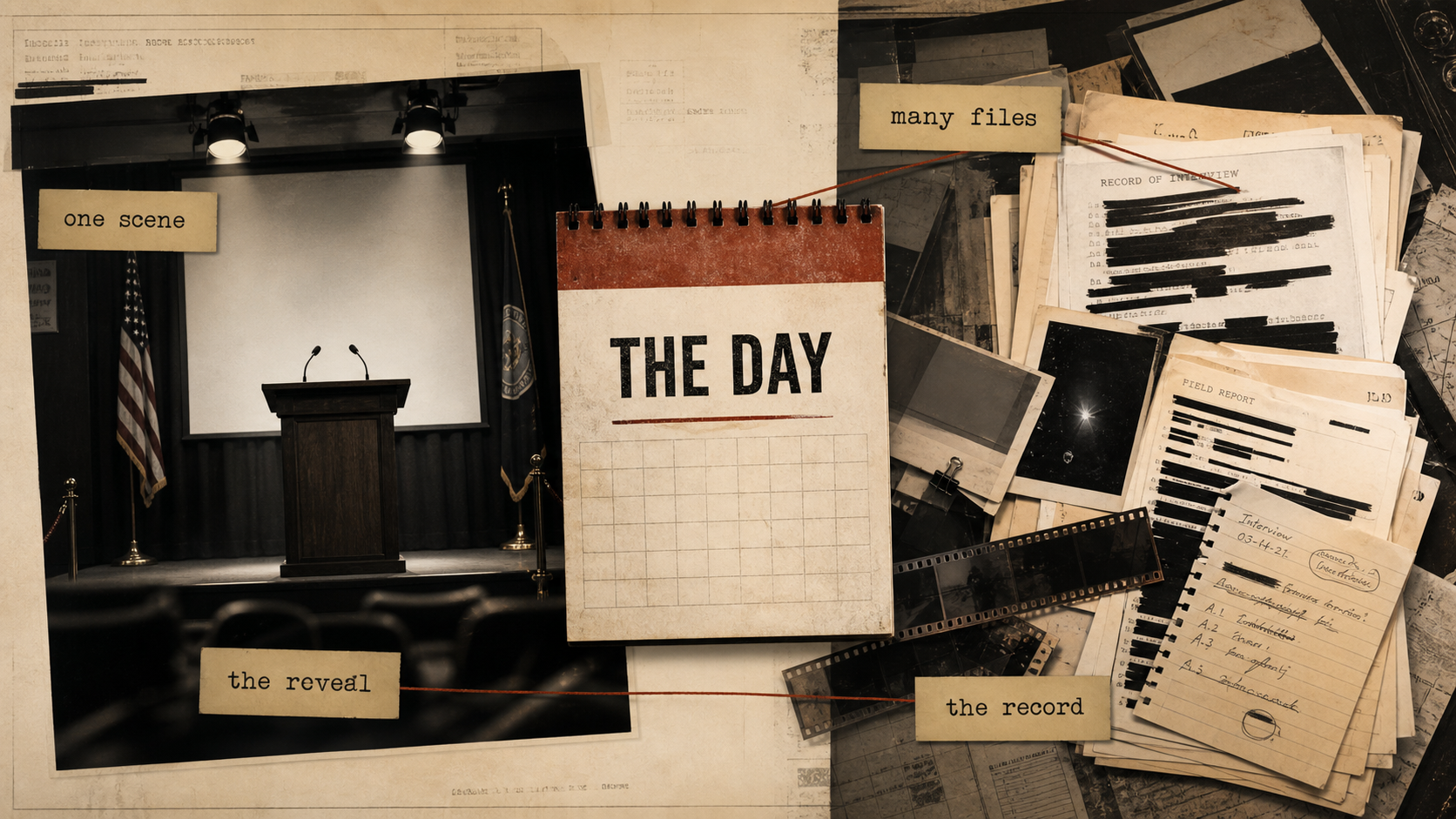
That hype matters less than the shape of the premise. The imagined disclosure day usually has a clean rhythm:
- someone in authority steps to a podium;
- the denial period ends;
- the public gets a date, a statement, and a visible piece of proof;
- the old rumors suddenly become a history lesson;
- the world reacts in one recognizable moment.
That is why the title travels. It gives the mess a calendar date.
The file version
Real UAP records are slow, partial, and frustrating.
They arrive as PDFs, redactions, short clips, inconsistent file names, missing metadata, witness summaries, and agency language that refuses to do narrative work.
PURSUE Release 01 appeared on May 8. Release 02 appeared on May 22. The live trail is file labels, DVIDS pages, old scans, agency wording, and arguments over what a title can carry.
A movie can do in two hours what a records process cannot do cleanly at all: pick a scene, pick a face, pick a moment, and let the audience feel the reveal arrive.
What people are really searching for
The overlap is the story.
Some readers are searching for Disclosure Day because they want the Spielberg movie: release date, trailer, cast, early reactions.
Some are searching because the title sounds like a real-world UFO event.
And some are already tying it to the current release environment: UFO files, UAP records, PURSUE, AARO, June 9, and the idea that a government reveal might finally arrive with a name attached.
That is where fiction and records start rubbing against each other.
The slower version
If there is a real disclosure process, it probably looks less like one cinematic day and more like:
- one release that is too thin;
- one official saying more is coming;
- one committee asking for files;
- one agency saying classification review takes time;
- one video without enough context;
- one witness giving a sharper claim than the documents can support;
- one public argument about whether any of it counts.
Not one trumpet blast. More like paperwork with bad lighting.
Why UAP Logbook is logging it
Disclosure Day is not a file release, witness statement, sensor record, or government admission.
It is a very large UFO movie arriving while people are actively looking for UFO files.
That is enough to log. The film can shape the expectation around disclosure even if it says nothing about the records themselves.
Sources
- Down To Earth With Kristian Harloff: Spielberg and Disclosure Day
- Universal Pictures Canada: Disclosure Day
- Amblin: Disclosure Day
- GamesRadar: early reactions to Disclosure Day
- Space.com: Disclosure Day release date, plot, cast, and trailers
- The Atlantic: the government-conspiracy frame around Spielberg's UFO movie
- GamesRadar: David Koepp addresses online rumors about Disclosure Day
- Reuters/CinemaCon syndication: Spielberg discusses Disclosure Day