
Short Note / Jul 03, 2026
French National Assembly UAP Colloquium: The French method on display
On June 29, 2026, the French National Assembly hosted its first UAP colloquium, focusing on scientific methods, GEIPAN's public case data, and military reporting protocols.
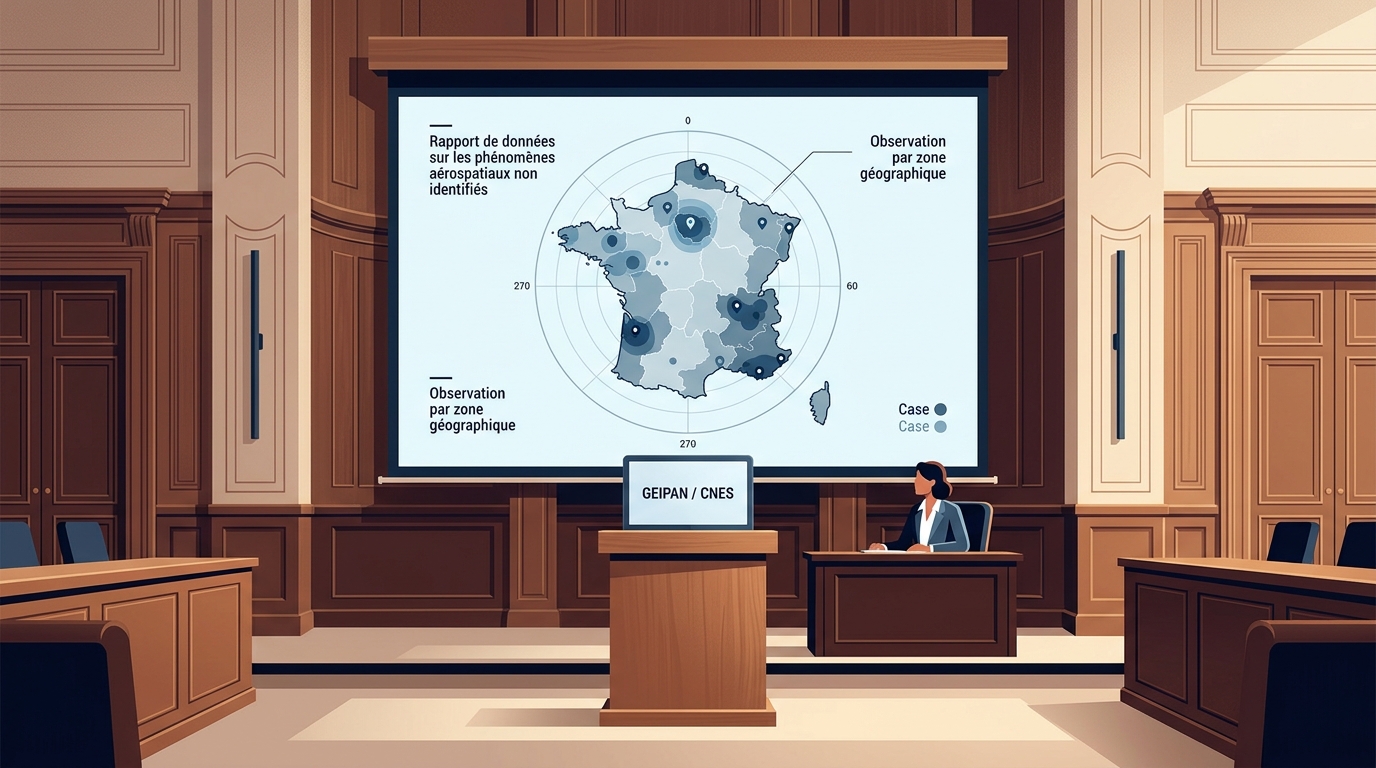
The French National Assembly hosted its first-ever parliamentary colloquium on Unidentified Aerospace Phenomena on June 29, 2026, in the Salle Victor-Hugo — and it drew a crowd. All 250 seats were filled, and co-organizer Pierre Henriet later called it "probably the first time a colloquium has attracted this much interest". The four-hour event, titled "La recherche sur les phénomènes aérospatiaux non identifiés (PAN) au-delà des fantasmes," brought scientists, military officials, and legislators together around one goal: a sober framework for studying aerial anomalies. It was livestreamed on LCP, the National Assembly's own channel.
An Unlikely Political Pairing
Arnaud Saint-Martin, a deputy from the far-left France Insoumise and a member of the Defense Committee, co-organized the event with Pierre Henriet of the centrist Horizons party. Both sit on OPECST, the Parliamentary Office for Scientific and Technological Assessment, but their political distance is exactly what made French outlets note the pairing as "a surprising political UFO" (objet politique non identifié). Henriet's party is also positioning for the 2027 presidential race, adding a layer of political timing to the story.
Why Now
The colloquium landed just weeks after the Pentagon released a new batch of declassified UAP documents in late May 2026 — a timing overlap French press treated as a direct point of contrast rather than coincidence. No whistleblowers, no leaked footage. Just archives, spreadsheets, and satellite logs.
The French Method vs. the U.S. Model
The American approach leans on legislative pressure, whistleblowers, and the Pentagon's AARO office. France has run something different since 1977: a permanent civil study agency, GEIPAN, housed inside the space agency CNES. Director Frédéric Courtade laid out the numbers — about 97 percent of reports resolve to satellites, weather, or aircraft, and a small residual, Category D, stays unexplained. Over the past decade, better digital tracking has held that rate steady at 2 to 3 percent.
UAPs in the Academic Frame
Sociologist Pierre Lagrange, joined by fellow researchers Jérôme Lamy and Dominique Pinsolle, argued the topic has been pushed out of mainstream academia and into folklore for decades. His pitch: let curiosity, not classification, drive the research. Representatives from the 3AF's Sigma2 commission — the aerospace engineering association's technical case-review body — presented their own data analysis on unresolved sightings.
Sylvain Maisonneuve, a crisis-management expert and author of "Ovnis, l'enquête déclassifiée" (Albin Michel), addressed how public authorities handle anomalous reports. His argument: transparent, state-backed research keeps conspiracy theories from filling the vacuum.
Military Airspace Protocols
French Air and Space Force representatives outlined how sightings move through the system. Unlike U.S. pilots, who have historically faced stigma reporting UAPs, French gendarmerie and civil aviation authorities funnel both civilian and military reports directly to GEIPAN. The panel described how airspace surveillance interfaces with that civil pipeline without compromising security protocols.
Organizers were careful to frame this as institutional recognition, not disclosure — the emphasis stayed on data-sharing and methodology. Recordings of Saint-Martin's introduction and the roundtables are going up on the organizers' channels, including Saint-Martin's YouTube.
Related UAP Logbook notes
- France has had a UFO office since 1977
- French National Assembly schedules UAP colloquium for June 29
- What other countries are doing about UAPs
Sources
- Arnaud Saint-Martin (YouTube Channel): Colloque PAN à l'Assemblée nationale: Allocution d'ouverture et tables rondes, published July 2026.
- Civiqo: Assemblée nationale : des députés et des experts se penchent sur le phénomène des ovnis, June 29, 2026.
- LCP (La Chaîne Parlementaire): Les Ovnis s'invitent à l'Assemblée le temps d'un colloque inédit, accessed July 3, 2026.
- CNES / GEIPAN: Mission, statistics, and case categories, accessed July 3, 2026.