News / May 20, 2026
What other countries are doing about UAPs
Outside the United States, UAP work is less cinematic and more scattered: reporting forms, aviation safety channels, public archives, FOI logs, and a few small official offices.
Updated 2026-07-03. This article was first published in May 2026 with eleven country sections. Since then, UAP Logbook has added dedicated reporting on Japan's parliamentary track, France's National Assembly UAP colloquium, the Stasi's UFO files, Oskar Linke's East German landing story that reached the CIA, China's 1998 Cangzhou intercept, and CIA foreign-file notes from Nepal and Zimbabwe. A new "Recent UAP Logbook international follow-ups" section at the bottom of this article points to the specific notes.
The U.S. dominates most public UAP coverage, but it is not the only place where governments, aviation authorities, or public agencies have touched the subject.
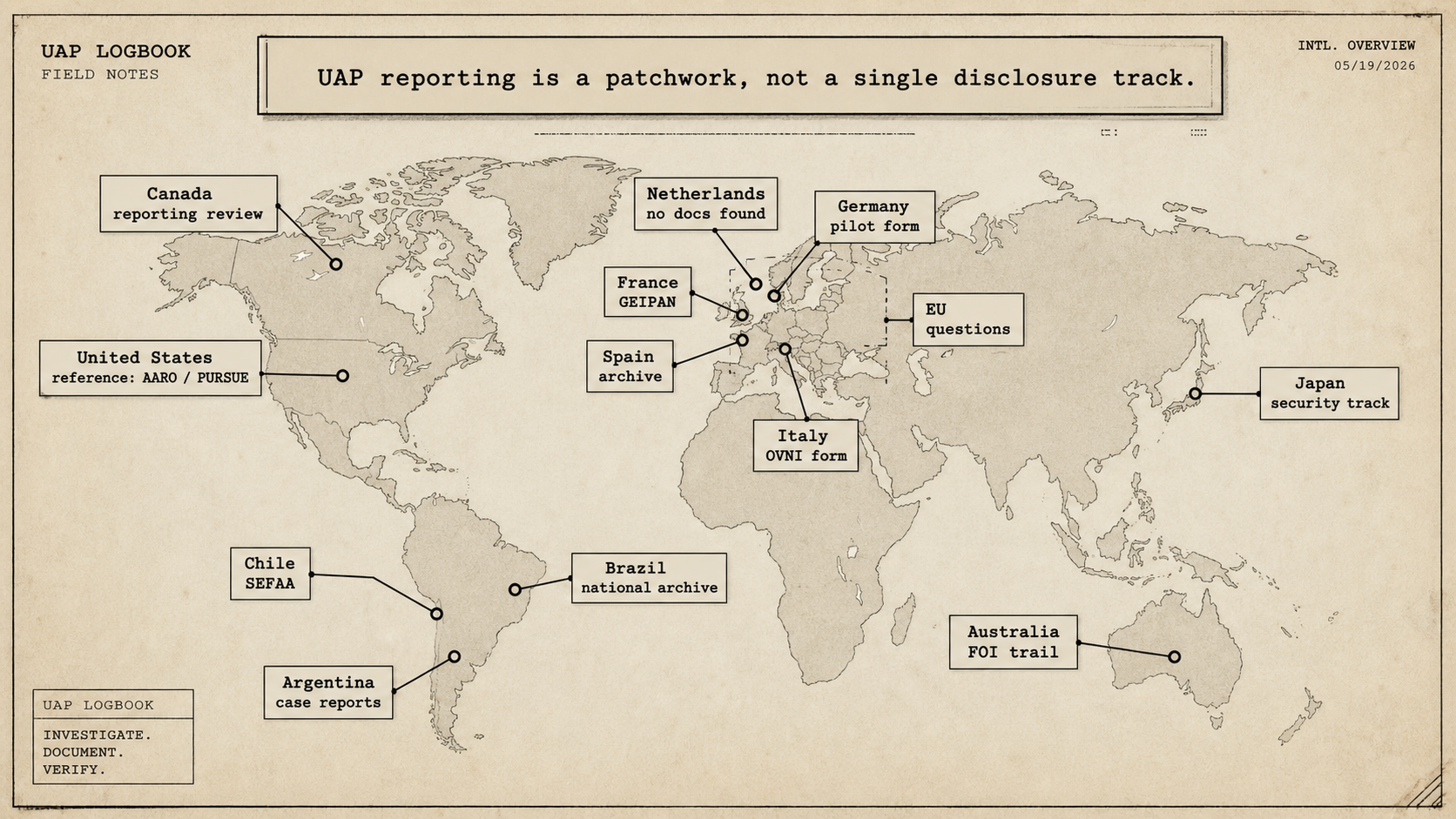
Outside the United States, the pattern is quieter. There are reporting forms, old archives, freedom-of-information releases, aviation safety channels, and a few official anomaly offices. There is much less evidence of a single global "disclosure" track.
That makes the international picture useful precisely because it is uneven.
Some countries built formal reporting systems. Some hold old UFO files in public archives. Some treat the subject as an aviation-safety or public-records issue. Some say they searched and found nothing. The interesting part is not that everyone is secretly doing the same thing. The interesting part is that they are not.
The short version
Several countries have public UAP or UFO-related records, but they do not all mean the same thing.
- Canada has a government science-advisor report about how UAP reports should be managed.
- France and Chile have long-running official anomaly-reporting bodies.
- Italy still has an official OVNI reporting form through the Air Force and Carabinieri.
- Argentina publishes annual case-resolution material through its aerospace-identification center.
- Spain has a digitized archive of declassified UFO files.
- Australia has a FOI trail through Defence, ATSB, and air-traffic material.
- Germany has a practical pilot-reporting route through the University of Wuerzburg and the Luftfahrt-Bundesamt.
- Brazil has an archive-and-transfer story involving Aeronautics and the National Archive.
- The Netherlands has a clean negative record: a Woo request found no UAP documents.
- The EU has parliamentary questions, but no central UAP office.
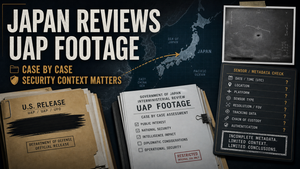
- Japan now has a cross-party parliamentary group asking for a Cabinet Secretariat reporting desk, a case-by-case disclosure answer from Defence Minister Kihara, and a Ministry-led review of U.S. UAP footage released under PURSUE.
- East Germany left a documented Stasi UFO file trail, and a 1950 East German refugee story reached the CIA as a newspaper clipping.
- China's public record is thinner, but a 1998 Cangzhou military intercept of a "short-legged mushroom" object is documented in Chinese sources and a 2025 China-Russia reverse-engineering claim has been picked up from a single leaked-sounding line.
This is not one story. It is a map of different bureaucracies touching the same uncomfortable category: things seen in the sky that were not immediately identified.
Canada: reporting system, not disclosure
Canada is the cleanest example of a modern public-policy approach.
The Sky Canada Project, led by the Office of the Chief Science Advisor of Canada, produced a June 2025 report on the management of public UAP reporting. The report is not an investigation into specific sightings. It says the project was about current resources and processes for handling UAP reports, not about deciding what UAPs are.
That distinction matters.
The report says Canadians may report roughly 600 to 1,000 UAP sightings each year, but there is no cohesive national system for collecting and following up on those reports. It also says reports are scattered across government and non-government channels, and that most agencies do not analyze sightings unless they fall inside a specific safety, security, or transport mandate.
Canada's useful contribution is not a secret file drop. It is a sober question: if citizens and pilots report unusual aerial observations, who receives the reports, who follows up, and what happens to the data?
France: GEIPAN and a parliamentary colloquium
France has one of the most established official models.
GEIPAN, under the French space agency CNES, collects, studies, and publishes cases of unidentified aerospace phenomena. Its public case database is important because it does not treat every report as mysterious. Cases can be categorized after investigation, including ordinary explanations.
That makes GEIPAN useful as an anti-hype reference point. It keeps the category open without turning every witness report into a conclusion.
France is also politically relevant because other countries, including Canada, cite GEIPAN as an example of a structured approach. But the important feature is procedural: collection, investigation, classification, publication.
In June 2026, France went one step further. The National Assembly held its first parliamentary UAP colloquium on 29 June, co-organized by LFI's Arnaud Saint-Martin and Horizons' Pierre Henriet, with speakers from GEIPAN (Ludovic Courtade), researcher Amblard Lagrange, and military analyst Arnaud Maisonneuve. The colloquium is the first time the French parliament has run a structured event on the subject, and it sits inside a long line of OPECST hearings that already pushed GEIPAN into existence in 1977. The procedural feature, not the reveal language, is what the colloquium adds.
Chile: an official office that resolves many cases
Chile has SEFAA, the Section for the Study of Anomalous Aerial Phenomena, within the Directorate General of Civil Aeronautics.
SEFAA is worth watching because it is an official aviation-linked body and because its public posture is not "everything is unexplained." In a 2023 lecture, a SEFAA representative described common explanations including birds, insects, reflections, flares, and satellites. The same lecture said that, since 2018, 75 percent of cases had been resolved at that point.
That is exactly the kind of number that should cool the room down.
Chile's model shows what an official anomaly office often does in practice: receive reports, inspect audiovisual material where it exists, compare against ordinary explanations, and publish or discuss outcomes.
Italy: the official UFO form still exists
Italy's Air Force still has an official OVNI page.
The origin goes back to the Italian wave of sightings in 1978, after which then-prime minister Giulio Andreotti designated the Aeronautica Militare as the institutional body responsible for collecting, checking, and monitoring OVNI reports.
The current process is strikingly old-school. Anyone who wants to report an OVNI-related event can fill out an official form and hand it to the nearest Carabinieri station. The Air Force then performs technical checks to see whether the report correlates with human activity or natural phenomena. If no technical or natural explanation is found, the episode can be classified as an unidentified flying object sighting and published in the annual sighting section.
This does not mean Italy has a secret UAP program. It means Italy has a surviving official reporting channel with published annual lists.
Argentina: annual case-resolution reports
Argentina has a formal aerospace-identification center under the Air Force.
The Centro de Identificacion Aeroespacial was created in 2019 after a restructuring of the earlier CEFAE. Its public description says the center organizes, coordinates, and carries out investigation and analysis of events, activities, or elements in aerospace that are of interest, then identifies causes and informs the relevant bodies.
It also says the center continues, as a secondary task, to provide a public service for resolving sighting cases and publishing annual material.
That makes Argentina another useful country to track: not because every case is extraordinary, but because there is a visible institutional home and a habit of publishing case-resolution reports.
Spain: old files, already public
Spain is mostly an archive story.
The Spanish Defence Virtual Library hosts declassified OVNI files. The archive page says the declassification process began in 1991, that a physical copy was deposited in 1992 at the Central Library of the Air Force in Madrid, and that the digitized material can now be consulted online.
The archive covers 80 files and about 1,900 pages of strange aerial-sighting material involving, in some way, Spanish Air Force personnel or material. The cases run from 1962 to 1995.
That is not current disclosure. It is still important because it shows what a mature public archive looks like: not a teaser, not a press tour, just documents.
Australia: FOI, aviation records, and no central office
Australia's trail is less centralized but still useful.
The Department of Defence FOI disclosure log includes UAP and UFO-related releases, including Senate Estimates material and correspondence. The Australian Transport Safety Bureau has a 2025-26 FOI item covering aviation occurrences involving objects, activity, or phenomena that were unidentified at the time and not readily classifiable as aircraft, drones, balloons, meteorological events, or other conventional sources.
Airservices Australia material also contains pilot and controller reports using terms such as "UFO" in air-traffic contexts.
The 1971 Australian Defence file that David Grusch pointed researchers to is a useful historical anchor: a Joint Intelligence Organisation memo filed from Woomera and Maralinga, the British nuclear test range. The file is real, the locations are real, the test site is real, and the report itself does not make the case extraordinary. It is a Cold War document with a real filing chain, which is rarer than it sounds.
The key point is modest: Australia has records. It does not appear to have a public UAP office comparable to GEIPAN or SEFAA. The Australian story currently runs through FOI and aviation reporting, not a disclosure bureau.
Germany: a pilot reporting route, an old archive, and a new file lane
Germany has a practical reporting development rather than a national UAP office.
The University of Wuerzburg announced cooperation between its IFEX project and the Luftfahrt-Bundesamt. The stated idea is simple: pilots need a way to report unusual aerial observations without forcing those observations into bad categories.
IFEX runs a UAP reporting form for pilots. The LBA said it would link to the form under its general occurrence-reporting area. IFEX also said the form should be expanded with database integration and the ability to upload images and video.
That is small, but useful. Germany's story is not about a dramatic archive. It is about whether aviation reporting can catch observations that would otherwise fall through the cracks.
But Germany is not only a modern story. It is also a Cold War file trail.
In 1561, residents of Nuremberg reported a sky battle with rods, crosses, and globes, captured in a single Hans Glaser broadsheet woodcut. In 1665, the Stralsund broadsheet described fishers, a sermon, and a warning. Both cases are deep-history UFO afterlife, not evidence of anything flying, but both are still cited because the images kept recirculating.
More substantively, the East German Stasi left a documented UFO file trail. UAP Logbook's recent Stasi files piece works through three cases from the Bundesbeauftragter archive (Halle 1985, Schmiedeberg 1985, Neuenhof bei Eisenach 1988) and shows that the Stasi did not officially believe in UFOs but did handle aerial reports as a public-order and state-security matter. A separate piece follows the 1950 story of Oskar Linke, an East German refugee who described a frying-pan-shaped landed object near Haselbach. His account entered CIA report 00-W-23682 as unevaluated information, translated via the Greek newspaper I Kathimerini in Athens. The story is specific, dated, and routed through a real intelligence channel. It is not a recovered-object story. It is a Cold War filing artifact.
Brazil: archives and Aeronautics transfers
Brazil has one of the more interesting public-records trails.
Brazilian reporting says the National Archive holds more than 800 OVNI records from Aeronautics. A 2025 Brazilian access-to-information decision says available COMAER records from 1952 to 2024 had already been transferred to the Arquivo Nacional. It also says COMAER's role is receiving and cataloguing UFO reports from users of air-traffic services and forwarding them annually to the National Archive.
That is a strong archive story. It is not proof that the records contain extraordinary evidence.
The important part is the process: records come in, get catalogued, and move to the archive. If 2025 records exist, the same official decision indicates they would be catalogued and sent around mid-2026.
Brazil also has recent UAP video material that turned out to be more complicated than the original viral label. The Mayk Leão clip from Campo Largo, Paraná, generated FAB and ABIN denials. The Pedra Menina video from Caparaó became a Starlink problem once the wider frame was checked. Both cases are useful as anti-hype anchors inside the Brazilian record: the file trail is real, and the dramatic clips do not always survive the follow-up.
Japan: from PURSUE clip to a Cabinet Secretariat ask
Japan's UAP story is the most active parliamentary track outside the United States right now, and it is also a useful counter-example to the U.S. disclosure script.
In May 2026, a cross-party Japanese parliamentary group asked Defence Minister Kihara to set up a Cabinet Secretariat reporting and coordination desk for UAP reports. The proposal was procedural, not dramatic: a single place where ministries can route UAP observations, rather than the current arrangement where the Self-Defense Forces, the Coast Guard, the Ministry of Land, Infrastructure, Transport and Tourism, and the police each handle what falls into their lane.
Kihara's response was that any disclosure would be case by case, and that it would be limited by security and alliance considerations. That is the same shape other countries have used when asked the same question.
Separately, Japan's Ministry of Defence reviewed U.S.-released PURSUE footage that involved Japan and confirmed it had done so. The review is not the same as a disclosure promise, and UAP Logbook's piece on Kihara is careful to mark that distinction.
Two PURSUE clip follow-ups make the Japan case more concrete. The "three glowing rings" clip circulating in Japanese social media in May 2026 points back to PR047, a U.S. file. The Japan UAP timeline piece walks from the 2024 Diet security track through Kihara's case-by-case answer and shows how a non-U.S. country can follow a U.S. file drop without copying the disclosure language.
Japan does not have a UAP office. It has a parliamentary group, a procedural ask, and a Defence Ministry that knows how to say "case by case" in two languages.
East Germany: a Stasi file trail and a CIA clipping
East Germany is a useful Cold War counterweight to the U.S. file trail.
UAP Logbook's Stasi files piece draws on Andreas Müller's Deutschlands UFO-Akten (2021) and on the Bundesbeauftragter archive to walk through three cases. The Halle 1985 incident generated Volkspolizei witness reports and a Stasi debris search, with a university consultation. The Schmiedeberg 1985 case is the weakest on the public record and is honestly marked as such. The Neuenhof bei Eisenach 1988 case was reconstructed with the Republikflucht-first working hypothesis, the moon conclusion, and Müller's disagreement with the official resolution.
The Oskar Linke story is a different lane. Linke was an East German refugee whose account of a 1950 landing near Haselbach, made together with his daughter Gabriele, reached the CIA as a newspaper clipping. The translation entered the U.S. intelligence file via the Greek newspaper I Kathimerini in Athens, 9 July 1952, and was filed as CIA report 00-W-23682. The shape of the report matters: it is a refugee account that reached a foreign intelligence service through a foreign-language press clipping, not a recovered-object story.
Together, the Stasi files and the Linke clipping show what an Eastern-bloc file trail looks like. The Stasi officially did not believe in UFOs and handled reports as state-security cases. The Linke story entered the U.S. record as unevaluated information. Neither side is using the case the way a U.S. disclosure advocate would. Both are part of the international picture.
China: one documented military intercept, one thin claim
China's UAP public record is the thinnest of the major countries, and that is part of the story.
The clearest documented case is the 1998 Cangzhou military intercept in Hebei. Chinese sources describe a radar return, two JJ-6 trainer-interceptors scrambled, and a "short-legged mushroom" object. The intercept is named, the date is named, the unit is named, and the source chain runs through Chinese aviation publications. The Cangzhou case is unusual because it is one of the few non-U.S. military intercept cases that survived as a public record with a source trail.
Outside Cangzhou, the public record is thin. A June 2026 UAP Logbook note walked through a 2025 China-Russia "joint UAP reverse-engineering" claim that had been circulating in English-language coverage. The claim rested on a single leaked-sounding line and did not survive the source check. That is the China lane in 2026: one solid case, several thin claims, and not much public material in between.
CIA foreign files: Nepal, Zimbabwe, and the 1949 Russia question
The U.S. file trail is not only domestic. Three CIA files held under the PURSUE release are foreign-file notes that work as international UAP material in their own right.
CIA-UAP-016 holds seven 1968 Himalayan UFO sightings across Ladakh, Nepal, Sikkim, and Bhutan, with a Pokhara / Batulechaur metallic-disc line. Later Nepali reporting points toward a Cold War space-fragment trail rather than an exotic-object trail, but the public file still stands as a piece of South Asian UAP reporting that reached a U.S. intelligence desk.
CIA-UAP-017 holds the July 2008 Harare International Airport UFO report from Zimbabwe, with a hollow-center disc description, rotating lights, beams, and high-alert language. The file is dated, located, and routed through a real reporting channel. The 1949 Army flying saucer study asked the Russia question directly: a Walter Winchell rumor about a Russia-guided-missile explanation for U.S. sightings, against an Air Materiel Command evaluation of 210 incidents. The file does not solve the question, but it shows that the Cold War foreign-technology question has been on the U.S. record for seventy-five years.
These three files are not the same as a French GEIPAN case or a Chilean SEFAA file. They are U.S. foreign reporting. They belong in the international picture because the trail is bilateral, not because the country of origin built a UAP office.
The Netherlands: a search that found nothing
The Netherlands is useful because it is negative.
A January 2026 Woo decision on UAP documents says the request covered policy documents, registrations, risk analyses, and international information exchange involving Dutch government bodies. The result: no documents were found.
That does not prove nothing was ever seen in Dutch skies. It means the requested government document trail did not exist, or at least was not found under that request.
Negative records matter. They keep the map honest.
The EU: questions, not an office
At EU level, the public trail is mostly parliamentary questions.
Members of the European Parliament have asked about UAP in relation to aviation safety, security, and international developments. Commission answers keep the subject close to Member State competence and existing aviation occurrence-reporting systems.
That is a pattern seen elsewhere: when the subject enters government language, it often becomes a reporting and safety problem before it becomes anything larger.
The EU does not currently look like a central UAP program. It looks like a place where scattered national approaches and aviation categories may eventually create pressure for clearer reporting.
What the international pattern actually shows
The international picture does not support a single simple claim.
It does not show every government rushing toward disclosure. It also does not show that the subject exists only in fringe culture.
What it shows is more bureaucratic and more interesting:
- aviation systems sometimes receive reports that do not fit easy categories;
- public agencies often lack a single place to send them;
- old military or aviation files can end up in national archives;
- a few countries have official anomaly offices;
- parliamentary groups can ask procedural questions without producing a disclosure event;
- foreign reporting on UAP can enter U.S. intelligence files as a Cold War filing artifact;
- FOI laws expose fragments of how the subject is handled;
- negative searches are part of the record too.
The strongest countries for useful public tracking are not necessarily the loudest ones. They are the ones with visible procedures: France, Chile, Canada, Italy, Argentina, Australia, Germany, Brazil, Spain, Japan, and the U.S. foreign-file trail.
Recent UAP Logbook international follow-ups (May-July 2026)
These notes sit inside the international cluster this article describes. Each one ties to a country, file, or trail mentioned above.
France
- France has had a UFO office since 1977 - GEIPAN explainer, anchored on the OPECST and the June 29 National Assembly colloquium.
- French National Assembly schedules UAP colloquium for June 29 - the announcement note.
- French National Assembly UAP Colloquium: The French method on display - the colloquium results note, with Saint-Martin, Henriet, Courtade (GEIPAN), Lagrange, and Maisonneuve.
Japan
- Japan UAP follow-up: a short timeline - from the 2024 Diet security track to Kihara's case-by-case answer.
- Japan reviewed U.S. UAP footage - the review-vs-disclosure distinction in Kihara's answer.
- Japan's "three glowing rings" UAP clip points back to PR047 - the PURSUE clip that surfaced in Japanese social media.
- Japan's UFO lawmakers now want a central reporting desk - the parliamentary ask for a Cabinet Secretariat reporting desk.
East Germany and Cold War files
- East Germany didn't believe in UFOs. Its security files did. - three Stasi cases from the Bundesbeauftragter archive.
- The East German flying saucer reached the CIA as a clipping - the Linke refugee story that entered CIA report 00-W-23682.
China
- The 1998 Cangzhou UFO intercept is China's strangest military case - radar, JJ-6 interceptors, "short-legged mushroom."
- The China-Russia UAP claim needs more than one leaked-sounding line - the 2025 reverse-engineering claim, source-checked.
CIA foreign files and the U.S. foreign trail
- The Pokhara disc in the CIA's Himalayan UFO file - 1968 Ladakh / Nepal / Sikkim / Bhutan sightings.
- CIA-UAP-017: The Harare airport UFO that put Zimbabwe on high alert - July 2008 hollow-center disc over Harare.
- The 1949 Army flying saucer study asked the Russia question - Winchell, AMC, 210 incidents.
Australia and Brazil
- David Grusch pointed researchers to a 1971 Australian UFO file. Here's what it says - Woomera, Maralinga, the 1971 JIO memo.
- Chile's UFO office keeps ruining good UFO stories - SEFAA's case-resolution posture.
What would make this more useful
The next step is not another broad claim. It is better public data.
Useful international UAP records would include:
- original reports, not just summaries;
- dates, locations, duration, and observer role;
- sensor or platform context where safety permits;
- the method used to rule out aircraft, drones, satellites, balloons, weather, insects, reflections, and camera artifacts;
- the final classification and who made it;
- a record of cases that remain unresolved because of missing data, not because they are extraordinary.
That is the standard that separates an archive from a mythology engine.
Why this matters
The international angle matters because it moves the UAP discussion away from a single U.S. narrative.
Different countries are making different choices. Some publish old files. Some collect new reports. Some build pilot forms. Some run parliamentary colloquia. Some answer FOI requests. Some say they have nothing.
That patchwork is not as dramatic as a disclosure countdown.
It is more useful.
Sources
- Office of the Chief Science Advisor of Canada: Sky Canada Project, "Management of Public Reporting of Unidentified Aerial Phenomena in Canada," June 2025 - https://ised-isde.canada.ca/site/science/en/office-chief-science-advisor/sky-canada-project/management-public-reporting-unidentified-aerial-phenomena-canada
- CNES / GEIPAN: missions, methods, and results - https://www.cnes-geipan.fr/fr/missions-methodes-et-resultats
- SEFAA / DGAC Chile: 2026 case pages and public material - https://sefaa.dgac.gob.cl/2026/
- SEFAA: 2023 lecture at Academia Politecnica Aeronautica - https://sefaa.dgac.gob.cl/2023/02/27/sefaa-dicto-charla-en-la-academia-politecnica-aeronautica/
- Aeronautica Militare: OVNI reporting page - https://www.aeronautica.difesa.it/en/ovni/
- Argentina.gob.ar: Centro de Identificacion Aeroespacial - https://www.argentina.gob.ar/fuerzaaerea/centro-de-identificacion-aeroespacial
- Biblioteca Virtual de Defensa: Expedientes OVNI - https://bibliotecavirtual.defensa.gob.es/BVMDefensa/exp_ovni/es/micrositios/inicio.do
- Australian Department of Defence: FOI disclosure log search for "unidentified" - https://www.defence.gov.au/about/accessing-information/freedom-information-disclosure-log?combined_search=unidentified&field_agency_value=All&op=Search
- Australian Transport Safety Bureau: FOI disclosure 2025-26 - https://www.atsb.gov.au/foi-disclosure-2025-26
- University of Wuerzburg: UAP reporting cooperation with the Luftfahrt-Bundesamt - https://www.uni-wuerzburg.de/en/news-and-events/news/detail/news/uap-reports/
- University of Wuerzburg / IFEX: UAP reporting form for pilots - https://www.uni-wuerzburg.de/en/ifex/research-projects/uap-reporting-center-for-pilots/uap-reporting-form-for-pilots/
- SBT News: Brazilian National Archive OVNI records - https://sbtnews.sbt.com.br/noticia/brasil/arquivo-nacional-reune-mais-de-800-registros-de-ovn-is-no-brasil-e-debate-chega-ao-congresso-1
- Brazil Casa Civil / CMRI: access-to-information decision on COMAER OVNI records - https://www.gov.br/casacivil/pt-br/assuntos/colegiados/comissao-mista-de-reavaliacao-de-informacoes-cmri/decisoes-de-recurso-de-4a-instancia/sistema-deliberacoes/2025/decisao-298-2025-nup-60141-001724-2024-73.pdf
- Rijksoverheid: Woo decision on Unidentified Aerial Phenomena, January 5, 2026 - https://www.rijksoverheid.nl/documenten/woo-besluiten/2026/01/05/besluit-op-woo-verzoek-over-unidentified-aerial-phenomena-uap
- European Parliament: E-10-2025-002266, UAP and flight safety/security - https://www.europarl.europa.eu/doceo/document/E-10-2025-002266_EN.html