News / Jun 05, 2026
France has had a UFO office since 1977
France does not have to invent a UAP desk for 2026. It already has GEIPAN, a small CNES office with decades of UFO reports, police files, witness forms, and case categories.
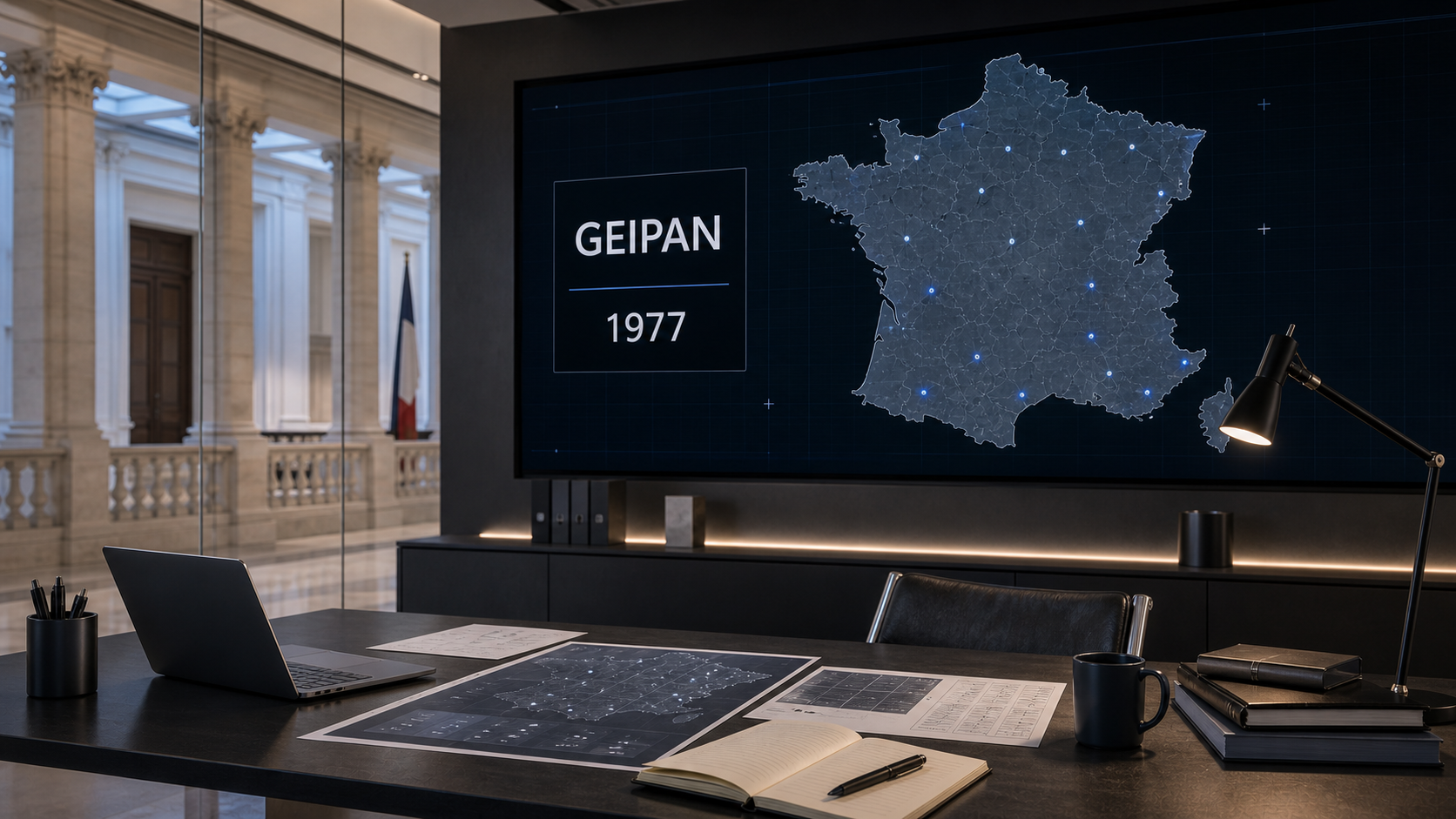
On June 29, the French National Assembly hosts a public colloquium on unidentified aerospace phenomena research, organized by deputies Arnaud Saint-Martin and Pierre Henriet. The session runs 3 p.m. to 7 p.m. in the Salle Victor-Hugo, and LCP, the Assembly's parliamentary channel, is filming it. The title: "La recherche sur les phénomènes aérospatiaux non identifiés (PAN) au-delà des fantasmes", UAP research, beyond fantasy.
France doesn't have to start from zero on this. The country has had a UFO office since 1977.
The office
GEIPAN sits inside CNES, the French space agency, and runs on a small core staff, a network of volunteer investigators, scientific experts, and partner relationships with the gendarmerie, police, civil aviation, defense, weather services, and research bodies. The office collects, studies, archives, classifies, and publishes reports of unidentified aerospace phenomena. The French acronym is PAN, not UFO; the English equivalent is UAP.
The history is straightforward. GEIPAN started as GEPAN in 1977. In 1988, GEPAN became SEPRA. In 2005, after a CNES audit, the work was restructured again and GEIPAN replaced SEPRA, with the "I" added to signal a more public-facing mandate. Archives and case files started going online in 2007.
GEIPAN isn't framed as an alien-hunting shop. Its own mission page says it isn't a UFO expert in the popular sense and isn't a research organization looking for extraterrestrial life or futuristic visitor technology. The work is more local: receive a witness report, build a file, investigate, anonymize, classify, publish. The sequence is older than most UAP offices anywhere.
The categories
GEIPAN classifies cases after investigation. Category A means the phenomenon was identified. Category B means probably identified. Category C means the case couldn't be identified because the data is too thin. Category D means the phenomenon remains unidentified after investigation.
Since 2008, GEIPAN has used a more detailed A/B/C/D1/D2 method based on two variables: strangeness and consistency.
GEIPAN's mission page says roughly 7 percent of observations remain unexplained across the longer history, with the rate dropping to around 2 percent over the last decade as digital tools improved, the definition of category D tightened, and the volume of low-strangeness reports rose.
Most reports move somewhere. A small set survives.
The lavender field
Valensole reads like rural cinema and still sits in the official case base.
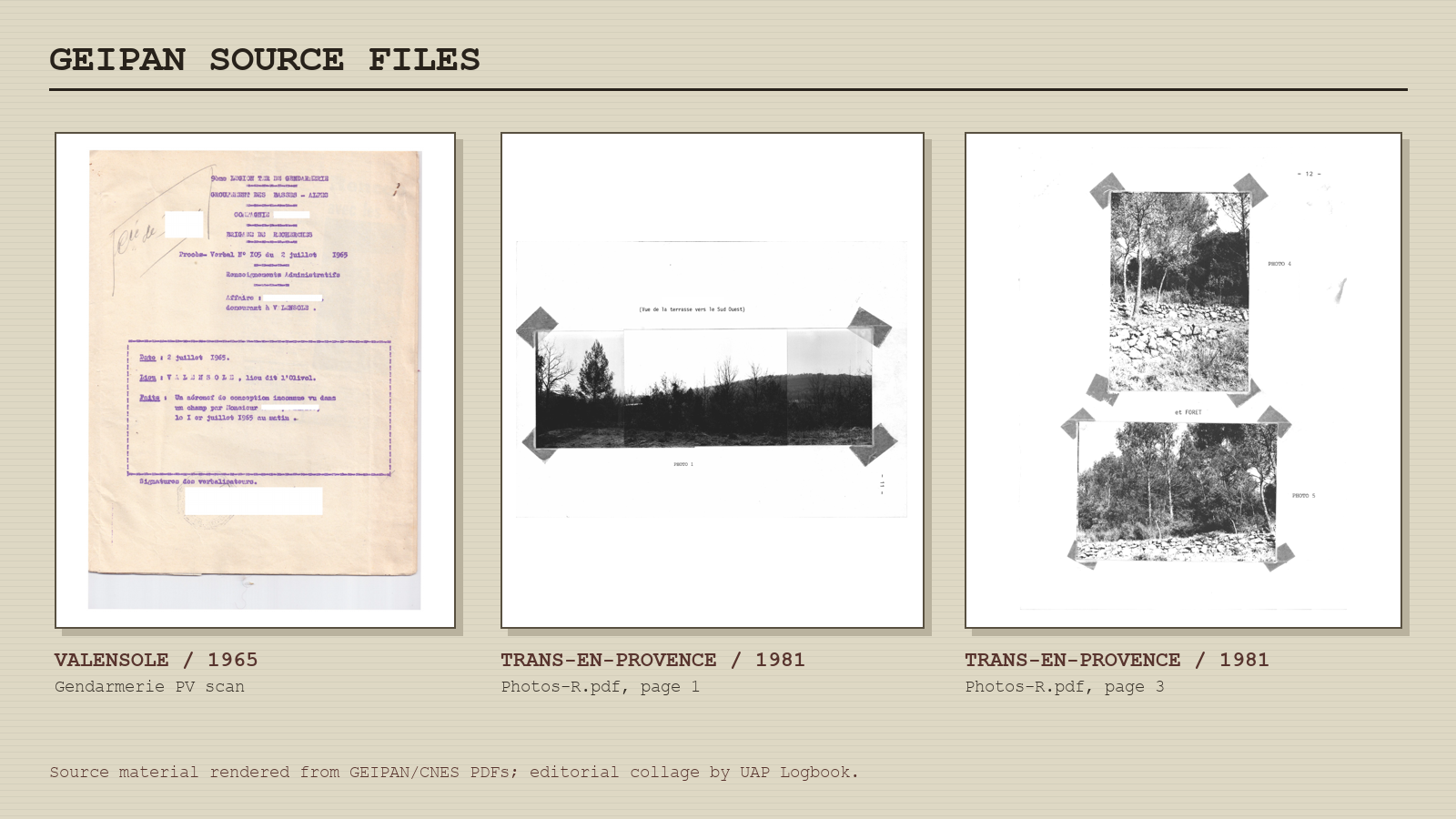
On July 1, 1965, at 5:45 a.m., a farmer in a lavender field heard a whistle. GEIPAN's case page says he moved toward the sound and saw an unknown dark, matte craft on the ground. He reported two figures, a rapid departure toward Manosque, and traces at the site afterward.
The trace description is the hook: a star-shaped mark with a cylindrical hole in wet soil. The farmer later said the ground had become hard.
The gendarmerie took statements. GEIPAN notes that GEPAN didn't exist yet in 1965, but later GEPAN, SEPRA, and GEIPAN officials kept interest in the file. The case is classified D.
It is a strong case: named place, named date, police trail, physical-trace claim, and an official archive page. None of that closes the file.
The garden in Var
Trans-en-Provence is the heavier case.
On January 8, 1981, a witness in the Var said he saw a craft descend, land below his property, then take off vertically after a short stay. GEIPAN's case page describes a whistling sound, a gray object, circular protrusions underneath, and ground traces after the departure. The archive page is dense: technical notes, meteorological material, lab analyses, photographs, and a gendarmerie report. The classification is D.
This is the French case that keeps reappearing when people ask whether any official UFO archive ever took a landing-trace story seriously.
GEIPAN can publish a file, preserve documents, and classify the case. It can't make the object reappear.
The night France saw a triangle
The best case for understanding GEIPAN is the one that did get explained.
On November 5, 1990, thousands of people across France saw a huge luminous phenomenon cross the sky. SEPRA was flooded with calls from gendarmerie brigades. The object was described by some witnesses as an immense luminous triangle.
GEIPAN's case page now classifies it A: the atmospheric reentry of the third stage of a Soviet Proton rocket. The file is useful as a counterweight. A national wave can feel close, structured, and enormous to witnesses. The file can still move toward a space-debris answer.
If Valensole and Trans-en-Provence are the cases that keep the archive alive, November 1990 is the case that keeps it honest.
Cussac, carefully
Cussac is tempting. The 1967 story has two children, a field in Cantal, small black figures, a bright sphere, and a later GEPAN/SEPRA place in French UFO culture. The COMETA report includes Cussac as one of the French cases in its broader UFO-and-defense argument.
Cussac is worth its own note. For this article, the cases are the office itself, the Valensole file, Trans-en-Provence, and November 5, 1990.
Why the June room matters
The National Assembly event isn't a disclosure day.
France is putting UAP/PAN research into a parliamentary setting while already running an official public case office inside its space agency. GEIPAN investigators are expected among the participants, according to LCP's report. The program is framed around research, institutions, experts, and what can be studied beyond fantasy.
The American track runs through whistleblowers, congressional demands, AARO fights, Pentagon wording, and file drops. The French track has a different shape: the older layer is quieter, built around gendarmerie reports, witness forms, anonymized files, classification letters, and case pages that can be searched.
The cases are online. Some are explained. Some are too thin to use. A small set survives.
The cases to pull next
Follow-ups from this piece: Valensole as a short note or feature, with the lavender field, the two figures, the star-shaped trace, and the D classification. Trans-en-Provence as a main article, with the 1981 landing report, lab analyses, photographs, gendarmerie material, and the long fight over physical traces. November 5, 1990 as an explainer, with a national UFO wave turning into a Proton reentry file. Cussac as a careful historical case, only after the primary GEIPAN trail is pinned down. June 29 as a follow-up if the event is streamed and produces usable quotes or a speaker list.
France already has the UAP office other countries keep talking about building. A few cases still bite. On June 29, that old machinery walks into the National Assembly.
Related UAP Logbook notes
- What other countries are doing about UAPs
- Chile's SEFAA office and satellite cases
- Japan's UAP cabinet-secretariat proposal
- What is PURSUE? The UAP records release program explained
Sources
- LCP / Assemblée nationale: "Les Ovnis s'invitent à l'Assemblée le temps d'un colloque inédit" - https://lcp.fr/actualites/les-ovnis-s-invitent-a-l-assemblee-le-temps-d-un-colloque-inedit-436604
- CNES / GEIPAN: Mission, methods, and results - https://www.cnes-geipan.fr/en/missions-methodes-et-resultats
- CNES / GEIPAN: Its history - https://www.cnes-geipan.fr/en/histoire-du-geipan
- CNES / GEIPAN: FAQ classification notes - https://www.cnes-geipan.fr/en/missions-methodes-et-resultats
- GEIPAN case: Valensole (04), July 1, 1965 - https://www.geipan.fr/en/node/46692
- GEIPAN case: Trans-en-Provence (83), January 8, 1981 - https://www.cnes-geipan.fr/en/node/48918
- GEIPAN case: atmospheric reentry, November 5, 1990 - https://www.cnes-geipan.fr/fr/cas/1990-11-01225
- CNES / GEIPAN: COMETA report PDF, for Cussac context only - https://www.cnes-geipan.fr/sites/default/files/Cometa_0.pdf