
Short Note / Jun 24, 2026
Gulf Breeze had a UFO model in the attic
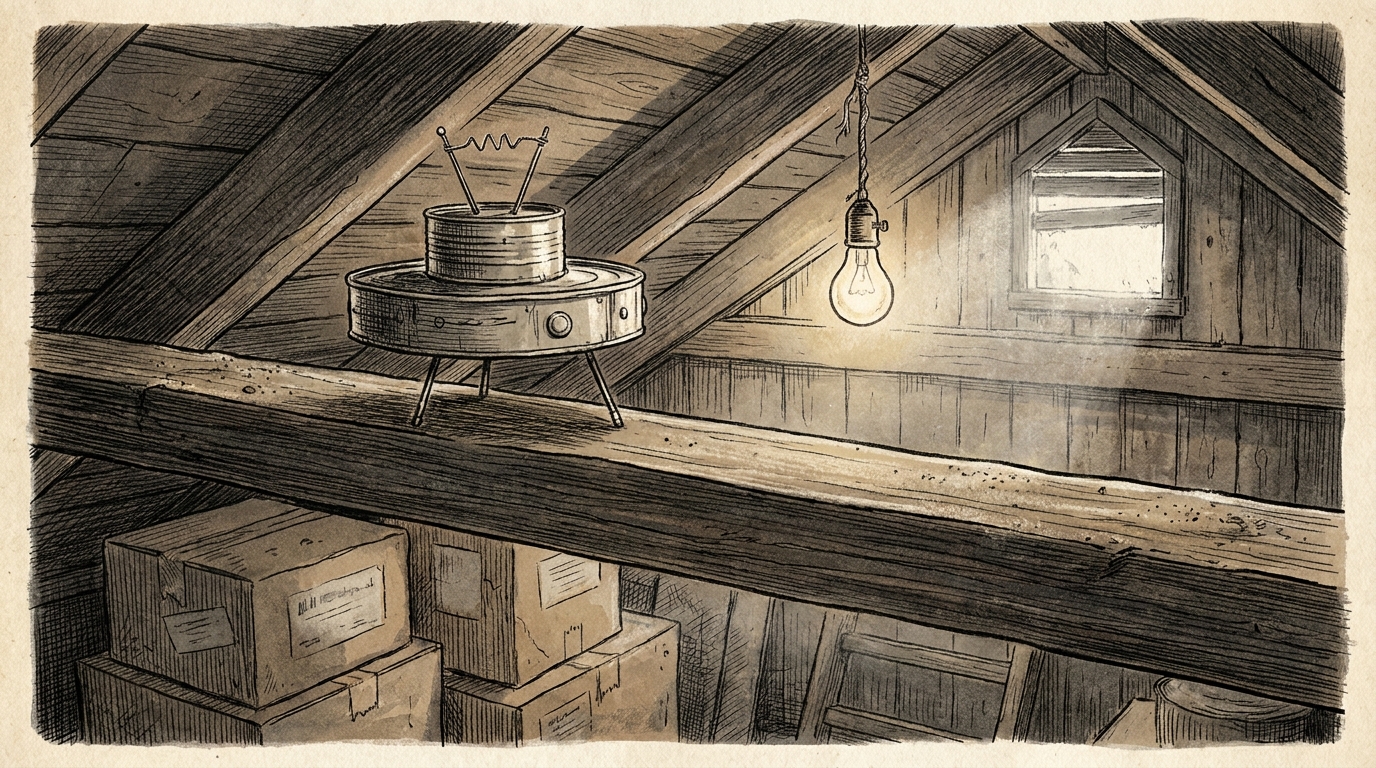
Gulf Breeze was a UFO photo story until the hard object showed up: a small, saucer-like model found in June 1990 in the attic of Ed Walters's former house, and used by the Pensacola News Journal to test the famous photograph.
Gulf Breeze was a photo case before it was an attic case.
In the late 1980s, a Florida building contractor named Ed Walters took UFO pictures that turned his small town into a national saucer story. The images were clean enough to circulate, strange enough to argue over, and local enough to feel like something had landed in ordinary America.
Then the object in the story changed.
Not the object in the sky. The object in the attic.
On June 10, 1990, a reporter for the Pensacola News Journal named Craig Myers entered the house Walters had moved out of and found a small, saucer-like model in the attic. The shape matched the famous photographs. Myers and the paper used the model to stage their own photos. When those were laid next to Walters's originals, the comparison was the kind the case had been missing.
Walters' answer was on the record by the end of 1990. He signed a sworn statement denying any knowledge of the model. He refused a further polygraph test. Later, defending his case, he argued the attic model only vaguely resembled the craft in his pictures. A 1991 wave around Pensacola, with roughly 200 named witnesses, was used by his supporters to keep the wider case alive after the photo had taken the damage.
What the attic model changes
Photo cases can float. A model is different. A model can be picked up and put next to the original.
That is the comparison the Pensacola News Journal published in 1990. The recreation was not proof that every Gulf Breeze photograph was faked. It was proof that the most-circulated single image in the case could plausibly be made from an object the size of a lampshade. The other 1987 to 1988 sightings around Pensacola are still in the record.
What is in the public file
- The Wikipedia summary of the Gulf Breeze UFO incident, with the Pensacola News Journal citation trail.
- Craig Myers's 1990 Pensacola News Journal reporting: the attic finding, the model photos, and the recreation test.
- Myers's later book on the Gulf Breeze case.
- The Pensacola News Journal's 30-years-later recap, published September 25, 2017, page A4.
- Myers's academic essay "The MUFON-ian Candidate: The Gulf Breeze UFO Case as Religion," a source-critical read of how the case was promoted and amplified inside UFO organizations.
- Ed Walters's 1990 sworn statement denying knowledge of the model, and his refusal of a further polygraph.
What is not in the public file
- The original attic-discovered model itself. It circulated in 1990 reporting, but its current custody, condition, and chain of custody are not in the public record.
- Independent physical-analysis documentation of the model: composition, weight, paint, scale measurements, comparison prints under controlled lighting.
- A full Pensacola News Journal archive of the original June 1990 pages (most secondary sources cite it indirectly rather than reproducing the layouts).
- A line-by-line, side-by-side analysis of the 1990 recreation against every one of Walters's other 37 claimed photographs, not just the most-circulated one.
The model exists in 1990 newspaper photographs. Where it is now, who has it, and whether the rest of the Gulf Breeze photographs could be tested the same way — none of that is in the public file.
Related UAP Logbook notes
- The UFO hoaxes that still haunt disclosure
- The Roswell Slides died on one word: mummy
- The FBI Vault called the MJ-12 documents bogus
Sources
- Wikipedia: Gulf Breeze UFO incident (with Pensacola News Journal citation trail).
- Pensacola News Journal: Gulf Breeze UFO sightings, 30 years later, public still divided (September 25, 2017).
- Myers, Craig R. "The MUFON-ian Candidate: The Gulf Breeze UFO Case as Religion."
- Unsolved Mysteries Wiki: Gulf Breeze UFO model found, June 10, 1990.
- The Mystery Delver: High Hoax? — Using the model found in Ed Walters' former home, a Pensacola News Journal reporter showed how the model could have been used in a hoax.
- Wikimedia Commons: Gulf Breeze UFO model image (rights status to be verified before any direct re-use).