
Short Note / Jun 22, 2026
The Roswell Slides collapsed on a museum placard
The Roswell Slides were built as a UFO body reveal. The weak point was not hidden in a classified file. It was printed on a placard beside the body.
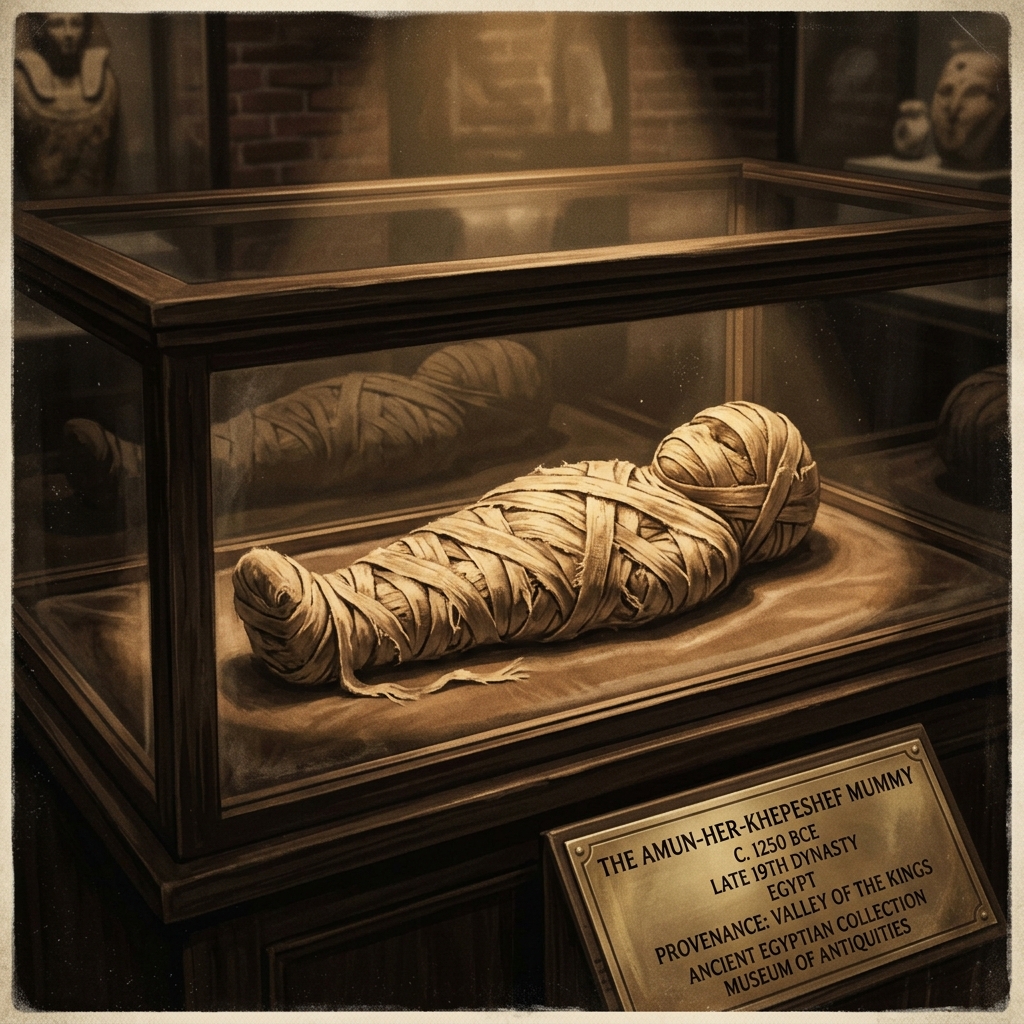
On May 5, 2015, Jaime Maussan presented two Kodachrome slides to nearly 7,000 paying attendees at Mexico City's Auditorio Nacional. Tickets cost between $20 and $86. The event was called BeWitness. The promise was a smoking gun: photographic evidence of a non-human body, dated to around 1947, consistent with the Roswell crash.
Astronaut Edgar Mitchell attended. Maussan called the images "undeniable" proof of extraterrestrial life.
Within hours, the claim was gone.
What the placard said
The slides had been found in a box in an attic in Sedona, Arizona, alongside photos of Bing Crosby, Clark Gable, and a pre-presidential Dwight Eisenhower. A blurred museum placard sat beside the body in the image. The promoters could not read it, or said they could not.
Researchers outside the event had no such problem. A member of the Roswell Slides Research Group, posting under the name Neb Lator, ran the high-resolution image through SmartDeBlur Pro — widely available software — and within hours produced a legible text. The top line read: MUMMIFIED BODY OF TWO YEAR OLD BOY. Further processing added: "At the time of burial the body was clothed in a cotton shirt. Burial wrappings consisted of these small cotton blankets. Loaned by Mr. S.L. Palmer, San Francisco, California."
The body was a Puebloan child, removed from cliff dwellings at Mesa Verde in 1894 and put on display at the Chapin Mesa Archeological Museum in Colorado. The slides had been taken at the museum sometime before May 1947 — which also eliminated the Roswell crash as a possible source date.
What collapsed and why it matters
The structure of the claim was its own weakness. Maussan's team had possessed the high-resolution scan for years during promotion. The ordinary text sitting beside the extraordinary body was readable the entire time. What kept it obscure was a combination of low-resolution public releases and the promotional logic of the reveal — the longer the mystery holds, the larger the audience.
Once a researcher with standard software read the label, the frame collapsed completely. No counter-file was needed. No insider leak. Just the museum placard that had been in the picture from the beginning.
The lasting lesson
The Roswell Slides are a precise case study in how body claims circulate. The dramatic version — non-human remains, Roswell provenance, photographic proof — traveled through press coverage, event streaming, and UFO networks before the caption was checked.
Modern UAP stories follow the same pattern at higher speed. Cropped frames, short clips, and partial documents move before the label is read. The Roswell Slides are a useful reference point not because the hoax was sophisticated — it was not — but because the correction required nothing more than reading the sign next to the body.
The placard was always there. It just needed someone to look at it.
Related UAP Logbook notes
- The UFO hoaxes that still haunt disclosure
- The Roswell bodies page people skip
- David Grusch moved Immaculate Constellation away from the Pentagon name search
Sources
- Roswell Slides: The Child Identified.
- Anomaly Archives: Roswell Slides collection.
- BeWitness event records, Auditorio Nacional, Mexico City, May 5, 2015.
- Roswell Slides Research Group investigations (Neb Lator).
- Mesa Verde National Park / Chapin Mesa Archeological Museum archives.