
Main Article / Jul 01, 2026
The "I cannot discuss this" sentence, in five UAP witnesses' words
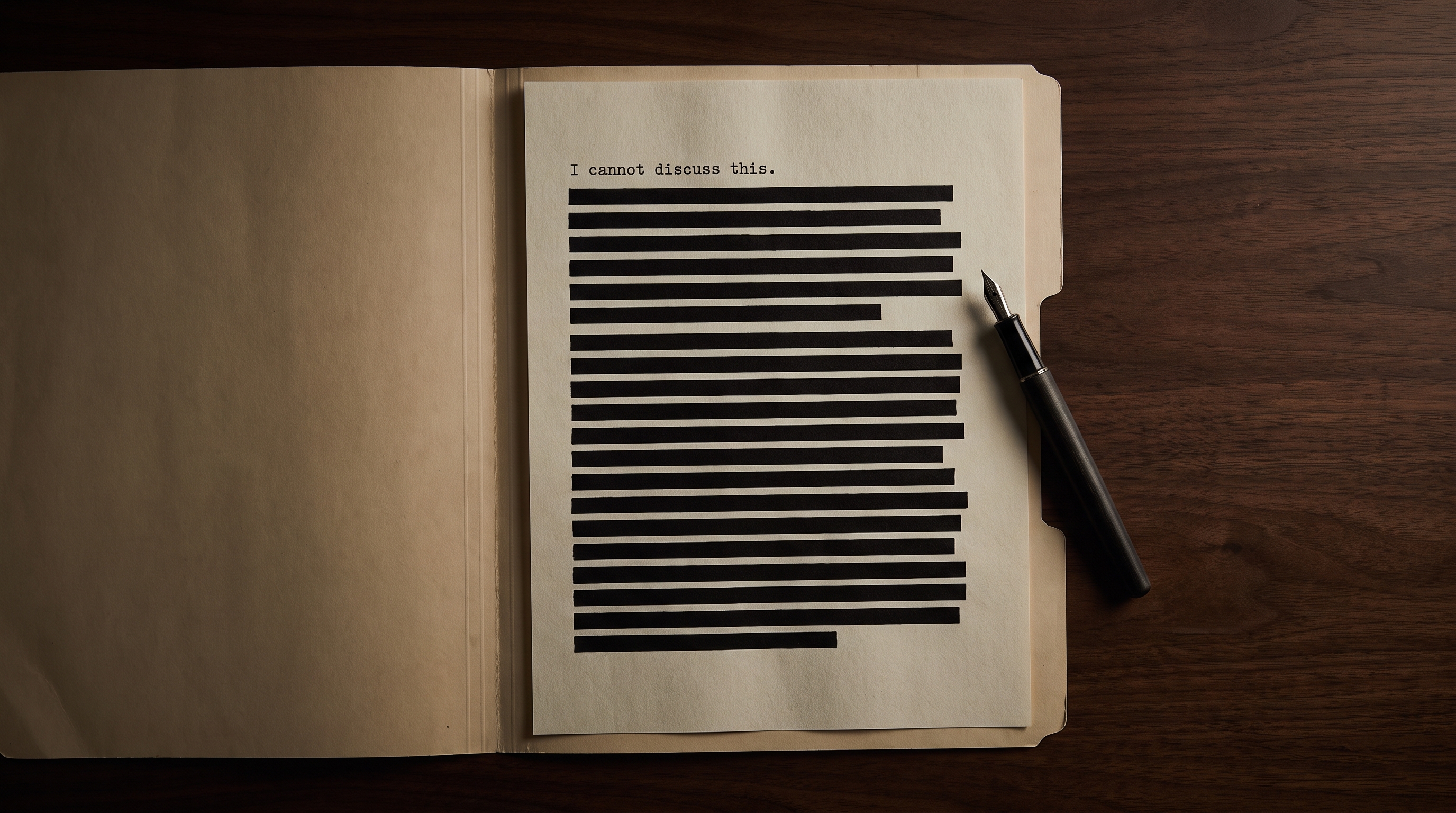
Across the 2026 disclosure cycle, a particular sentence keeps showing up in UAP statements. It is not a denial. It is not a confirmation. It performs a specific job — and it has become the standard unit of claim construction in the modern UAP conversation.
Ross Coulthart said something on June 28, 2026, that journalists don't usually say out loud. Near the end of his NewsNation Reality Check Q&A, he turned to Luis "Lue" Elizondo, sitting off-camera, and told him: "Lue, I know a lot of people and they know you. I know you can't speak about the role that you've held within the legacy program."
It wasn't a gotcha, and it wasn't a denial either. Coulthart was just describing, in plain terms, a constraint he believed was real: something Elizondo knows, isn't allowed to say, and both men know it. That single exchange is worth pulling apart, because the same move has been running through UAP and UFO coverage for almost two years now, in slightly different clothes each time.
Five versions of the same sentence
Call it a shape rather than a quote, because it keeps recurring with the same bones.
Coulthart to Elizondo, June 28, 2026. Not a denial, not a confirmation — a journalist naming an ongoing restriction. The line does three things at once: it says the constraint is real, it says the reporter knows it's real, and it tells the audience that whatever Elizondo says next can't really be judged on its content, only on whether he's willing to gesture at the constraint at all.
David Grusch, on The Megyn Kelly Show, January 7, 2026. Asked about his access to the alleged legacy crash-retrieval program, Grusch told Kelly: "In fact, without being inappropriate, I will say that General Clapper was well aware of the crash retrieval issue, managed the crash retrieval issue, and, when he was a DNI, USDI, DIA, he placed people in critical roles to manage this issue, both publicly — and I'll just say not publicly as well." That phrase "without being inappropriate" is doing the hinge work. It signals: what follows is being withheld by a rule, not by reluctance.
Grusch again, on the Immaculate Constellation program, in a Judicial Watch interview from May 5, 2026. Asked directly about the program by name, he opened with "I have to watch how I talk about a code word," then described its supposed architecture — a White House special access program, covert-action authorities, an Eisenhower-era executive order, a small cleared core — without confirming a single operational detail the host had actually asked about.
The 2024–2025 witness pool. Jake Barber, Michael Herrera, and others who've claimed direct contact with alleged retrieval operations have used near-identical variations across their on-camera interviews. Strip away the specifics and three elements survive every version: a claim to specific knowledge, an explicit refusal to specify it, and a deferral to some future moment when the restriction might lift.
Elizondo, repeatedly, from 2021 through 2026. Across his entire post-resignation press cycle — the 60 Minutes interview, his 2024 memoir Imminent, dozens of social media replies — he's returned to some version of "there are things I simply cannot discuss at this time." It's not an occasional line anymore. It's become one of his tics.
What the sentence is actually doing
It marks a boundary, first — telling the listener exactly where the public record stops and the private one begins. The boundary is the sentence; there's no separate line to point to.
It's also a claim. Nobody who has nothing to disclose bothers with this formulation. Saying "I can't tell you" is only useful — rhetorically, socially — to someone asserting there's something worth withholding in the first place.
And it works as a shield. Any follow-up question now has to ask the speaker to break a rule they've just cited on the record. That's an awkward position for a journalist to push from, and everyone in the room knows it.
Three jobs, one short sentence, and it's efficient enough that it's become the default vocabulary for talking about UAP material a witness claims to hold but can't produce.
Why it holds up
The reason this pattern survives is that it can't really be tested. Nobody can disprove a claim to undisclosed knowledge — not a journalist, not a congressional committee, not a rival witness. There's no document to subpoena, no footage to release, no second source who can independently verify a thing that was never specified. The constraint is the claim. It's also the entire specification of the claim, which is the problem.
Compare that to The Black Vault's 2024 FOIA release on the AATIP memo (case 21-FR-0964). That was an actual document — drafted by Elizondo, ordering the Department of Defense to route UAP material through a specific office. Once it surfaced, Pentagon spokesperson Susan Gough called it "unsolicited." Elizondo pushed back in writing: the memo, he said, "was in fact a request by none other than the Secretary's front office staff." Two people, two claims, both checkable against one real document. That's a dispute an outsider can actually adjudicate.
"I cannot discuss this" offers nothing like that. No document to confirm it against, no counter-witness to deny it, no way for a reporter without clearance to test it. It's a claim built with no failure mode.
What's missing from the record
Run through the same five examples again and notice what's absent. Grusch's January interview produces a detailed statement about Clapper and Stephanie O'Sullivan — and no program name, no date, no location, no chain of custody. His Judicial Watch interview produces a full architectural sketch of a program — and no document, no roster, no title. Coulthart's June clip produces an on-air assertion that a role existed — and no contract, no name, no paper trail.
The tail phrase "at this time" is worth noticing too. It gives the constraint a calendar, implying the information might surface someday. That's what keeps the claim alive rather than closed — it's deferred, not resolved.
Why the pattern isn't going anywhere
It persists because the incentives favor it. Witnesses who use the line stay inside the disclosure coalition's good graces. Witnesses who try to say more than the line allows tend to lose access or credibility fast. Reporters who push too hard to name the unnameable often become the story themselves, instead of the claim being the story. The line costs the speaker almost nothing and buys them a lot.
Until that constraint produces something concrete — a named program, a contract, a roster entry, an object with a documented chain of custody — the public record on this topic will keep taking this shape. Whether Coulthart, Grusch, Elizondo, Barber, or Herrera are telling the truth isn't really the question worth chasing. The more useful question is what kind of record you end up with when so much of it is built from sentences whose only real job is marking what can't be said.
Sources
- Ross Coulthart and Meagan Medick, "Reality Check" Q&A, NewsNation DC Bureau, June 28, 2026 (full 47-minute episode): youtu.be/9RcCJfdIhEw
- UAP James X clip of Coulthart's specific answer (243,415 views as of Monday morning): x.com/UAPJames/status/2071254193138979196
- David Grusch on The Megyn Kelly Show (episode 1225), January 7, 2026 — full transcript: podscripts.co
- Judicial Watch, "UAP Whistleblower David Grusch on 'Non-human' Biologics & Craft," published May 5, 2026: youtube.com
- The Black Vault, "AATIP Memo Unveiled After FOIA Battle: DoD Inconsistencies Exposed" (FOIA case 21-FR-0964), August 23, 2024: theblackvault.com
- Luis Elizondo, Imminent: Inside the Pentagon's Hunt for UFOs (William Morrow, 2024)
- Ross Coulthart, In Plain Sight: An Investigation into UFOs and Impossible Science (HarperCollins, 2021)