
Main Article / Jul 01, 2026
Burlison told NewsNation the FBI filmed the same plasma orbs in U.S. neighborhoods
On NewsNation's Reality Check, Rep. Eric Burlison said FBI field agents filmed the same glowing plasma orbs he has been shown at residential locations, and that Stephen Miller is now driving the White House's UAP file ask. He also confirmed the MIT Lincoln Laboratory 1952 audio file is moving through declassification, and was clearer than before about how his office knows what to ask for.
Rep. Eric Burlison, a Missouri Republican who sits on the House Oversight and Government Reform Committee and the Task Force on the Declassification of Federal Secrets, sat down with Ross Coulthart in Washington for NewsNation's Reality Check on June 30, 2026. In one sitting, he put several new details on the record for the first time.
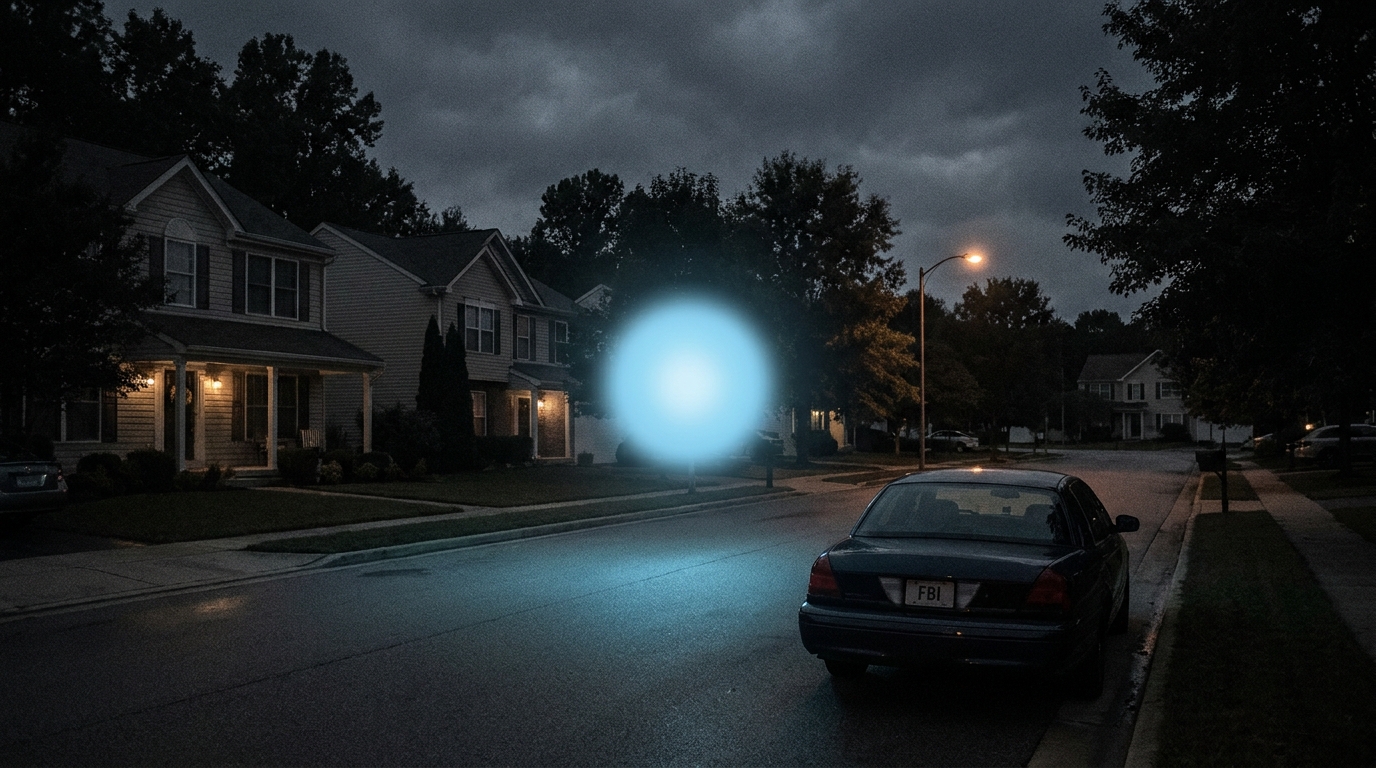
The biggest claim concerns residential neighborhoods. Burlison said FBI field agents have filmed the same glowing plasma orbs at homes across the country — footage that has since been shown to members of Congress in a SCIF. The interview also confirmed that the 1952 “flying saucer talk” audio file from MIT Lincoln Laboratory is moving through the declassification pipeline, that MITRE has been asked about crash retrieval and reverse-engineering work, and that Stephen Miller has become the White House's point person on UAP disclosure.
None of this has produced a public record yet. What it has produced is a clearer sense of what Burlison is now willing to say on a mainstream cable set, on camera, with the lights on.
What Burlison says he has been shown
Coulthart asked Burlison directly what he has seen inside the SCIF — videos and photographs still withheld from the public. His answer matched his earlier descriptions of glowing, plasma-looking orbs.
“What I consistently have seen that to me that's unshakable is the is these plasmoids, these glowing balls of plasma. I don't know if it is plasma, but they look like what plasma would look like, and it's moving intelligently. They seem to be maybe half the size of a sedan or something like that, but they are, they're just — they're not flying by conventional means. And so one can't really just — I have no idea what they are, and neither does our intelligence community.”
Asked why he calls the motion “intelligent,” he pushed back on the word itself:
“Well, look, I mean, they're not moving in a way that seemed natural, right? So they're moving in, sometimes right angles. They're going from, they're just standing still to an incredible speed. And it's part of the briefing that we don't know what they are.”
Burlison's language echoes one of the longest-running phrases in the UAP record — “sentient plasmoid life,” the wording David Grusch has used in congressional settings, and Grusch has in fact served as a senior adviser to Burlison on this issue. He describes the orbs as roughly sedan-sized, capable of jumping from a standstill to high speed without an apparent acceleration phase, and sometimes maneuvering in sharp right angles. Nothing in that description is publicly verifiable yet. What can be verified is that Burlison has repeated the same descriptors since last summer, that they match his earlier on-camera comments, and that no footage has surfaced.
The ODNI briefing that came back for more
Coulthart pressed Burlison on the Office of the Director of National Intelligence, which has been briefing him in person. The telling part is what happened after the first round.
“In fact, I just asked point blank to the office of the director of national intelligence when they briefed me about this. They — that briefing began as — that was a second briefing. The first briefing that I had, they said, 'Sir, we just don’t — we've not found any evidence of anything.' They called me in two months later to say, 'We felt like we had to bring you back because we — we have had an experience that we cannot deny.'”
That “experience” points to the cluster of sightings around a western U.S. military installation reported earlier this year, including senior intelligence officials who saw the same glowing orbs that later showed up in flight-controller footage elsewhere. Burlison called it something you can't readily dismiss or snicker about — and the shift in tone between the two briefings is the only on-record admission from a sitting congressman that ODNI has changed its working posture on this question in 2026. ODNI has not issued a public statement confirming or characterizing either briefing.
The new claim: FBI agents filmed them in U.S. neighborhoods
This was the centerpiece moment. Burlison extended the ODNI experience into the FBI, putting the bureau on residential record for the first time.
“So, I've seen footage. So I've not seen the footage from that event, but I've seen similar objects that are filmed by the FBI. Because I was told that the FBI team who saw an object, they were actually part of the ODNI investigation investigating another case at the same time.”
Coulthart pushed on the location, and Burlison walked the line carefully:
“I don't — I'm not certain, and I need to get to the bottom of that whether or not the FBI was at that Western military facility. But what I have seen, that the FBI has provided, is footage from different locations. These are residential locations where they — their field agents have responded to reports, and they've arrived, and then they see them themselves. So they've seen the same glowing plasma orbs in residential locations and have filmed them and brought us in and briefed us and showed us those same videos.”
Three things follow from that exchange. Burlison is explicit that the residential FBI footage is from separate locations, not the western military facility. The FBI agents filmed the orbs only after responding to local reports — witnesses first, FBI cameras second. And Burlison is still trying to confirm whether any FBI personnel were physically present at the western installation alongside ODNI, which leaves an open gap in the geometry of his own account.
The public record already holds a near-match. PURSUE Release 03, published by the Department of War on June 12, 2026, includes an FBI file chain centered on a sparsely populated area of the northeastern United States: FBI-UAP-PR004, “Northeastern Orb Sighting,” 2025 documents a July 2025 backyard event in which two witnesses described a “brilliant red sphere” about one meter in diameter with a “white plasma sun” at its center, with two orbs moving in tandem before appearing to merge. FBI-UAP-D009, filed in February 2026, is the FD-302 interview record from the same general area. The FBI assesses the witnesses as credible. The PURSUE page is explicit that the only alteration to the iPhone footage was cropping to protect the witnesses' privacy.
Burlison's residential claim fits the shape of that file family. Until the footage he saw is filed, named, and matched to an FBI case number, the residential claim remains a sitting congressman's characterization of classified material rather than an inspectable scene.
MIT Lincoln Lab's 1952 audio file is “in the process”
The interview closes a loop open since Burlison's May 7 letter to MIT Lincoln Laboratory director Melissa G. Choi, which asked the lab to locate and transmit a 1952 reel-to-reel catalogued as AF-ATIC-FILM, 03/52 — labeled “flying saucer talk,” with Edward J. Ruppelt as briefer. Lab attorneys agreed to respond within 30 days; that window closed in mid-June with no recording transferred and no public statement issued. MIT Lincoln Laboratory did not respond to a request for comment on the deadline.
Despite that public silence, Burlison said on June 30 that the lab's response has moved past mere acknowledgment:
“Our letter to MIT Lincoln Lab produced some results. There's a real-to-reel audio file from 1952 that did exist, because we asked specifically — we had received a tip that that file existed, and we've made that request — that also has led us. They've confirmed it, and they're in the process of declassifying it and getting it to us.”
Asked whether the file would arrive redacted, Burlison named the structural problem rather than dodging it:
“Under the executive order that was passed under the Obama administration, anything older than 25 years is meant to be automatically declassified. That's not — we've not found that to be the case. If anything, you've got to force it. You've got to tell these agencies: 'Hey, we know that there's a file. It's called this.' And then they'll go look for it and release it. It's not that they don't have an automatic posture to just want to release things.”
By Burlison's read, the reel captures an Air Force general seeking guidance from MIT scientists on a phenomenon he connects to the same family of files as the July 1952 Washington National Airport case — the radar returns and visual sightings that ran over the capital and ended with Brig. Gen. Landry's call to Truman's Air Force aide. The reel itself may still be just a label, but the flyover has been public record for 74 years. Jordan Flowers's earlier UAP Logbook note covers that connection in more detail.
The exchange also surfaced the mechanism behind the asks. Asked how his office knows what to file for by name, Burlison went further than naming witnesses:
“So, while I may not have heard the file myself, I know that if it has been altered or changed, we will know. You’ll know — right? They know that we know. We've got people on the inside that are giving us this information. Otherwise, how else would we know that that file exists and what it's named and what date it was dated, all of that.”
That phrasing — implicit whistleblowing sourcing inside the executive branch — is among Burlison's strongest on-record claims about access on this question. The interview does not name those insiders, and Burlison offered no protection for them. The paper trail works because the office knows what to ask for; the office knows what to ask for because sources inside the apparatus tell them.
MITRE, Varginha, and the Trump–Miller line
The interview also confirmed movement on three fronts and opened a new one.
On MITRE, Coulthart picked up a thread hanging since the May 22 inquiry, which formally asked the FFRDC to designate a records official, issue a preservation hold, and produce a records-location index on any crash-retrieval or reverse-engineering work. That inquiry sits inside a 45-day window with a deadline in mid-July; MITRE has said it is searching but has not yet produced records (the UAP Logbook file on the MITRE search tracks that line). Coulthart's question distilled the ask:
“What you're looking for through MIT Corporation at the moment is, is there any knowledge there of a crash retrieval program, reverse engineering of non-human technology? Right. Or an understanding or scientific evaluation of any extraterrestrial craft.”
When Coulthart raised the long-running MITRE psionics and GATE-program accusations, Burlison kept his answer deliberately narrow: “I've heard about these things, and I'm willing to take a next step at some point to look into some of that, but right now I'm focused on the nuts and bolts of the UAP stuff.” He left the door open without walking through it.
On Varginha, Burlison confirmed the FBI has received follow-up letters tied to the 1996 Brazil incident long investigated by filmmaker James Fox, requesting flight records and any documentation of U.S. personnel present. None of that material has surfaced publicly.
On the White House, Burlison named Stephen Miller as the person Trump has assigned to drive UAP file accountability:
“If it does exist, I do think that this administration is absolutely driven to find that, to answer that question, because he assigned this to Stephen Miller. And Stephen Miller is a pitbull, and he is taking this very seriously and very aggressively. All these agencies now — they now know that the White House isn't going to accept half measures. The White House wants answers on this. They are being very aggressive about this.”
This marks the first on-record congressional attribution of the UAP disclosure push to Miller specifically. The NDAA amendment and the broader FFRDC deadline cadence have been the legislative frame; Miller is now the executive one.
It lands against a public track record that critics across the political press have called a release without substance. The Week's verdict on the first PURSUE tranche was a “Pentagon dud disclosure”; Ars Technica called the May file drop a “bunch of UAP files, but there's no there there.” DefenseScoop's survey of the UAP research community was blunter still: former Deputy Assistant Secretary of Defense for Intelligence Christopher Mellon said “data alone is not disclosure,” and former Navy aviator Ryan Graves warned that “the goal should be a durable, credible reporting and analysis process, not just periodic releases of low-context files.” The pattern gives Burlison's insider claims weight by contrast: after months of public dribble, he is now the channel putting specific records and specific footage on the record.
What is still missing
Three pieces of evidence would move these claims from congressional characterization to public record: the FBI residential footage itself, including where and when it was filmed and what chain of custody produced the versions shown in the SCIF; the MIT Lincoln Lab audio file in full, so it can be checked against the original Ruppelt-era “flying saucer talk” reel or identified as a separate 1952 recording; and MITRE's formal response on crash retrieval, due as the 45-day window Burlison referenced approaches.
Asked what he thinks is actually going on, Burlison held the line: “I honestly don't want to jump to that conclusion, because I don't want to jade or prejudge. I don't want to prejudge what it might be.” That restraint — describing the objects in technical terms like plasma, motion, and dimension without claiming to know what they are — is part of why his account has become the most-quoted on-record congressional scene-setting since the Grusch hearing.
For now, the residential claim is Burlison's story. But it has edges: a name, an agency, a motion pattern, a location type, and a chairman who has been willing to repeat it on camera for a year.
Sources
- NewsNation Reality Check — Rep. Eric Burlison on UAP material he saw inside SCIF and files he's forcing open, YouTube, June 30, 2026 (interview recorded June 30, 2026 in Washington, D.C.; aired June 30, 2026; transcript reviewed).
- Rep. Eric Burlison: “Rep. Burlison Welcomes Former U.S. Air Force Officer David Grusch as Special Advisor”, March 27, 2025.
- Rep. Eric Burlison: “Burlison Requests Review of Identified 1952 UAP Recording”, May 8, 2026, and the May 7 letter to MIT Lincoln Laboratory.
- Rep. Eric Burlison: “Burlison Presses MITRE for Answers on UAP Records”, May 26, 2026.
- House Rules Committee: Burlison NDAA Amendment 1044 PDF, offered June 18, 2026.
- DefenseScoop: “'Data alone is not disclosure': UAP research community reacts to Trump's first PURSUE file drop”, Brandi Vincent, May 14, 2026 (carrying Mellon and Graves quotes).
- The Week: “UFOs: The Pentagon's dud disclosure”, May 18, 2026.
- Ars Technica: “The US military just released a bunch of UAP files, but there's no there there”, May 8, 2026.
- DVIDS: FBI-UAP-PR004, “Northeastern Orb Sighting,” 2025 (Department of War release).
- Department of War: PURSUE portal and Release 03, cleared for release June 12, 2026.
- Probed: FBI-UAP-D009, FD-302-67, “Northeastern Orb Sighting,” 2026 (FD-302 interview record, February 2026).