
Short Note / Jul 02, 2026
Loeb's UAP council asked the Pentagon for 50 files. It has no clearance to see classified evidence.
Three weeks after announcing a UAP (the government's term for what most readers still call UFO) Science Advisory Council, Avi Loeb has given his first wide-ranging interview. The Pentagon request list is real. The institutional home is real. The clearance to see what the council was set up to evaluate is not.
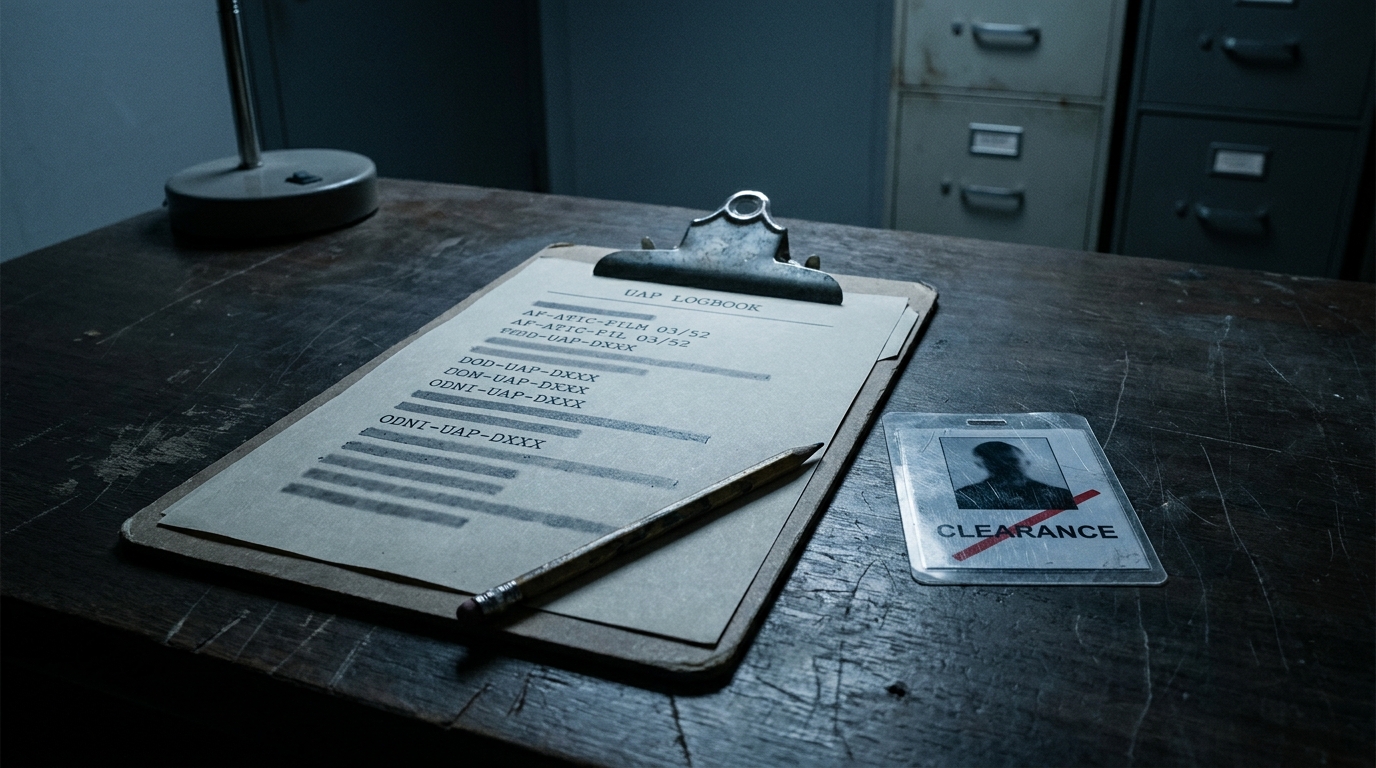
Three weeks after announcing a UAP Science Advisory Council to advise the U.S. government, Harvard astrophysicist Avi Loeb has given his first wide-ranging interview about it.
On July 1, 2026, in a long IBTimes UK piece, Loeb said his team had "submitted a request for over 50 items of information" from the Pentagon, and that all of it would be unclassified. He framed the work as "a detective story" and reiterated his standing assumption that the objects the council exists to evaluate are human-made unless the data prove otherwise.
He also said something absent from his June 14 Medium post: that the council's job is to argue for better sensors and comment on whatever the government chooses to hand over. The council, in his own telling, will not see what it exists to evaluate. "Let's keep our eyes on the orbs," Loeb told the paper. "Not the social media."
An institutional frame has appeared
Two weeks ago, on June 16, the council's institutional shape moved from "Loeb says" to something closer to "ODNI confirms."
Reporter Christopher Sharp of Liberation Times obtained a written statement from an ODNI official confirming that ODNI, alongside the FBI and the Department of War, had established a new UAP Governance Board, which had met for the first time the day before, on June 15.
The board's charter mission, as quoted by Sharp, is to "address national security threats posed by UAP," "integrate and optimize interagency processes" feeding AARO, and "assist in the timely coordination of declassification of UAP-related information, in accordance with Executive Order 13526." Sharp reported that the board is supported by "several advisory groups with expertise outside the U.S. government" — and the Loeb council is one of them.
This closes a gap the council's own announcements had left open. Loeb wrote that he was tasked by the White House, AARO, ODNI, the FBI, and the Intelligence Community; the ODNI statement says the board itself was founded by ODNI, the FBI, and the Department of War. Put side by side, the two accounts sketch a hierarchy rather than a contradiction — a board above, a council below, with the council sitting inside a real institutional home.
The 50-file request
Loeb told Scientific American in June that his fifteen-member team had submitted the 50-plus request to the Pentagon shortly after its first meeting. He told DefenseScoop the same week that "all of the data shared with the newly installed team will be unclassified."
That covers material AARO has already released under the PURSUE file program — cases involving an orange "mother orb" launching smaller red orbs in October 2023, the 40 percent of recent AARO-tracked cases that remain unresolved, and the small spherical objects circulating publicly since 2024. It does not cover the classified files the council was assembled, in part, to evaluate.
The clearance gap
Loeb has drawn this line himself.
In a June 16 phone call to journalist Michael Shellenberger, founder of the publication Public, Loeb confirmed his team holds "no access to any classified information and no legal authority whatsoever." A summary of that call ran in Above The Norm News the same day.
He has since said he would back other outside advisory bodies on identical terms — none of them carrying clearance or power either. The implication is straightforward: the council will argue for better sensors and pick over whatever the government chooses to hand over, but it won't see the radar recordings, pilot debriefs, or sensor files that three years of UAP reporting have pointed to as the actual evidence.
What the critics are saying
The pushback is now on the public record.
Sean Kirkpatrick, who led the Pentagon's All-domain Anomaly Resolution Office until last year, told AP and IBTimes that Loeb is "not viewed favourably" within parts of the scientific community and questioned his lack of national-security experience, adding that "the makeup of Loeb's team suggests the Trump administration is more interested in fringe theories than hard science."
Steve Desch, an astrophysicist at Arizona State University who has publicly disputed Loeb's work on interstellar objects, was blunter: "I don't know what's going to come of this, but we're not going to get any closer to answering these questions with him in charge," he told IBTimes.
The roster itself has drawn criticism too. The published list includes Garry Nolan, the Stanford immunologist and longtime UAP-materials researcher; Tim Gallaudet, the retired rear admiral and former acting NOAA administrator; Ben Lamm, the entrepreneur behind Colossal Biosciences; Michael Shermer, founder of Skeptic magazine; and several psychologists and a science communicator. Loeb's own Medium post expands the roster to thirteen across data science, instrumentation, oceanography, biology, anthropology, and psychology — six in sensor and data-science seats, five in psychology, communication, anthropology, and "the study of anomalies." That split reads two ways: a deliberate pairing of sensor work with public-preparation work, or a roster drawn largely from Loeb's own professional circle. Loeb has not addressed either framing.
What the public record still does not show
The first UAP Logbook note on this council closed with a list of records to watch for: a charter, a Federal Register notice, an agency announcement, a public member list, a named government contact, or a statement clarifying the group's status as informal or ad hoc. As of this writing, none of that has changed.
The board above the council is now well-sourced — an ODNI statement, an on-record charter mission, a confirmed June 15 first meeting. The council itself still has no charter in the GSA Federal Advisory Committee Act database, no Federal Register notice, and no public member list filed by any agency. Loeb has named the entire roster; the government has confirmed none of it, and AARO's spokesperson, asked by Sharp, declined to comment. Loeb's later Medium posts, including a June 28 follow-up titled "Imitation is the Sincerest Form of Flattery," describe the council as one of several outside advisory groups supporting the board and frame its role as comparable to his existing Galileo Project — but he has not used the FACA framework that would formalize any of it.
Where things stand
Since June 14, the story has advanced on three fronts. The council now has a confirmed home inside government, sitting under a Governance Board that ODNI has named by charter, founding agencies, and first meeting date. It has also acted, asking the Pentagon for more than fifty files — all unclassified, none of them the material the broader UAP debate has centered on. And a first wave of on-record criticism, from Kirkpatrick and Desch among others, questions whether the group amounts to serious science; the White House has yet to respond to any of it.
What hasn't changed is the paper trail. No charter, no Federal Register listing, no government-issued member roster — the council remains, procedurally, exactly where it started: a name Loeb has given the public, sitting beneath a board the government has named itself.
Related UAP Logbook notes
- Is Avi Loeb leading a new government UAP science council? Here's what is known (June 14, 2026)
- What is PURSUE? The UAP records release program explained
Sources
- Christopher Sharp, "U.S. Government Establishes New Interagency UAP Governance Board to Coordinate Investigations and Declassification", Liberation Times, June 16, 2026.
- Avi Loeb, "About UAP and Interstellar Objects", Medium, late June 2026.
- Avi Loeb, "Imitation is the Sincerest Form of Flattery", Medium, late June 2026.
- Avi Loeb, "A UAP Science Advisory Council to the U.S. Government: Keeping Our Eyes on the Orbs, Not the Audience!", Medium, June 14, 2026.
- Robert Gorgonio, "'Keep Our Eyes on Orbs': Polarising Harvard Alien Theorist Dismisses Critics After Landing White House UFO Job", IBTimes UK, July 1, 2026.
- "The White House goes all in on aliens with new UAP Science Advisory Council", Scientific American, June 2026.
- "Harvard professor with polarizing alien theories is picked to lead Trump administration UFO council", AP via wfmz, July 1, 2026.
- Brandi Vincent, "New science advisory council forms to help US government 'resolve the UAP mystery'", DefenseScoop, June 17, 2026.
- "A New Board Now Controls the UFO Files. Its Own Scientists Aren't Allowed to See Them", Above The Norm News, June 16, 2026.