
Main Article / Jul 02, 2026
Project Sign ended in February 1949 with an open verdict. The Estimate of the Situation did not.
Project Sign is where the modern U.S. Air Force UFO hunt begins — and where the canonical legend of the "Estimate of the Situation" gets its start. The official February 1949 conclusion was an open question. The legend never closed.
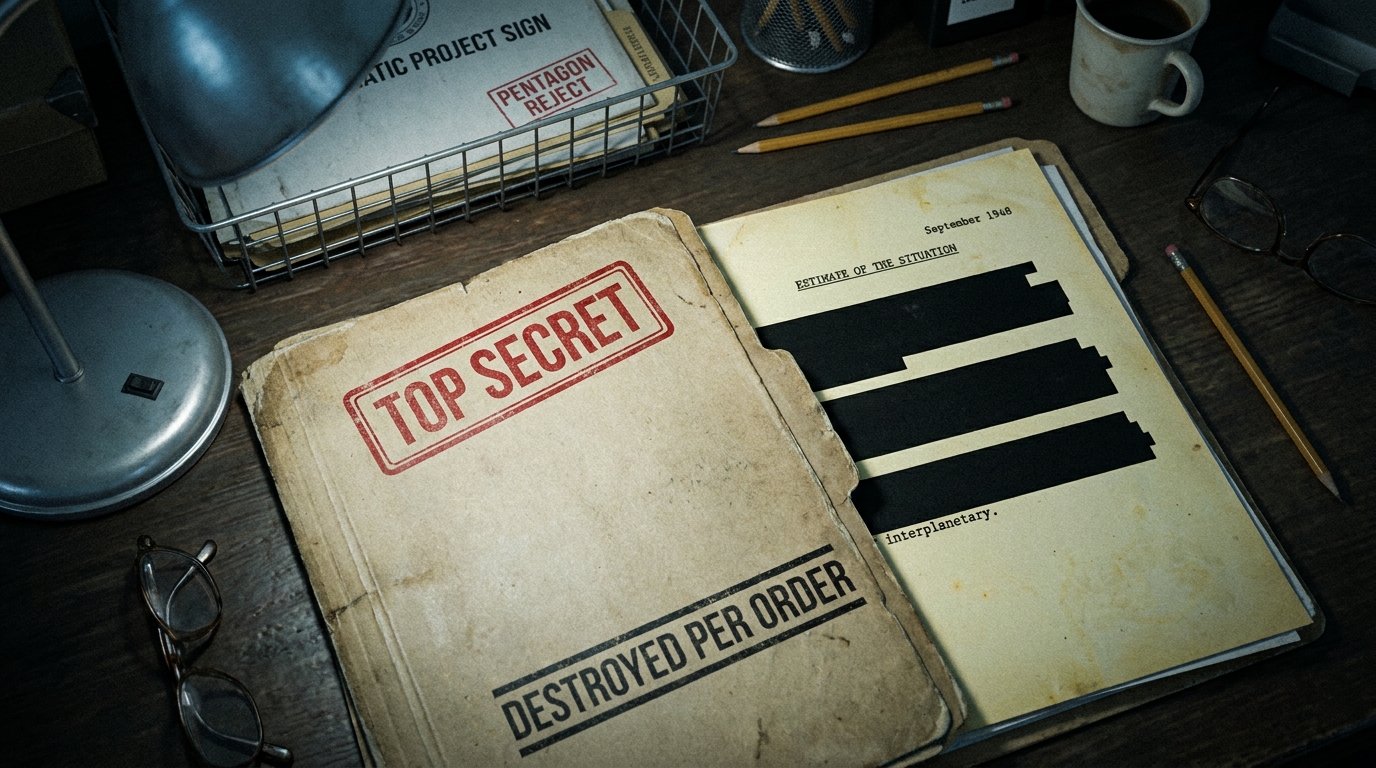
Project Sign was the first formal U.S. Air Force program to investigate unidentified flying objects, and it ran for the calendar year of 1948.
It was also the birthplace of the most famous missing document in American ufology. The "Estimate of the Situation" — an alleged top-secret Sign report that concluded the flying saucers were real and probably interplanetary — has been told and retold since 1956. In legend, the document was rejected by Air Force Chief of Staff General Hoyt S. Vandenberg and every copy was ordered destroyed.
In the public record, the situation is more sober. The official February 1949 conclusion of Project Sign was that the evidence was inconclusive. The Estimate itself, the All-domain Anomaly Resolution Office wrote in 2024, is "unsubstantiated and derived from only one source."
The legend did not close when the project did. The official verdict did.
What Project Sign actually was
Project Sign began work in January 1948 at the Air Technical Intelligence Center (ATIC), the intelligence arm of Air Materiel Command, headquartered at Wright-Patterson Air Force Base in Dayton, Ohio. It had been set up in response to the wave of "flying disc" reports that began after pilot Kenneth Arnold's June 1947 sighting near Mount Rainier, and it was the formal successor to a shorter, less-organized effort informally called Project Saucer.
The project's director was Captain Robert R. Sneider. Its most-cited civilian consultant was Alfred Loedding, who had been working UFO cases at Wright-Patterson since before the formal project existed. The staff was small — historians of the program describe it as "the most talented group to work on UFOs until the air force ended its investigation in 1969" — and it carried an Air Force priority designation of 2A, the highest that could be assigned short of a war emergency.
Per the original January 1948 directive, Sign's job was to "collect, collate, evaluate and distribute to interested government agencies and contractors all information concerning sightings and phenomena in the atmosphere which can be construed to be of concern to the national security."
Over the calendar year of 1948, Sign evaluated 243 reported UFO sightings, conducted on-site investigations of several, and built what was, for its time, the most systematic federal file on the subject.
The cases that filled the file
Three sightings from 1948 became the spine of Sign's case work.
The first was the Mantell incident of January 7, 1948, in which Kentucky Air National Guard pilot Captain Thomas F. Mantell Jr. died after pursuing a "UFO" to above 20,000 feet in a P-51 Mustang. The object was later identified in subsequent Project Blue Book analysis as a classified Navy Skyhook balloon. At the time, however, the incident was treated by the Air Force as a fatal pursuit of something unidentified.
The second was the Chiles-Whitted encounter of July 24, 1948. Two Eastern Air Lines pilots, both combat veterans, reported a near-collision with a rocket-shaped object roughly 100 feet long, emitting reddish-orange exhaust, with what they described as a double row of illuminated "windows" along its body, near Montgomery, Alabama. Their account was corroborated by a passenger, by a military ground witness, by a separate pilot report in the area at the same time, and by a similar sighting near The Hague four days earlier.
The third was the Gorman "UFO Dogfight" of October 1, 1948, in which North Dakota Air National Guard pilot Lieutenant George Gorman reported a 27-minute engagement with a luminous object over Fargo. Sign's investigators tested Gorman's aircraft with a Geiger counter after the incident and recorded radiation readings that the Sign team interpreted as consistent with their working theory.
Sign later sent notice to the Pentagon to alert all services to "the potential for new UFOs reports in mid-October," based on its own analysis correlating sightings with close approaches of Mercury, Venus, and Mars to Earth. That last claim, in particular, would later haunt the project.
What the project concluded
Sign's official final report, dated February 1949, reached an undecided verdict.
The Air Materiel Command's intelligence division wrote that there was "no definite and conclusive evidence is yet available that would prove or disprove the existence of these unidentified objects as real aircraft of unknown and unconventional configuration." The report said most sightings could be explained as misinterpretation of known objects, mass hysteria, hallucination, or hoax — and it recommended that military intelligence continue to control the investigation of UFO sightings.
It did not, however, rule out the possibility of extraterrestrial phenomena. The AARO Historical Record Report, summarizing the document 75 years later, reads Sign's verdict in the same careful way: inconclusive on the headline question, recommendation that the work continue.
The Estimate of the Situation
The story that grew up around Project Sign is louder than its official conclusion.
According to the version that has been told since 1956, the Sign staff by late summer of 1948 had concluded — privately, and contrary to the public February 1949 report — that the flying saucers were real, were not Soviet, and were most likely extraterrestrial. They drafted a Top Secret intelligence estimate, the "Estimate of the Situation," to send up the chain. Colonels William Clingerman and Howard McCoy signed it. It reached General Charles P. Cabell, the Director of Air Force Intelligence, who passed it to General Hoyt S. Vandenberg, the Chief of Staff. Vandenberg rejected it for lack of physical evidence. All copies were ordered destroyed.
The single public source for that account is Captain Edward J. Ruppelt, the future first director of Project Blue Book, in his 1956 book The Report on Unidentified Flying Objects. Ruppelt wrote: "The situation was the UFO's; the estimate was that they were interplanetary." Ruppelt was not at Sign during 1948 but had access to the surviving Sign staff and files when he ran Blue Book from 1951 to 1953.
The academic reconstruction by historian Michael D. Swords, drawing on the surviving Sign files and on later interviews with surviving participants, largely confirms Ruppelt's narrative — including the Estimate's probable September 1948 date, the Cabell-to-Vandenberg handoff, and the destruction order — and adds detail on the staff's working assumptions about planetary correlations.
No copy of the Estimate has ever surfaced. FOIA requests have produced nothing. L. Mendel Rivers, then chairman of the House Armed Services Committee, testified in 1966 that no such Estimate had ever existed. In 2019, Popular Mechanics summarized the academic skepticism in a single line: the report is "probably more mythological than real."
What AARO said about the Estimate in 2024
The most authoritative recent treatment of Project Sign is Volume I of the All-domain Anomaly Resolution Office's Historical Record Report, published by the Department of Defense on March 8, 2024.
Volume I recounts Sign's establishment, staffing, the 243-sighting case work, and the February 1949 inconclusive conclusion. On the Estimate of the Situation, AARO writes that the report "allegedly concluded that UFOs were 'interplanetary' in origin" — and adds a footnote that is unusually direct for a government document:
Although the historical account is unsubstantiated and derived from only one source, Project SIGN staff in late July 1948 allegedly drafted, signed, and sent a report ("Estimate of the Situation") up the military chain for approval.
That footnote is the closest thing to an official contemporary verdict on the Estimate legend. AARO's working conclusion is that Project Sign produced the documented case work and the documented February 1949 conclusion; the Estimate of the Situation is a story told by Ruppelt, amplified by Swords, and contested by skeptics for seven decades.
The Ruppelt story is not dismissed. It is not corroborated either.
What changed after Sign
Whatever internal disagreement the Estimate represented, the public outcome was decisive.
On February 11, 1949, the Air Force renamed Project Sign as Project Grudge. According to Ruppelt, the new name was chosen deliberately. "Grudge was intended to provide prosaic explanations for as many UFO reports as possible." AARO's Historical Record Report adds that "the staff, especially those who seemed to lean towards belief in the 'interplanetary' origin of UFOs, were reportedly purged from the organization."
Grudge ran until December 27, 1949, when it was terminated and its work folded back into routine intelligence. By the time it ended, Ruppelt later wrote, the Grudge era had produced the "Dark Ages" of Air Force UFO investigation. By his count, roughly 20 percent of the sightings Grudge processed remained classified as "unknown."
In late 1951, a second Project Grudge was established under Captain Ruppelt, who explicitly set out to correct what he saw as the mistakes of the first. That second Grudge became Project Blue Book in March 1952. Blue Book ran until December 1969, by which time it had collected 12,618 UFO reports and closed them at a roughly 96-to-99 percent "explained" rate — a number that has itself been contested, but which became the baseline for every later official UAP posture, including AARO's.
Why the Sign story still matters
Seven decades later, Project Sign is not just a chapter in ufology. It is the spine of the modern UAP disclosure argument.
Sign's documented February 1949 conclusion — the evidence is inconclusive, the work should continue — was the first time the U.S. military wrote that sentence down in a UFO report. Project Grudge replaced that sentence with "they are mostly misidentifications and hoaxes." Project Blue Book kept that posture for two decades. AARO, in 2024, walked back to a Sign-shaped position: the historical record shows no evidence of extraterrestrial technology, but the question is kept open by the small residue of unresolved cases.
Each step in that sequence has been contested, by insiders and outsiders, on different grounds. What is not contested is the architectural pattern: a foundation conclusion of openness, a successor conclusion of debunking, a long middle period of case-by-case sorting, and a current office that has returned to the foundation's framing without resolving the underlying question.
The Estimate of the Situation sits inside that pattern as a piece of lore rather than evidence. If it existed as Ruppelt described, it would be the earliest on-record internal U.S. military endorsement of the extraterrestrial hypothesis. If it did not exist, the legend is itself the artifact — a story told for seventy years about what one Air Force office almost concluded before being told to conclude something else.
What the public record still does not show
Three pieces of evidence would move the Estimate story from legend to record.
The first is the document itself, or a copy, or a fragment. None has surfaced in seventy-five years of FOIA, declassification, and historian inquiry. Swords's reconstruction is the closest secondary document — a careful academic reading of what the Estimate likely contained — but it is not the Estimate.
The second is a corroborating second source. Ruppelt's 1956 account is the only on-record testimony to the Estimate's existence. Swords's interviews with surviving Sign participants add detail but predate Ruppelt's book. L. Mendel Rivers, the House Armed Services chairman who would have known about such a document if any had survived in official channels, testified in 1966 that it had not existed.
The third is a Vandenberg-side explanation. The Chief of Staff's alleged rejection of the Estimate is described in Ruppelt's and Swords's accounts but is not documented in any primary source. There is no contemporary memo, no internal Air Force note, no interview transcript on the record that shows Vandenberg or his staff acting on a document called the "Estimate of the Situation."
What the public record does show is the official February 1949 report, the chain of successor projects, and the long AARO audit that took 75 years to put them all in one document. That audit is the spine. The Estimate is the story the spine has carried around since 1956.
Related UAP Logbook notes
- Air Materiel Command's December 1947 flying discs memo — what Sign was set up to follow up on
- Foo Fighters over the 415th Night Fighter Squadron — the World War II precursor sightings
- The 1949 Army flying saucer study and the Russia guided-missile rumor — the Grudge-era Soviet-threat framing
- CIA's STARGATE files and the Soviet psychoweapons panic — the parallel post-Grudge intelligence lane
- AARO's contractor reporting channel is a small but useful UAP clue — what AARO looks like today
Sources
- All-domain Anomaly Resolution Office, "Report on the Historical Record of U.S. Government Involvement with Unidentified Anomalous Phenomena (UAP), Volume I," March 8, 2024 — primary anchor; pages on Project Sign, Project Grudge, and the Estimate footnote.
- Michael D. Swords, "Project Sign and the Estimate of the Situation" — academic reconstruction of Sign's internal records and the Estimate legend.
- Edward J. Ruppelt, The Report on Unidentified Flying Objects (Doubleday, 1956) — chapters 3 and 4 on the Classics, Project Grudge, and the Estimate.
- Wikipedia, "Project Sign" — compiled secondary scholarship with citation trail.
- Wikipedia, "The Report on Unidentified Flying Objects" — Ruppelt's 1956 book and its UFO disclosure role.
- U.S. Congress, House Committee on Armed Services, Unidentified Flying Objects Hearing, Eighty-ninth Congress, Second Session, April 5, 1966 — L. Mendel Rivers testimony on whether the Estimate existed.
- M. J. Banias, "50 Years Ago, the Air Force Tried to Make UFOs Go Away. It Didn't Work," Popular Mechanics, December 17, 2019 — skeptical treatment of the Estimate legend.