Short Note / Jun 08, 2026
Garry Nolan on CBS: Spielberg's Disclosure Day and the metals nobody can explain
Dr. Garry Nolan joined CBS News 24/7 to discuss Steven Spielberg's upcoming film Disclosure Day, the timeline of alien visitation, and anomalous UAP metals.
Steven Spielberg's science-fiction thriller Disclosure Day opens June 12. Dr. Garry Nolan was on CBS News 24/7 on June 8. The timing wasn't accidental — and Nolan didn't pretend otherwise.
The Stanford pathology professor and executive director of The Sol Foundation spent the interview doing something unusual for a scientist with his credentials: tracing his own career back to a 1977 Spielberg film. Close Encounters of the Third Kind, he explained, was what pointed him toward UAP research in the first place. The French scientist in that film — Claude Lacombe, played by director François Truffaut — was modeled after Jacques Vallee, the French-American researcher who has spent over fifty years investigating the phenomenon and is now one of Nolan's closest collaborators.
The new film, starring Emily Blunt and Josh O'Connor, centers on a government cover-up of extraterrestrial intelligence and the scramble to get the truth out. Nolan suggested Spielberg has moved on from the wonder of Close Encounters toward something more grounded in what UAP researchers have actually been saying publicly: "What I think in the new film Spielberg approaches in a wholly different way is a much more modern and up-to-date and probably more informed by data and things that people had been coming out and saying about what actually might be happening."
"If something is here, it's likely been here a long time"
When the anchor raised Spielberg's recent public statement that he believes extraterrestrials are present on Earth, Nolan didn't hedge. He agreed, and offered a cosmological frame for why the timeline makes sense: "If something is here, it's likely been here a long time and probably predates human civilization. The universe is 14 billion years old. By two billion years after the universe started, all of the elements of life were available... So, we've had 12 billion years for somebody to evolve and produce technologies that could have allowed them to travel great distances."
He grounded the abstraction with a comparison closer to home. Humans, he said, are "barely a couple of thousand years out of the caves" and already producing AI systems that would have been unrecognizable to previous generations. Scale that trajectory out by billions of years, and the question of interstellar travel starts to look less exotic.
The samples with no good explanation
The most substantive part of the interview was the materials science. Nolan described physical samples collected by Jacques Vallee over decades of fieldwork — with documented chains of custody — that have come back from laboratory analysis with results nobody has cleanly explained.
The first is a chunk of molten metal recovered from the ground in Council Bluffs, Iowa in 1977, witnessed by multiple people after an unidentified craft was reported in the area. The alloy composition, Nolan said, is unusual — a combination of metals that serve no obvious engineering purpose and that no one has identified a reason to combine.
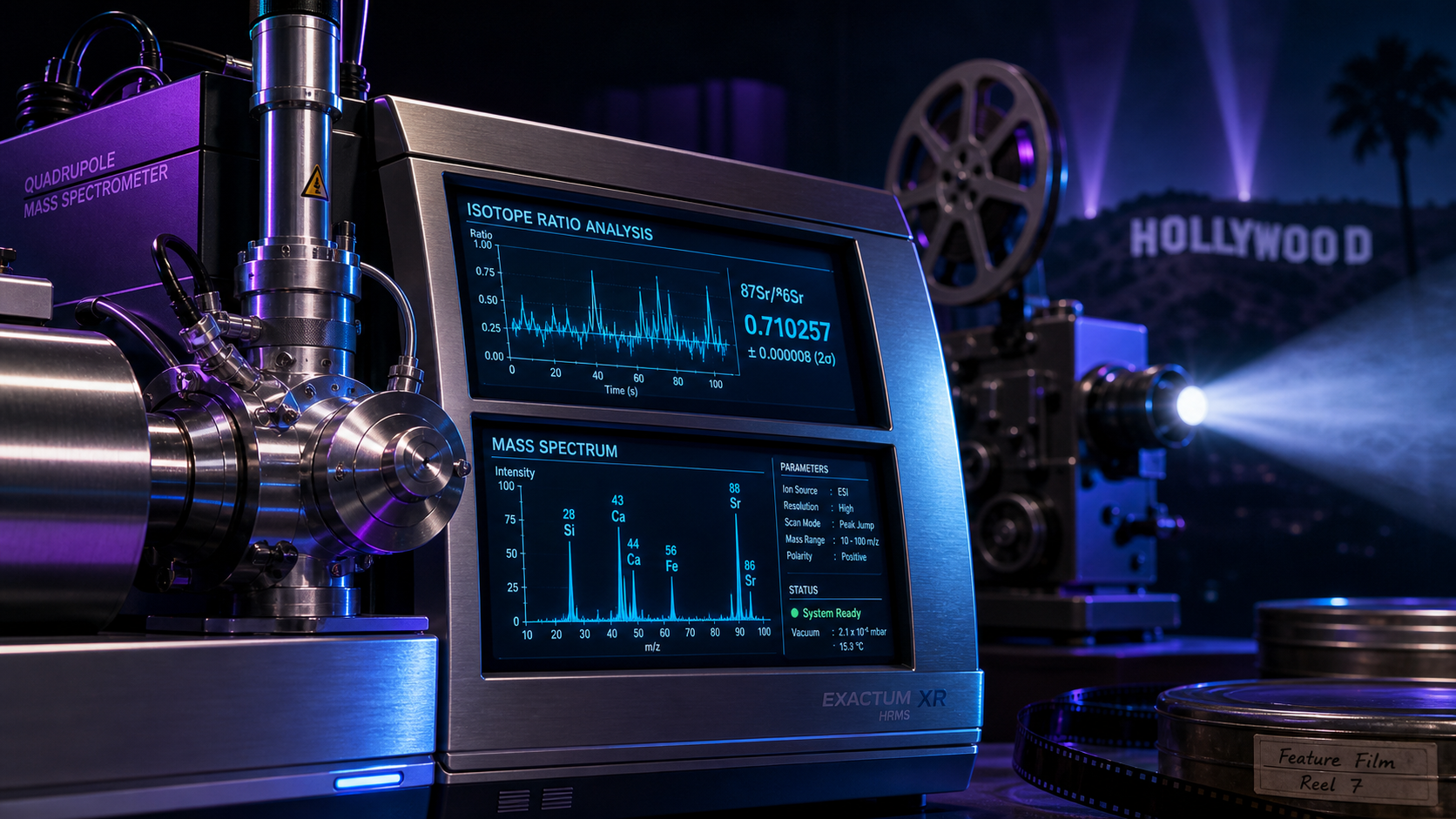
The second is a silicon sample from Ubatuba, Brazil, recovered in 1957. It tests at 99.999% purity — a standard that was beyond human manufacturing capability at the time — and its isotope ratios don't match terrestrial baselines. Isotope ratios are, in effect, the elemental fingerprint of where and how a material formed. When they deviate from what's found in Earth's crust and known industrial processes, that's the kind of anomaly that's supposed to send scientists back to the bench.
Nolan closed with a point about what anomalous materials might mean in the long run. Silicon, he noted, transformed civilization: "Everything we do today is based on silicon — all the AI." Whatever new materials or physical principles come out of rigorous UAP research, he suggested, the downstream implications could be just as consequential.
Disclosure Day opens in theaters June 12, 2026.