News / Jun 09, 2026
Robert Bigelow's UFO machine had a contract number
Robert Bigelow is usually treated as the billionaire who believed. The stronger story is the machine around him: a space-habitat company, a private paranormal institute, a ranch, a DIA contract, and an afterlife foundation.
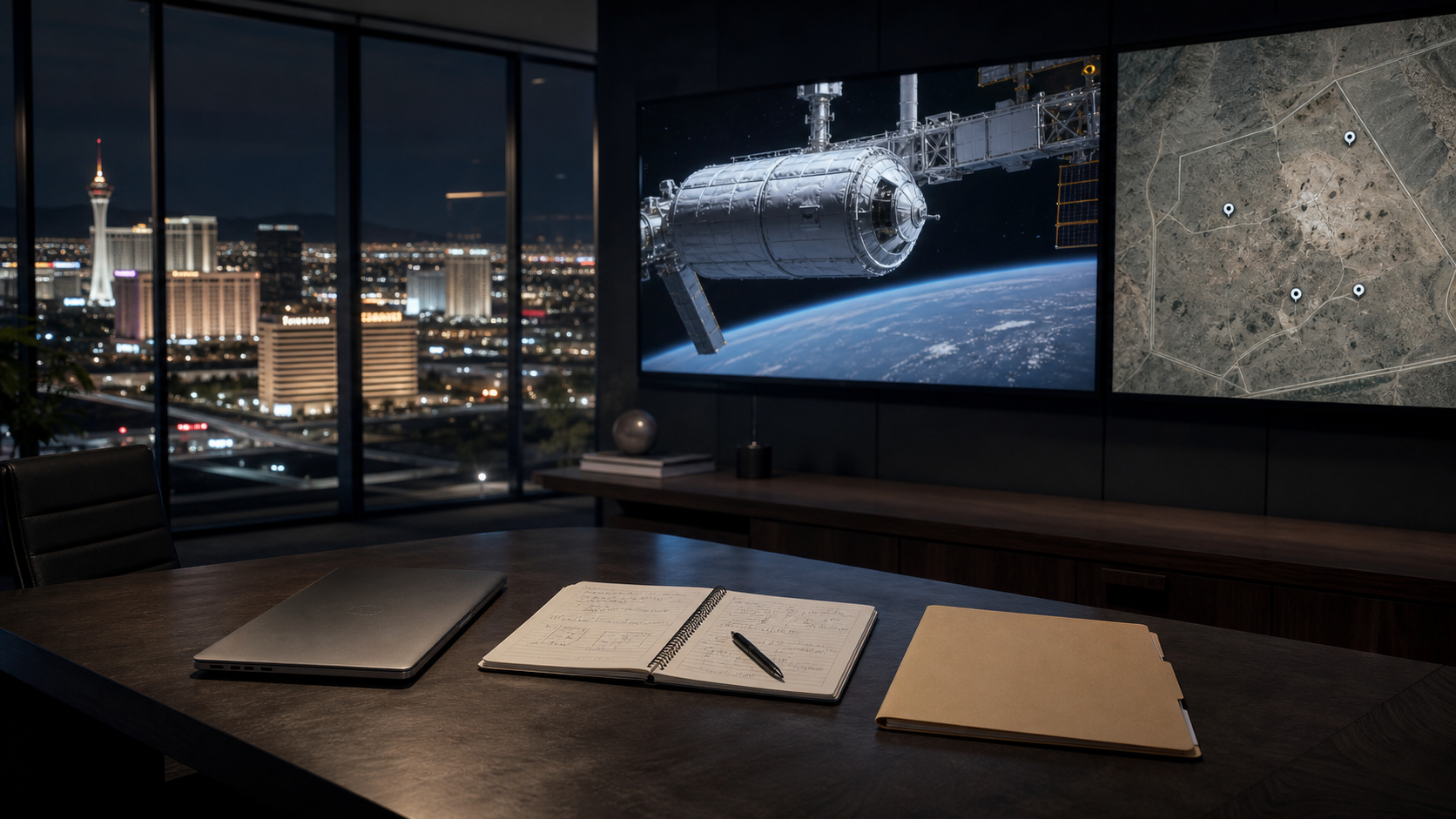
Robert Bigelow's UFO story has a better opening shot than a blurry light in the sky.
Las Vegas outside the window. A space-habitat module on an ISS screen. A Utah ranch map. A DIA contract file with a company name in it.
Bigelow is often flattened into one line: the billionaire who believed. That misses the stranger part. He built companies, funded researchers, bought places, hired people, and ended up in the middle of America's modern UFO turn with a federal contract attached.
Believer. Patron. Eccentric. Space entrepreneur. UFO kingmaker. The labels all catch something. The paper trail catches more.
Follow it long enough and the story stops looking like a personality profile. It starts looking like a private machine built around the impossible subjects.
The space company was real
Start with the part that left Earth.
NASA awarded Bigelow Aerospace a contract in 2013 to test the Bigelow Expandable Activity Module, BEAM, on the ISS. The module launched on April 8, 2016, was installed on April 16, expanded on May 28, and opened on June 6. NASA's own page lists the dimensions, the mass, the living volume, and the mission extension.
That changes the later UFO story. Bigelow was not only a rich man with an interest in strange things. He had a working aerospace company, federal relationships, technical staff, facilities, and money.
The UFO world has plenty of people with stories. Bigelow had buildings.
Before BAASS, there was NIDS
The weirder side was already there before the government contract.
In the 1990s, Bigelow created the National Institute for Discovery Science, usually called NIDS. Its subjects included anomalous aerial events, cattle mutilation reports, human effects, strange animal claims, and the Utah property that would become famous as Skinwalker Ranch.
Here the trail gets messier. NIDS was private. The ranch work was private. Some of the later story lives through books, interviews, television, and people who were inside that circle. The names became familiar: Colm Kelleher, George Knapp, researchers, investigators, witnesses, and a ranch that kept producing stories bigger than its records.
NIDS is the hinge. Bigelow did not arrive at the Pentagon as a casual donor who had just discovered UFOs. He had already spent years building a private anomaly shop.
Later, the government contract would land where that network already existed.
Then came BAASS
The sharpest part of the Bigelow story is not a ranch tale. It is a contract document.
The Defense Intelligence Agency contract file for the Advanced Aerospace Weapon System Applications Program names Bigelow Aerospace Advanced Space Studies, Inc., or BAASS. In the contract language, the BAASS proposal dated September 3, 2008, is incorporated by reference. The base year runs from September 22, 2008, to September 29, 2009. The contract type is listed as firm fixed price.
The work products sound less like a ghost story than an office: monthly status reports, a project management plan, research reports, travel, other direct costs, and a comprehensive integrated threat assessment.
The solicitation carried the number HHM402-08-R-0211. The Black Vault's copy of the original bid solicitation frames the work around future aerospace weapon-system applications and breakthrough technologies out to 2050. The listed topic areas are broad and strange in the way defense futures can be strange: lift, propulsion, control, power generation, spatial and temporal translation, materials, structure, signature reduction, human interface, human effects, and armament.
BAASS pulls Bigelow out of folklore. It was not only a name in UFO conversation. It was a company attached to a DIA program, a solicitation number, deliverables, and money.
It also gave the modern UFO story one of its most durable questions: what exactly did that machine collect?
The Pentagon door opened through Nevada
When the Pentagon UFO program broke into public view in 2017, Bigelow was already inside the frame.
The Washington Post reported that the Advanced Aviation Threat Identification Program had been formed to collect and analyze anomalous aerospace threats, that at least $22 million had been spent, and that official funding ended in 2012. The story also reported that the program operated out of the Pentagon and, for a time, a Las Vegas complex managed by Bigelow Aerospace.
The modern UFO news cycle did not start only in a Pentagon hallway or on a cockpit display. Part of its public origin story runs through a private aerospace complex in Las Vegas.
Smithsonian later summarized the AAWSAP/AATIP funding trail through Harry Reid, Ted Stevens, and Daniel Inouye, and described the Bigelow Aerospace role in exploring breakthrough aerospace possibilities, including the old UFO dream of reverse engineering.
Bigelow also supplied the quote that made him impossible to ignore. On 60 Minutes, he said he was "absolutely convinced" that Earth had been visited by extraterrestrials.
It was a perfect television line. The contract trail is better.
The UFO question became a staffing question
Belief is the noisy part. Staffing is harder to dismiss: who gets hired, where reports go, what a contract asks for, which experts are pulled into a program, and which private archive sits outside normal public-record channels.
A government-funded program can leave a paper trail, but a privately built anomaly network does not have to behave like a federal archive. Some names appear. Some reports surface. Some claims become public through interviews and books. Other parts remain inside company history, private files, or classified lanes.
That makes Bigelow more than another UAP personality. He is a routing point.
Before AAWSAP, he had NIDS. During AAWSAP, BAASS had the contract. Afterward, names from that world kept moving through Skinwalker, To The Stars, books, hearings, and UFO media. Colm Kelleher became one of the most recognizable bridges between the ranch, Bigelow-era research, and later UAP narratives. Luis Elizondo became the public face of the Pentagon-program story. Harry Reid became the political door.
Bigelow's machine did not settle the UFO case. It gave the UFO case buildings, payroll, reports, and institutional memory.
Why his name is back again
That is why Bigelow keeps getting pulled into 2026 UFO stories, even when he is not the one talking.
In March, Liberation Times reported that Representative Eric Burlison had visited Pax River after claims about a facility tied to an alleged Lockheed-to-Bigelow materials transfer. The story was hot because it put Bigelow back near the old recovered-materials question. Then the same report added a colder update: sources familiar with the trip said the specific hangar and runway details did not check out the way first described.
A separate rumor tried to make Bigelow the hidden source behind a supposed Trump UFO disclosure speech. That one did not hold. George Knapp said he contacted Bigelow directly and was told Bigelow had never met, spoken with, or emailed the filmmaker who had pushed the claim.
Both threads are useful for a different reason. They show how Bigelow's name still functions in the UFO economy: when a story needs a billionaire-sized back room, people reach for him.
Then the afterlife
The Bigelow trail did not stop at UFOs.
In 2020, Bigelow founded the Bigelow Institute for Consciousness Studies, or BICS. Its own site says the institute supports research into whether human consciousness survives physical death and into the nature of the afterlife. BICS later became a wholly owned subsidiary of the R.T. Bigelow Educational Foundation.
It looks like a different subject until the pattern repeats: Bigelow takes an edge question that mainstream institutions tend to keep at arm's length, then wraps it in money, structure, researchers, prizes, and a public-facing organization.
UFOs. Skinwalker. Human effects. Survival of consciousness. Different subjects. Same appetite for building around them.
The machine is the story
There are louder UFO names. There are better-known witnesses. There are people who produce cleaner headlines.
Bigelow is different because he keeps turning belief into organizations.
None of that makes the strongest claims true. None of it solves Skinwalker. It still leaves the BAASS collection, the AAWSAP archive, and the private side of the work partly out of view. But it does explain why his name keeps reappearing when the modern UFO story tries to trace itself backward.
NASA hardware. NIDS. Skinwalker Ranch. BAASS. AAWSAP. BICS.
The Bigelow file is not a personality profile and not a proof claim. It is a map of how one private actor helped build a UFO machine that became hard to separate from the government's own UAP era.
Related UAP Logbook reading
- Bob Lazar has a checkout page
- The Navy UFO patents did not disappear
- The CIA archive has a UFO and psi problem
- Four alien species, one media chain
Sources
- NASA: Bigelow Expandable Activity Module
- NASA: NASA to test Bigelow expandable module on space station
- DIA / AAWSAP contract file, via The Black Vault document archive
- The Black Vault: AAWSAP original bid solicitation
- The Washington Post: Head of Pentagon's secret UFO office sought to make evidence public
- Smithsonian Air & Space: The Year of UFOs
- Liberation Times: White House-approved trip allegedly took congressman to Maryland base
- Business Times: Trump UFO disclosure speech claim collapses after source denial
- Bigelow Institute for Consciousness Studies