
Short Note / Jun 18, 2026
The UAP science council now has a board above it
The fresh UAP story is not only Avi Loeb's science council. DefenseScoop and Liberation Times now report that ODNI, the FBI, and the Department of War established a higher-level UAP Governance Board.
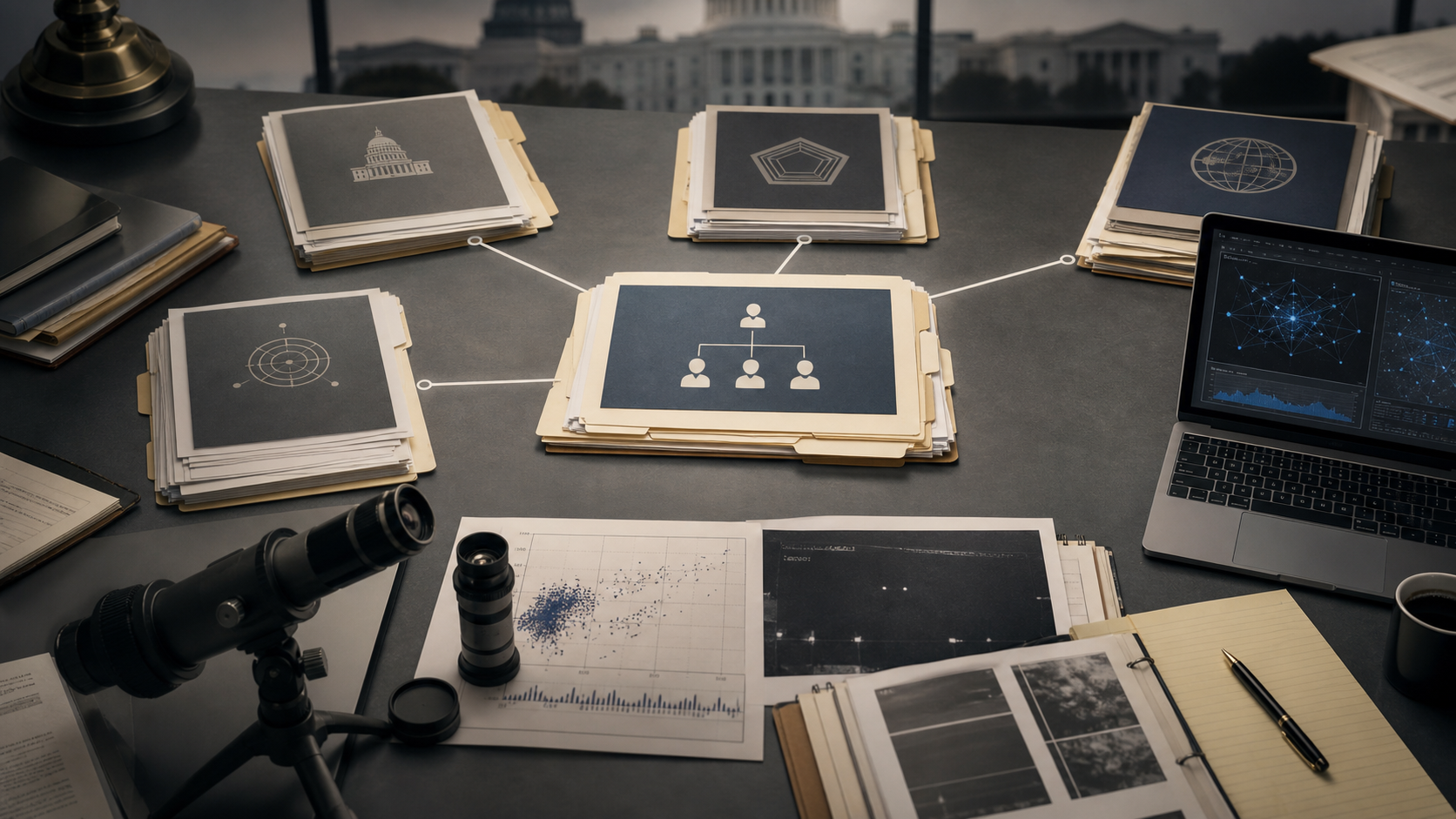
The new UAP science council is no longer the whole story.
A higher-level UAP Governance Board now sits above it, according to new reporting from DefenseScoop and Liberation Times. ODNI, the FBI, and the Department of War are described as standing up an interagency body to coordinate UAP investigations, data handling, and declassification support. Avi Loeb's UAP Science Advisory Council appears to be one advisory layer under that structure.
That changes the useful question. It is not just "Is Loeb leading a council?" It is "What is the board the council reports to, and what records will that board create?"
What changed
UAP Logbook already covered Loeb's first public announcement on June 14. At that point, the narrow version was clear: Loeb said he had been asked to assemble a UAP science advisory team, but the public record did not yet show what kind of official structure the group had.
Since then, two things have moved.
Loeb published more details, saying the council would report to a higher-level UAP Governance Board — one meant to bring together military, law-enforcement, intelligence-community, and civilian-agency capabilities around UAP-related national-security questions.
DefenseScoop then reported an ODNI confirmation: the board met for the first time during the week of June 15, was established by ODNI alongside the FBI and the Department of War in support of President Trump's UAP transparency directive, and is supported by multiple outside advisory groups, including Loeb's science council. Liberation Times reported the same basic structure on June 16, citing an ODNI official and describing the board as a new interagency body for coordination, investigation support, data collection and analysis, and declassification.
The board, not the council
The science council has the more visible names.
Loeb's list includes Carol Cleland, Kevin Knuth, Tim Gallaudet, Garry Nolan, Michael Shermer, Matthew Szydagis, Jennice Vilhauer, and others — researchers and public figures tied to anomaly identification, data analysis, instrumentation, oceanography, biology, materials science, psychology, anthropology, statistics, and skepticism. That roster will get attention because it makes the UAP story look like a science story.
The board is the part that makes it a government-process story. If ODNI, FBI, the Department of War, AARO, and other agencies are coordinating through a named UAP Governance Board, then the next public-interest questions are procedural: who sits on it, what authority it has, whether it has a charter, what records it creates, and how it affects the release of UAP files through PURSUE.
The board appears designed for exactly the kind of mess PURSUE has already put in public view. Release 03 alone included FBI orb files, a CIA Harare airport report, NASA audio, a 1949 Army flying-saucer study, a Colorado Springs witness-rendering-analysis chain, and an AARO Western U.S. Event memo — cases that touch law enforcement, military sites, intelligence holdings, historical records, technical analysis, and declassification decisions at the same time.
What the record still lacks
During this pass, I did not find a standalone ODNI, AARO, White House, or Department of War page publishing the board's charter, membership, meeting records, or terms of reference.
That does not mean the board is not real. DefenseScoop and Liberation Times both report ODNI involvement. It means the public paper trail is still thin.
The next useful records would be simple: a charter, a named chair, member agencies, meeting cadence, public points of contact, declassification workflow, advisory-group list, or a statement explaining whether the outside science council is formal, informal, temporary, or attached to another advisory mechanism.
Whether those records appear is the next test that matters.
Related UAP Logbook notes
- Is Avi Loeb leading a new government UAP science council? Here's what is known
- PURSUE Release 03 is out: CIA files, FBI orbs, and a 1949 flying saucer study
- "Orbs Launching Orbs": The unresolved AARO case from PURSUE Release 03
- What is PURSUE? The UAP records release program explained
Sources
- DefenseScoop: New science advisory council forms to help US government "resolve the UAP mystery", Brandi Vincent, June 17, 2026.
- Liberation Times: U.S. Government Establishes New Interagency UAP Governance Board to Coordinate Investigations and Declassification, Christopher Sharp, June 16, 2026.
- Avi Loeb: More Details on the UAP Science Advisory Council, June 2026.
- UAP Logbook: Is Avi Loeb leading a new government UAP science council? Here's what is known, published June 14, 2026.
- Department of War: PURSUE portal.