
News / Jun 18, 2026
Hal Puthoff's UFO paper trail runs from SRI to To The Stars
Hal Puthoff is not a new UFO name. His public trail runs through SRI remote-viewing work, CIA archive files, EarthTech, To The Stars Academy, and the modern UAP network.
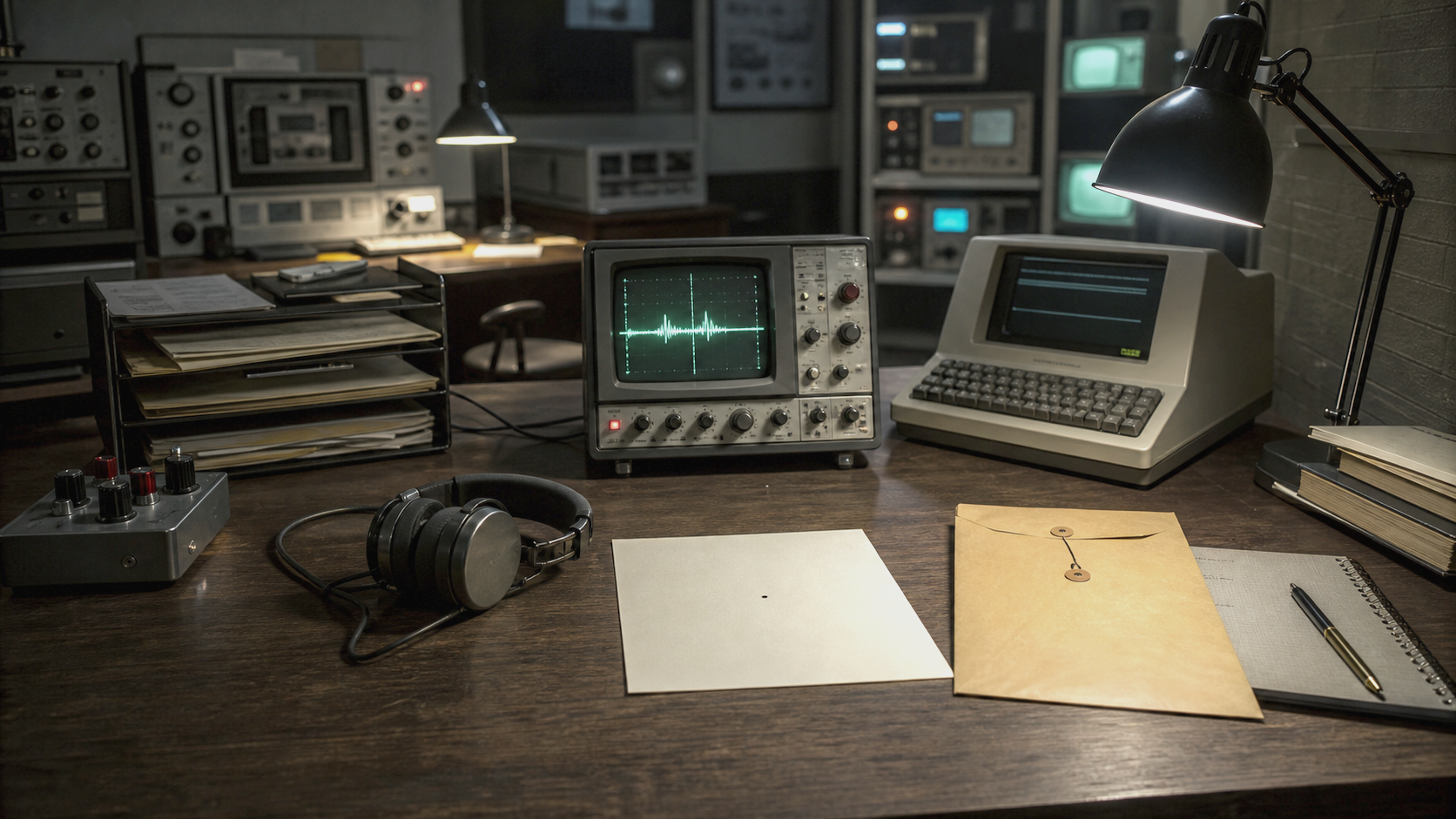
Hal Puthoff is not a new name in UAP stories. He is one reason several older threads keep reappearing.
His public biography runs from remote-viewing research at Stanford Research Institute in the 1970s, through a private frontier-physics institute in Austin, to a co-founder role at To The Stars Academy when Luis Elizondo went public in 2017.
That trail does not prove the big UAP claims. It shows how psi research, exotic propulsion, intelligence programs, and anomalous-craft stories came to share the same people and vocabulary for decades.
The SRI files
The first concrete part of the record is Stanford Research Institute.
CIA Reading Room files contain SRI remote-viewing material involving Puthoff and Russell Targ: experiments in which subjects were asked to describe remote sites unknown to them, documented and funded by U.S. intelligence agencies.
That archive is not proof that remote viewing worked. It is proof that the government-funded research trail is real enough to inspect.
For anyone following modern UAP claims, the distinction matters. The files gave later UAP culture something it still uses: paperwork around the strange.
EarthTech and the technical wrapper
Puthoff founded the Institute for Advanced Studies at Austin in 1985, according to EarthTech, and that institute was later incorporated under EarthTech International in 1991. EarthTech lists Puthoff as its founder, president and CEO, and director of the Austin institute.
EarthTech's public material covers spacetime metrics, quantum vacuum topics, exotic propulsion, interstellar flight science, and advanced energy sources.
Those subjects are not evidence of hidden craft or recovered technology. They explain why Puthoff fits so easily into UAP stories: he brings technical language to subjects that otherwise collapse into folklore.
Zero-point energy and vacuum physics give the UAP conversation a scientific surface, even when the underlying claim has not been demonstrated.
The disclosure-era network
After the New York Times pushed the Pentagon UFO story into mainstream view in 2017, Puthoff was already positioned for the moment. To The Stars Academy publicly identified him as a co-founder and vice president of science and technology alongside Elizondo.
Bigelow, Skinwalker Ranch, NIDS, AATIP, To The Stars, remote viewing, and frontier physics all became part of the same search cloud.
That network is easy to overdraw. The weaker version turns every crossing into a hidden master plan. The more useful version is narrower: a small group of people with long histories in intelligence, aerospace, anomalous research, and speculative physics kept turning up near the same questions.
Puthoff is one of the clearest examples.
What the record shows
The paper trail does not settle the big claims. It does not prove remote viewing was reliable, that vacuum-energy propulsion is classified, or that UAP files contain recovered craft.
What it does show is structural.
The modern UAP conversation moves from craft sightings to consciousness, from consciousness to intelligence programs, from intelligence programs to private research, and from private research to exotic propulsion because some of the same people helped carry those subjects together.
Puthoff's public trail is one of the cleaner maps of how that happened.
Related UAP Logbook reading
- Robert Bigelow's UFO machine had a contract number
- The CIA archive has a UFO and psi problem
- The Navy UFO patents did not disappear
- The UFO control panel in Lyn Buchanan's story
Sources
- CIA Reading Room: SRI remote-viewing paper involving Russell Targ and Harold Puthoff
- CIA Reading Room search: Harold Puthoff
- EarthTech International: About
- EarthTech International: Principal team
- To The Stars: research page and TTS Talks reference to Hal Puthoff
- To The Stars Academy press page naming Puthoff's role