Main Article / Jul 20, 2026
Could UFOs cross the stars? What known physics permits — and what remains open
The nearest star is more than four light-years away. Known physics offers some serious ways to send a machine across that distance, and several famous ideas that remain mathematics. A future theory may enlarge that menu. None of it turns an unusual UAP observation into evidence of interstellar travel.
The nearest star beyond the Sun is Proxima Centauri, more than four light-years away. A signal gets there in a little over four years. A conventional spacecraft would take far longer. That distance is the quiet problem sitting behind almost every story about visitors from another star.
It is also why UFO conversations reach for the same words: antimatter, gravity control, warp drive, wormholes, zero-point energy. The words have different scientific standing. Some describe real engineering paths that may one day move a small machine very fast. Some describe mathematical solutions in general relativity. None is a demonstrated explanation for an object seen on a military sensor or in a phone video.
The useful question is narrower: if a civilization wanted to send something across interstellar space, what technologies does known physics leave on the table — and what would have to change before more exotic ideas became engineering?
The distance does not require faster-than-light travel
“Interstellar” does not automatically mean faster than light. It means accepting a hard trade: either the journey takes a long time in the departure-and-arrival frame, or the vehicle reaches a substantial fraction of light speed and takes on an enormous energy, shielding and braking problem. At those speeds, relativity also separates the clocks: less time passes for travellers than for the people who stayed home. That changes the human experience of a mission, not the distance it has to cross.
NASA propulsion studies sort the landscape this way. Near-term work can improve missions through the Solar System with electric propulsion, sails and nuclear systems. A true trip to another star pushes toward concepts such as fusion, beamed-energy sails and antimatter. Those are not all equally mature. They are a ladder from hardware already flown to designs that exist mainly on paper.
For an unmanned probe, time is less of a biological problem. A machine does not need a life-support system or a return ticket. That does not make the journey easy. It changes the architecture.
Light sails are real, even if the interstellar version is not
A sail in space is not a metaphor. Sunlight carries momentum. A large reflective sheet can use that pressure for a slow but continuous push without carrying conventional propellant. NASA has flown solar-sail technology and has studied it for deep-space and interstellar precursor missions.
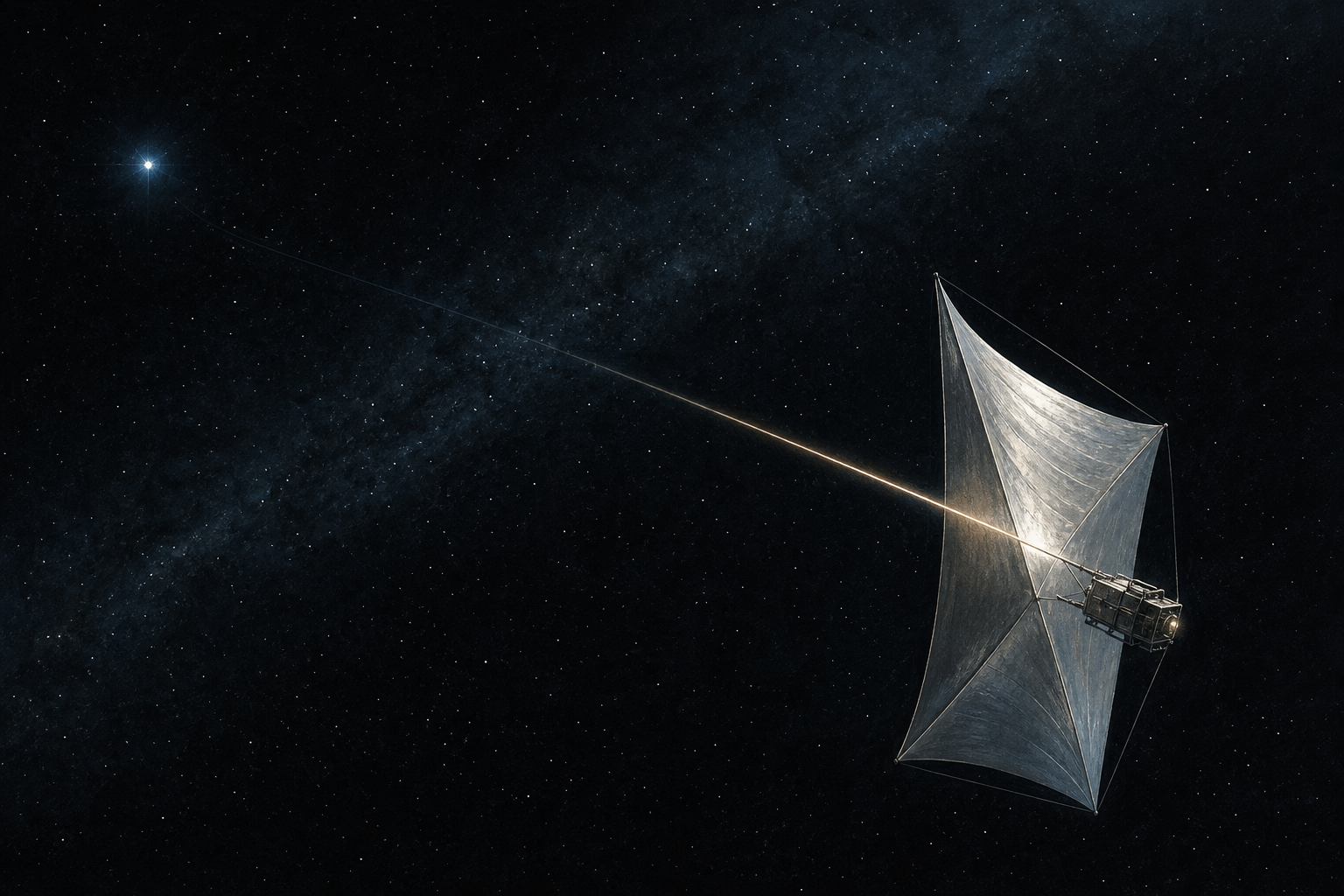
The more ambitious version replaces sunlight with a powerful, precisely aimed laser or particle beam. The vehicle can stay very light because the energy source remains at home. In principle, that is an attractive way to accelerate a tiny probe to a meaningful fraction of light speed.
The catch is visible in the sentence: the infrastructure is not on the craft. It is a huge energy and pointing system somewhere else, operating over immense distances. The sail must survive the beam, navigate interstellar dust and eventually slow down. A fast flyby is easier than an arrival.
That makes light sails a propulsion family with a working physical mechanism, not a ready-made UFO explanation.
Nuclear engines may be the least exotic answer
Fission reactors already power spacecraft systems. Nuclear-electric propulsion uses a reactor to make electricity for a high-efficiency engine. Fusion would go much further, if an engine can repeatedly confine and direct a fusion reaction with a useful mass ratio.
There is no working fusion starship. Fusion is a known physical process, studied for propulsion because it releases much more energy per unit mass than chemical reactions. NASA’s interstellar propulsion assessments list it among the concepts that could support a future precursor mission or, further out, interstellar travel.
Even a successful fusion vehicle would still be a vehicle. It would need reaction mass or another way to exchange momentum, radiators for waste heat, shielding against particles and a credible way to slow down. Fast travel makes every grain of dust in front of the craft part of the engineering problem.
Antimatter has energy. It does not have an easy engine.
Antimatter is the most tempting entry on the list because matter-antimatter annihilation converts an exceptional fraction of mass into energy. NASA has studied it as an advanced propulsion concept; CERN produces and traps antimatter for physics experiments.
CERN’s ALPHA experiment showed the scale of the gap in a useful way in 2011, holding antihydrogen atoms for 1,000 seconds — more than 16 minutes — so their properties could be studied. That was a major laboratory result. It was not a fuel tank.
An antimatter spacecraft would inherit a factory, a storage trap, radiation shielding, thermal control and a way to turn violent particle products into directed thrust. The fuel is not a small detail. It is the mission.
UAP Logbook has covered that engineering ledger in more detail in Antimatter is the perfect UFO fuel until you try to store it. The short version is simple: real physics is not the same thing as available hardware.
Warp drives and wormholes are not propulsion programmes
Warp drives and wormholes appear in serious theoretical papers because general relativity allows physicists to ask difficult questions about spacetime. The famous Alcubierre metric, for example, is a mathematical model in which space contracts ahead of a craft and expands behind it. The craft is not locally outrunning light inside its bubble.
That sentence is often turned into a headline saying that faster-than-light travel has been solved. It has not. Standard analyses find that the familiar warp-drive models require violations of classical energy conditions — in plain language, forms of energy or matter not available as an engineered resource. They also raise problems involving horizons, stability and causality.
This is an active theoretical frontier, not a closed door. Recent papers have explored constant-velocity, subluminal spacetime constructions designed to satisfy standard energy conditions. That is a meaningful refinement of the mathematics. It is still far from a fast interstellar vehicle: the proposed constructions retain large energy and control problems, and do not demonstrate faster-than-light travel.
NASA’s former Breakthrough Propulsion Physics project, active from 1996 to 2002, looked at ideas including warp drives, wormholes and vacuum-energy questions. It was an exploratory research effort, not a declaration that a warp engine had been found. Its own framing stressed that the underlying goals could be far from fruition or impossible.
The distinction matters because a metric is not a machine. A paper can describe what spacetime would have to do. It does not supply the material, power source, control system or experiment that makes it happen.
The most economical visitor may be a probe
If interstellar travel is ever practical, an automated probe is the least demanding version. It can be small, patient and expendable. It does not need to protect a crew through acceleration, radiation and decades or centuries of travel. That is an engineering inference, not evidence that any probe is here.
It also points to a useful correction in the popular picture. A civilization capable of interstellar travel would not necessarily arrive in a large, silent craft that performs impossible turns over a military range. It might send instruments that look nothing like familiar aircraft. Or it might not come at all. Physics can outline possibilities without supplying a visitor.
What a UAP report would have to show
Interstellar propulsion should be the last step of an argument, not the first. Before naming an engine, a report needs to establish the object’s motion: range, speed, acceleration, altitude, sensor mode, calibration, camera geometry, weather, platform position and the possibility of ordinary traffic, balloons, astronomy or electronic artefact.
Only then does a propulsion question become meaningful. An unusual appearance is not a power source. A rapid-looking movement in a clip is not an acceleration measurement. A classified setting is not a propulsion test report.
Known physics leaves room for ambitious machines. It is not a claim that nature has given up all its surprises. A future theory could enlarge the menu; to matter here, it would still have to produce measurements, predictions and eventually machines. Until then, an unidentified object does not get a free pass from the distance to the stars. The evidence gap between a possible propulsion concept and a demonstrated visitor remains real.
Related UAP Logbook reading
- Antimatter is the perfect UFO fuel until you try to store it
- When physicists propose an antigravity experiment, the UAP world listens
- The UFO claims hiding inside physics words
- Charles Buhler on force, not energy
Sources
- NASA Technical Reports Server: Prospects for Interstellar Propulsion — survey of solar sails, directed-energy sails, fusion and antimatter concepts.
- NASA: Status of Solar Sail Propulsion Within NASA – Moving Toward Interstellar Travel.
- NASA: electric-sail technology overview.
- NASA Technical Reports Server: Marc G. Millis, Prospects for Breakthrough Propulsion From Physics.
- CERN: ALPHA experiment traps antihydrogen atoms for 1,000 seconds.
- Miguel Alcubierre and Francisco S. N. Lobo, Warp drive basics.
- Pfenning and Ford, Fundamental limitations on “warp drive” spacetimes.
- Fuchs et al., Constant Velocity Physical Warp Drive Solution — a recent subluminal, positive-energy construction.