News / May 26, 2026
A 1963 White House space memo discussed the "space alien race" question
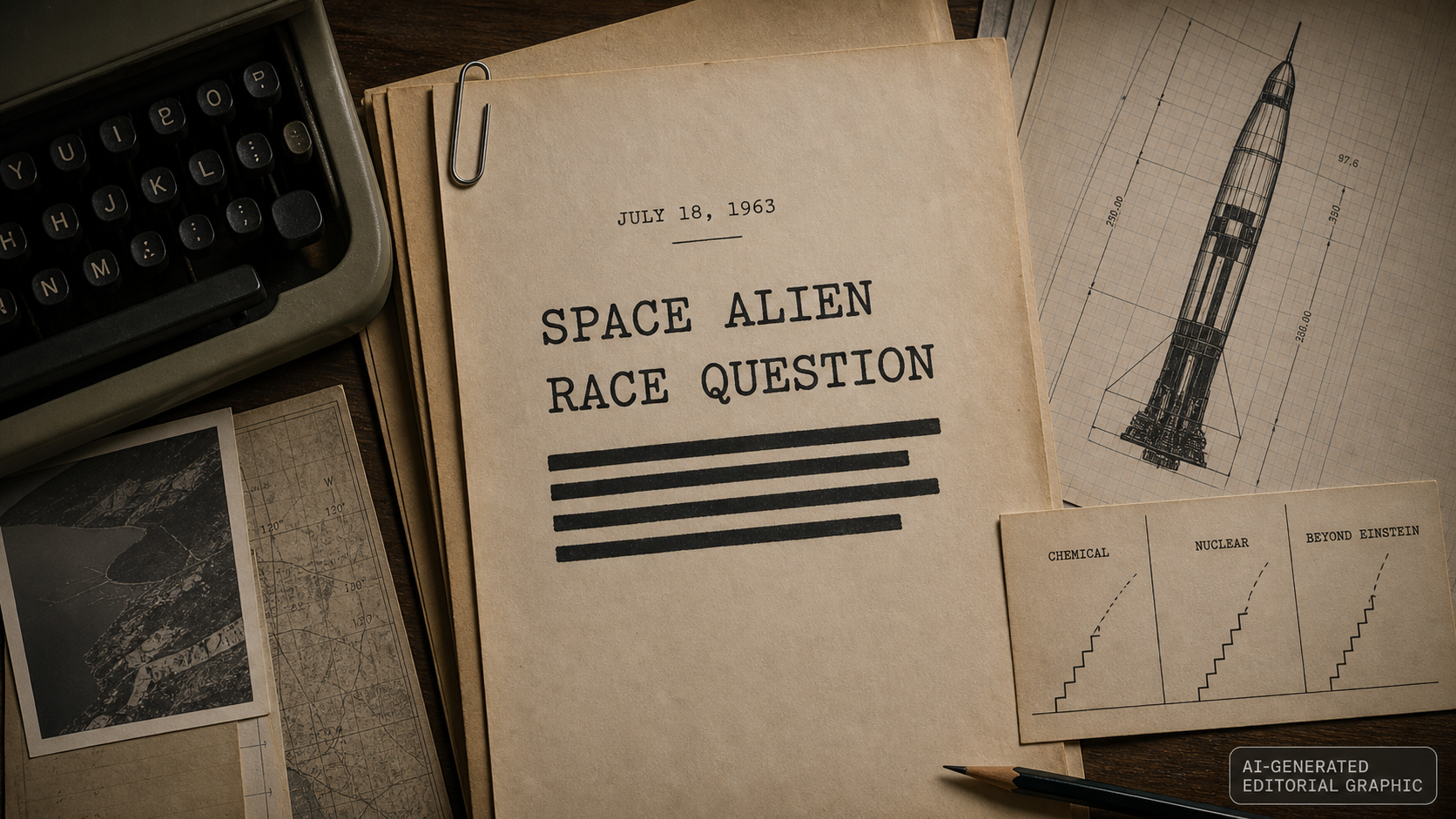
A July 1963 National Aeronautics and Space Council memo discussed what U.S. policy should do if alien intelligence were discovered in space. The memo sorted possible contact scenarios by technology level.
The file
War.gov's first UAP file release includes a July 18, 1963 memorandum with the subject line "Thoughts on the Space Alien Race Question."
The memo was written by Maxwell W. Hunter II, a member of the professional staff of the National Aeronautics and Space Council. It was sent to Robert F. Packard at the State Department's Office of International Scientific Affairs.
The first paragraph says the question had occasionally arisen during recent discussions: what should be done if an alien intelligence were discovered in space?
Scientific view and saucer claims
Hunter wrote that the consensus scientific view considered the chance of encountering an alien intelligent race in the solar system negligible. He attributed that view mainly to the presumed unsuitability of other planets for life as humans knew it.
He then noted the opposite claim from flying-saucer advocates: that there was overwhelming evidence of such beings.
Hunter wrote that he found it difficult to side with flying-saucer advocates, but also found the near-total impossibility envisioned by most scientists disturbing.
Life beyond the solar system
The memo then turns to the change in scientific thinking about planets and life outside the solar system.
Hunter wrote that older theories had treated other planetary systems as rare. By 1963, he said, the more common view was that planetary systems were a natural consequence of stellar evolution.
On that basis, he wrote, the number of habitable planets in the galaxy would be tremendous. He also noted that biology had moved closer to explaining a path from inanimate molecules to elementary living viruses.
That did not, in his wording, necessarily imply intelligent life.
Mars and the Moon
Hunter then separates possible intelligence outside the solar system from possible intelligence inside it.
For Mars, he mentions the old canal discussion and the idea that markings on Mars had been interpreted as signs of intelligence. He also describes a flying-saucer school of thought claiming that Martians had been mining the Moon.
The memo works through that idea in terms of travel energy. Mars has a lower escape speed than Earth, and the Moon would be easier to leave than Earth. Hunter wrote that a high-energy chemical rocket could, at favorable times, make a Mars-to-Moon trip while carrying payload.
The Moon section also lists three items that, if viewed less confidently, could be read as hints: reported hot gases from Alphonsus, infrared hot spots, and the lack of major successful lunar or planetary probes despite major U.S. and Soviet efforts.
Three contact scenarios
The later pages sort possible contact into three broad scenarios.
The first is an intelligence within the solar system using chemical spaceflight. In that scenario, Hunter wrote, current national policy might already be suited to the situation.
The second is an interstellar race moving at a large fraction of light speed, possibly expanding from star to star and stopping to refuel, deposit colonists, and build additional ships.
The third is an alien race able to travel faster than light. Hunter wrote that, if such a race were encountered, policy should be to negotiate quickly because the implications of its control of fundamental forces would be obvious.
Conclusion in the memo
Hunter's conclusion says plausible scientific thinking suggested that another intelligence race would not be found, but that the probability was finite and should perhaps not be completely ignored.
If such a race were found, he wrote, the first question would be whether it used primitive chemical spaceflight, nuclear-energy-level spaceflight, or physics beyond Einstein.
He added that a policy of immediately burying terrestrial hatchets would likely be in order.
The final paragraph says there was likely nothing to do at the moment because no one of consequence would take the subject seriously unless it happened. If it did happen, he wrote, policy would be determined by grand panic.
Public trail
War.gov lists the file as 59_214434_SP 16 [7.18.1963] in Release 01. The entry describes it as a declassified memorandum from the National Aeronautics and Space Council.
The same text also appears in the State Department's Foreign Relations of the United States series, in volume XXV for 1961-1963.
The public record currently available is the memo itself and its publication trail. It is not a sighting report and does not attach a case file, sensor record, or later policy follow-up.