News / Jul 14, 2026
Enceladus, Europa, and Titan: Where the Search for Life Is Going Next
Fresh Cassini data from Enceladus, Europa Clipper in cruise, Dragonfly delayed to 2028, JUICE past Venus — and a NASA Decadal Survey flagship on the drawing board. The search for life has moved off Mars and into the moons.
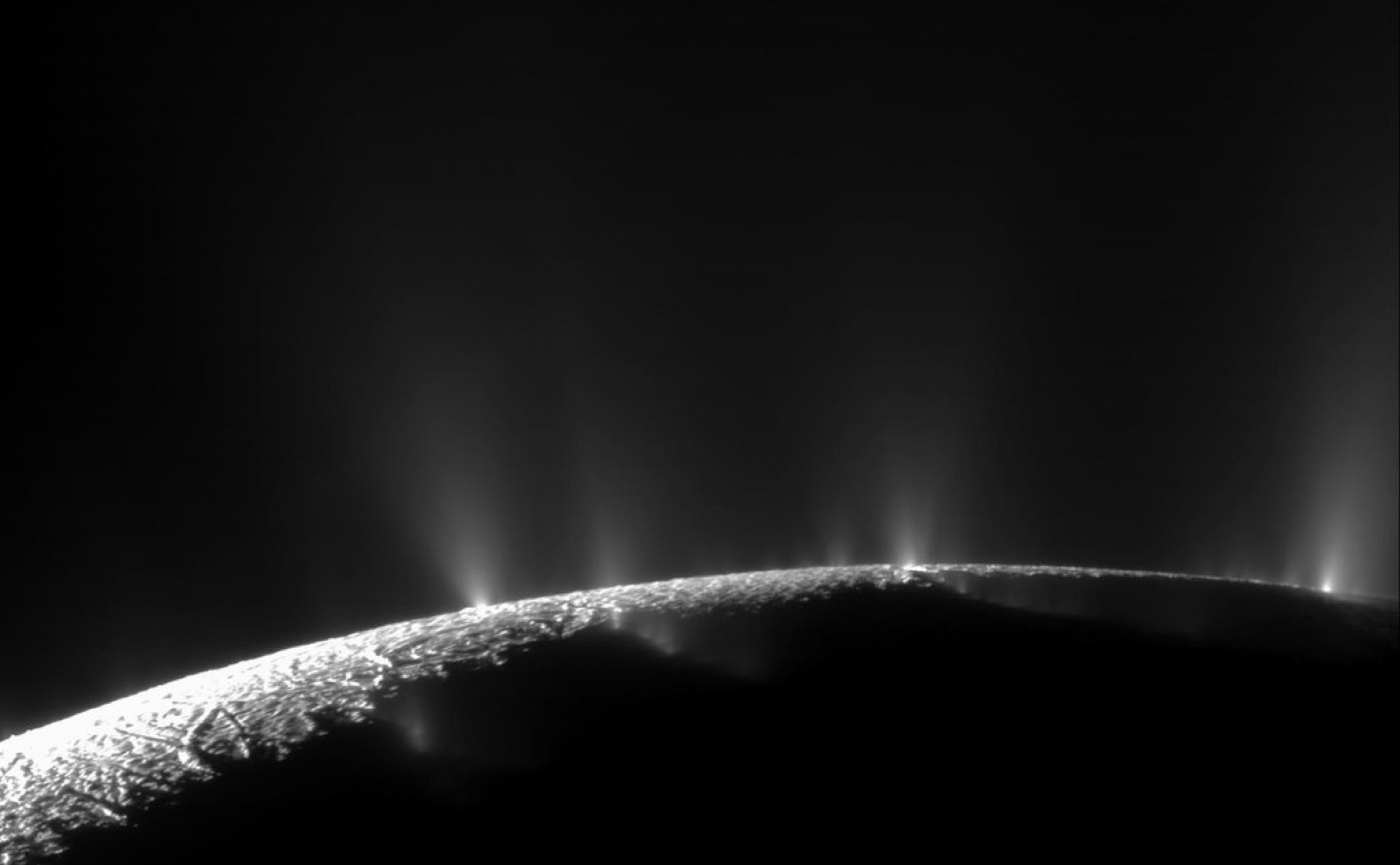
The ice was only minutes old when Cassini caught it.
In March 2008, the Saturn-bound spacecraft dove through the plume rising from Enceladus's south pole — a small moon whose icy shell hides a global liquid-water ocean. Its Cosmic Dust Analyzer recorded the impacts of ice grains smaller than a flu virus and stored the resulting spectra. Seventeen years later, a team at Freie Universität Berlin reanalyzed that data with updated reference libraries and a sharper question: what exactly was in that freshly ejected material?
The answer, published Oct. 1, 2025 in Nature Astronomy, is that the fresh ice carried a richer, more biologically suggestive organic inventory than the older, space-weathered ice drifting in Saturn's E ring. Led by Nozair Khawaja with Fabian Klenner and Frank Postberg, the team identified aliphatic and aromatic compounds, esters, ethers, alkenes, and tentative nitrogen- and oxygen-bearing fragments. Esters and ethers are the same chemical families that form the backbone of lipids — a basic component of every cell wall on Earth.
"These molecules we found in the freshly ejected material prove that the complex organic molecules Cassini detected in Saturn's E ring are not just a product of long exposure to space, but are readily available in Enceladus's ocean," Postberg said.
The paper does not claim to have found life. It claims the chemistry is real, that it originates in the ocean, and that it survives the trip from seafloor to space largely intact.
What "Fresh" Ice Reveals
Earlier plume studies relied mostly on E-ring ice — material that had drifted out of Enceladus's gravity and spent years irradiated by Saturn's magnetosphere. That work had already found organic compounds, salts, silica nanoparticles, phosphates, and molecular hydrogen, all consistent with water-rock reactions on an alkaline, hydrothermal-vent-style ocean floor.
The 2025 reanalysis instead isolated grains that had been in space for minutes, giving a more direct read on ocean chemistry before radiation could alter it. The 2008 flyby turned out to be unusually data-rich because Cassini crossed the plume's densest region at high relative speed; once water-cluster interference was modeled out, organic fragment patterns emerged that slower passes had missed.
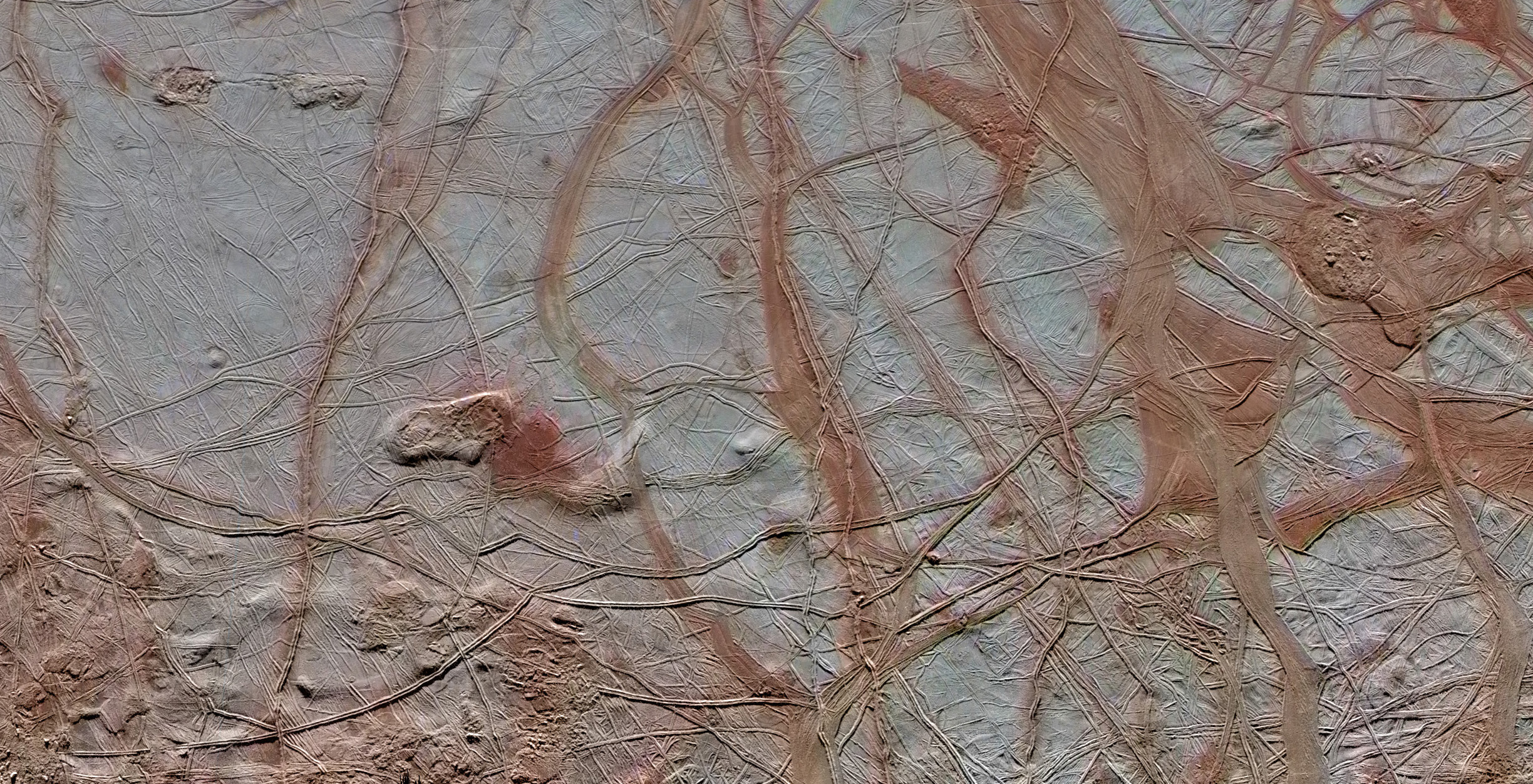
The paper's language stays measured: the new compounds "lay a potential path to chemical or biochemical activity," and the ocean's chemistry "supports reactions capable of forming more elaborate organic structures." It stops short of claiming life — but it does say the door to more direct sampling is now open.
Three Moons, Three Arrival Dates
The 2025 findings matter less for what they claim than for what they imply about the next decade of astrobiology.
On Mars, the search has stalled on sample return. Perseverance has cached rocks NASA calls potential biosignatures, and Curiosity has expanded the catalog of surface organics, but the cached samples have no funded U.S. flight program home. China's Tianwen-3 is on a separate track, targeting a Mars sample return around 2031.
The ocean moons don't share that bottleneck. Enceladus is already ejecting its ocean into space, and Cassini proved a passing spacecraft can catch it. Europa vents volatiles more slowly, supported by Hubble and Galileo observations. Titan has a thick atmosphere and active surface chemistry a rotorcraft can fly through. Three of the solar system's most plausible "habitable now" environments are moons — and all three sit within the next decade of spaceflight.
Europa Clipper Is Already in Flight
NASA's Europa Clipper launched Oct. 14, 2024 on a Falcon Heavy, making it the largest interplanetary spacecraft the agency has flown. It reaches the Jupiter system in April 2030, using a Mars gravity assist completed March 1, 2025, and an Earth gravity assist planned for December 2026 to conserve propellant.
During the Mars flyby, the spacecraft tested its ice-penetrating radar, REASON, in space for the first time. The instrument's antennas, mounted on the solar arrays, are too large to test fully on Earth. Over 40 minutes, REASON sent and received signals off the Martian surface, returning roughly 60 gigabytes of data and a clean radargram. "Every part of the instrument proved itself to do exactly what we intended," the principal investigator said. The next day, the thermal imager E-THEMIS captured over 1,000 infrared images of Mars, calibrated against the 25-year-old Mars Odyssey THEMIS dataset.
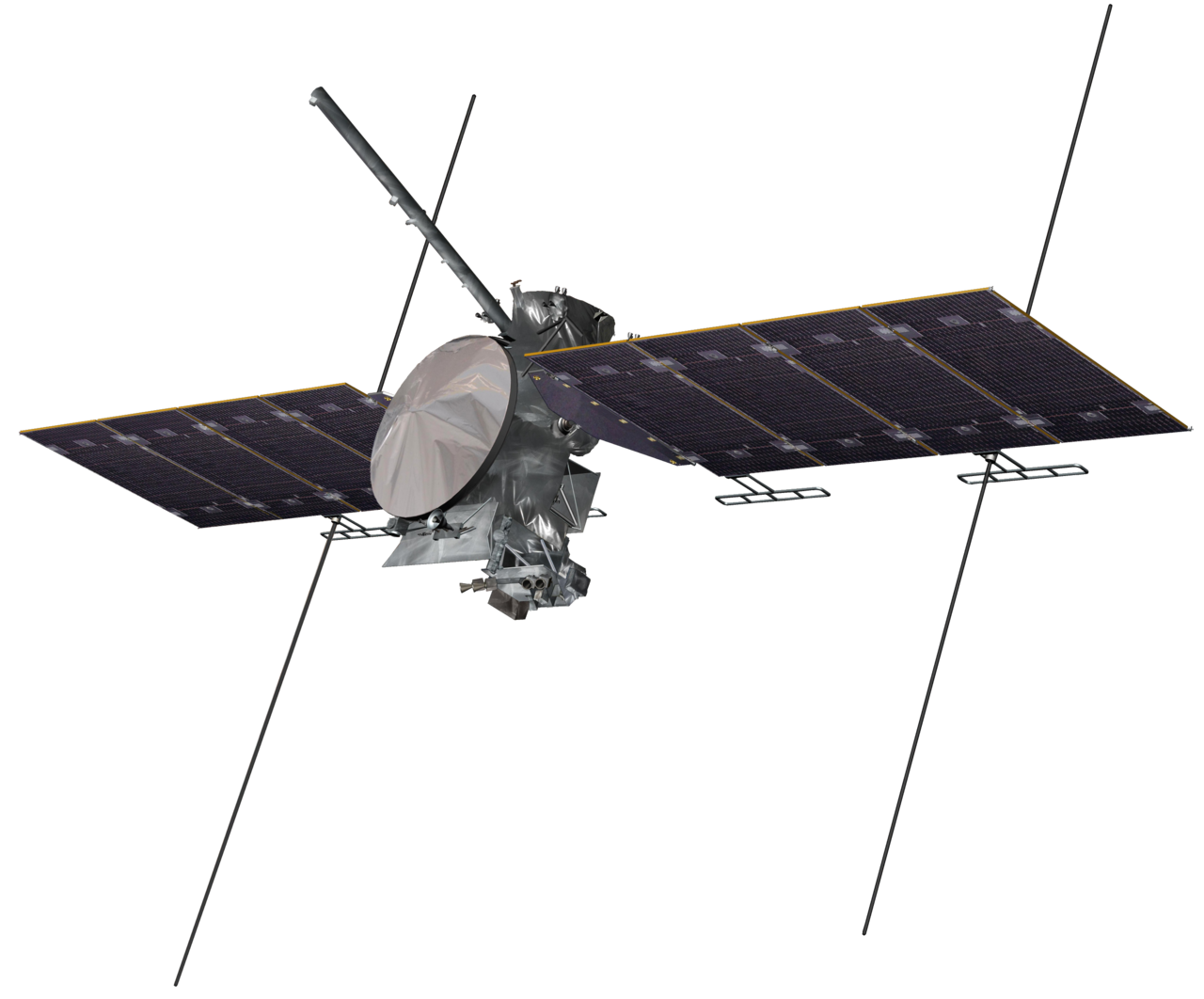
At Jupiter, Clipper will make roughly 49 close flybys of Europa, dipping to about 16 miles above the surface. None of its nine instruments detects life directly. REASON probes the ice shell, MASPEX samples venting gases, SUDA analyzes ejected ice grains, MISE maps organics and salts, and the magnetometer constrains the ocean's depth and salinity. Clipper is built to determine whether Europa could support life — not whether it does. NASA has been explicit about that distinction.
Titan Is the Chemistry Experiment
Titan is the only moon with a thick atmosphere and the only body besides Earth with stable surface liquids — in this case, methane and ethane at roughly 90 Kelvin rather than water. Equatorial dunes are made of organic sand, and the northern lakes and seas are liquid hydrocarbons sitting atop an icy crust that likely conceals its own subsurface water ocean.
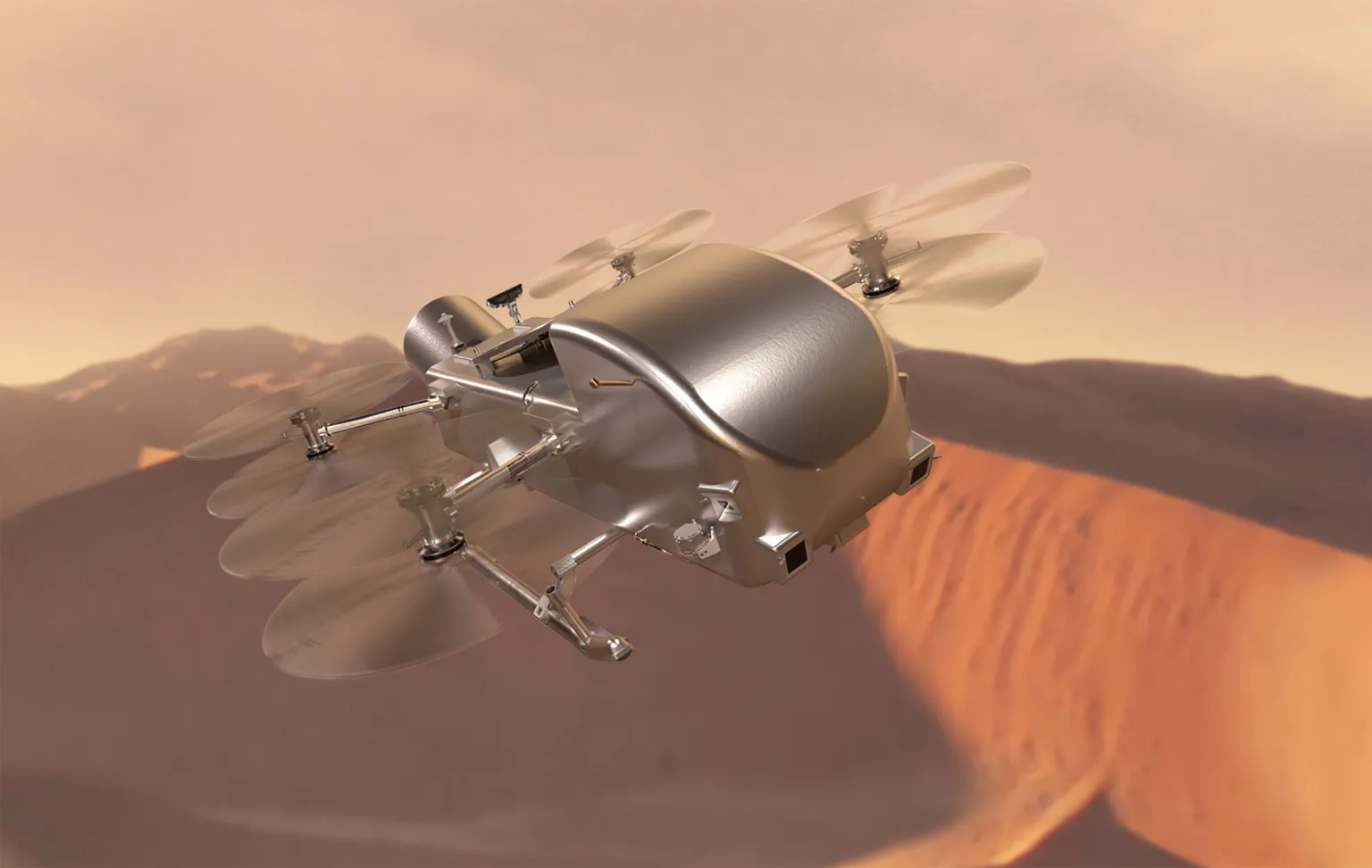
NASA's Dragonfly, selected in 2019, is an eight-rotor, car-sized rotorcraft built to hop between sites on Titan's surface over a planned 32-month primary mission, sampling prebiotic chemistry at each stop.

That's the plan. The reality is that Dragonfly has slipped significantly — and the reason matters beyond scheduling.
A September 2025 NASA Inspector General report found a cost increase of "nearly $1 billion" and a schedule delay of "more than two years" from the 2019 baseline. The mission is now projected at $3.35 billion, with a July 2028 launch on a Falcon Heavy and arrival at Titan in late 2034. As of early 2026, the lander is in integration and testing at Johns Hopkins Applied Physics Laboratory, with system-level testing at Lockheed Martin planned for early 2027; NASA describes the mission as "on track" for its revised 2028 launch date.
That overrun isn't happening in a vacuum. NASA's proposed fiscal year 2027 budget would cut the agency's science portfolio by nearly half, a repeat of a similar 2026 proposal that Congress ultimately rejected — but the pressure on flagship planetary missions, Dragonfly included, has not gone away. Cost growth on missions like Dragonfly makes them recurring targets whenever these cuts are debated.
When it does fly, Dragonfly won't search for life directly. It will study the chemistry life on Earth had access to before biology began — what NASA calls "prebiotic chemistry" — in what amounts to a hydrocarbon-soaked laboratory that has been running at liquid-nitrogen temperatures for 4.5 billion years.
JUICE Is the Third Leg
ESA's Jupiter Icy Moons Explorer launched in April 2023 and is roughly a third of the way to Jupiter. It completed the first-ever lunar-Earth double gravity assist on Aug. 19–20, 2024, then flew past Venus on Aug. 31, 2025, gaining the velocity change it needed. A second Earth flyby is set for September 2026, a third for January 2029, with Jupiter arrival in July 2031.
JUICE will make two brief Europa flybys in July 2032 — kept short to limit radiation exposure — before an extended Callisto and Ganymede survey. In December 2034, it becomes the first spacecraft to orbit another planet's moon by entering orbit around Ganymede, the solar system's largest moon and the only one with its own magnetosphere.
JUICE and Europa Clipper will overlap in the Jupiter system for roughly two years, from mid-2032 to mid-2034. They aren't redundant: Clipper is optimized for Europa specifically, while JUICE compares three moons before settling into a long Ganymede orbit.
The Shape of the Next Decade
This isn't a set of single-mission bets anymore — it's a stack of overlapping efforts.
Enceladus is yielding fresh insights from decades-old Cassini data while the community pushes for a dedicated follow-up. The leading concept, known as Orbilander, comes not from ESA but from NASA's own Planetary Science and Astrobiology Decadal Survey (2023–2032), which identified an Enceladus flagship mission as a top priority alongside completing Mars Sample Return. The proposed Orbilander would both orbit and land on Enceladus, sampling plume material with a dedicated life-detection suite; the earliest realistic project start is around 2030, with launch in the late 2030s and arrival in the early 2050s. The October 2025 paper strengthens the scientific case for funding it, though no mission has yet been approved or budgeted.
Europa Clipper carries the largest instrument payload ever sent to another moon. Titan will be sampled in situ by a flying vehicle — the first craft heavier than a small drone to fly through another world's atmosphere under its own power.
None of this amounts to detecting life. It's a generation of missions built to answer a narrower question: does the chemistry on these moons resemble what life on Earth needed to get started?
What Comes Next
Track the decade by arrival dates. Europa Clipper reaches Jupiter in April 2030, after its December 2026 Earth flyby. JUICE arrives in July 2031, after a January 2029 Earth flyby, and the two missions overlap in the Jovian system for about two years. Dragonfly launches in July 2028 and reaches Titan in late 2034, spending roughly 32 months hopping between sites.
Cassini's Enceladus data will keep being re-mined for new chemistry. A future dedicated mission depends on NASA's decadal-survey priorities translating into funding — a real risk given proposed cuts to the agency's science budget. The October 2025 findings have shifted the conversation from whether Enceladus is scientifically interesting to what should be done with the chemistry already measured.
For now, the ocean moons are doing what Mars sample return cannot yet do: giving astrobiology a real, funded, scheduled place to look.
Related UAP Logbook notes
- Mars is rewriting the search for life — one careful word at a time
- The exoplanet biosignature search, and why K2-18 b is a cautionary tale
- How SETI handles anomalies without losing the plot
- Where to see something strange in the sky
Sources
- NASA/JPL: "NASA Cassini Study Finds Organics 'Fresh' From Ocean of Enceladus", Nov. 18, 2025.
- N. Khawaja et al.: "Detection of organic compounds in freshly ejected ice grains from Enceladus", Nature Astronomy, Oct. 1, 2025.
- University of Washington: "Discovery of organic compounds bolsters case that Enceladus could support life", Oct. 3, 2025.
- S. MacKenzie et al.: "Enceladus Orbilander: A Flagship Mission Concept for Astrobiology", NASA NTRS, for the 2023–2033 Planetary Science Decadal Survey.
- National Academies: "Origins, Worlds, and Life: A Decadal Strategy for Planetary Science and Astrobiology 2023–2032".
- NASA: "NASA's Europa Clipper Radar Instrument Proves Itself at Mars", May 2025.
- NASA: "Europa Clipper Team Produces Radargram From Mars Flyby Data", 2025.
- Arizona State University: "NASA's Europa Clipper snaps infrared image of Mars, thanks to ASU instrument E-THEMIS", May 12, 2025.
- NASA: "Europa Clipper Spacecraft Instruments".
- NASA Office of Inspector General: "Dragonfly Mission Faces Schedule Delays and Nearly $1 Billion in Cost Increases", Sept. 2025.
- NASA OIG IG-25-011: "NASA's Management of the Dragonfly Project", Sept. 2025.
- NASA Science: "NASA's Dragonfly Mission Begins Rotorcraft Integration, Testing Stage", March 10, 2026.
- NASA: "FY 2027 Budget Request Summary", April 2026.
- The Planetary Society: "Analyzing the FY 2027 NASA Budget Request", April 2026.
- Space.com: "Deja vu: Trump proposes cutting NASA science funding by 47 percent — again", April 2026.
- ESA: "Cassini proves complex chemistry in Enceladus ocean".
- ESA: JUICE mission page.
- EarthSky: "JUICE mission to Jupiter completes Venus flyby", Sept. 1, 2025.
- Wikipedia: Jupiter Icy Moons Explorer.
- NASA: "NASA's Cassini Reveals Surprises with Titan's Lakes", April 15, 2019.
- NASA Europa Clipper mission page.
- NASA Dragonfly mission page.
- NASA/JPL image use policy.