News / Jul 12, 2026
The 90-degree turn in DOW-UAP-PR030
A released military sensor clip is circulating as one UFO changing shape and making an instantaneous turn. The original 308-frame file records two contrast tracks — including two frames in which both are visible separately.
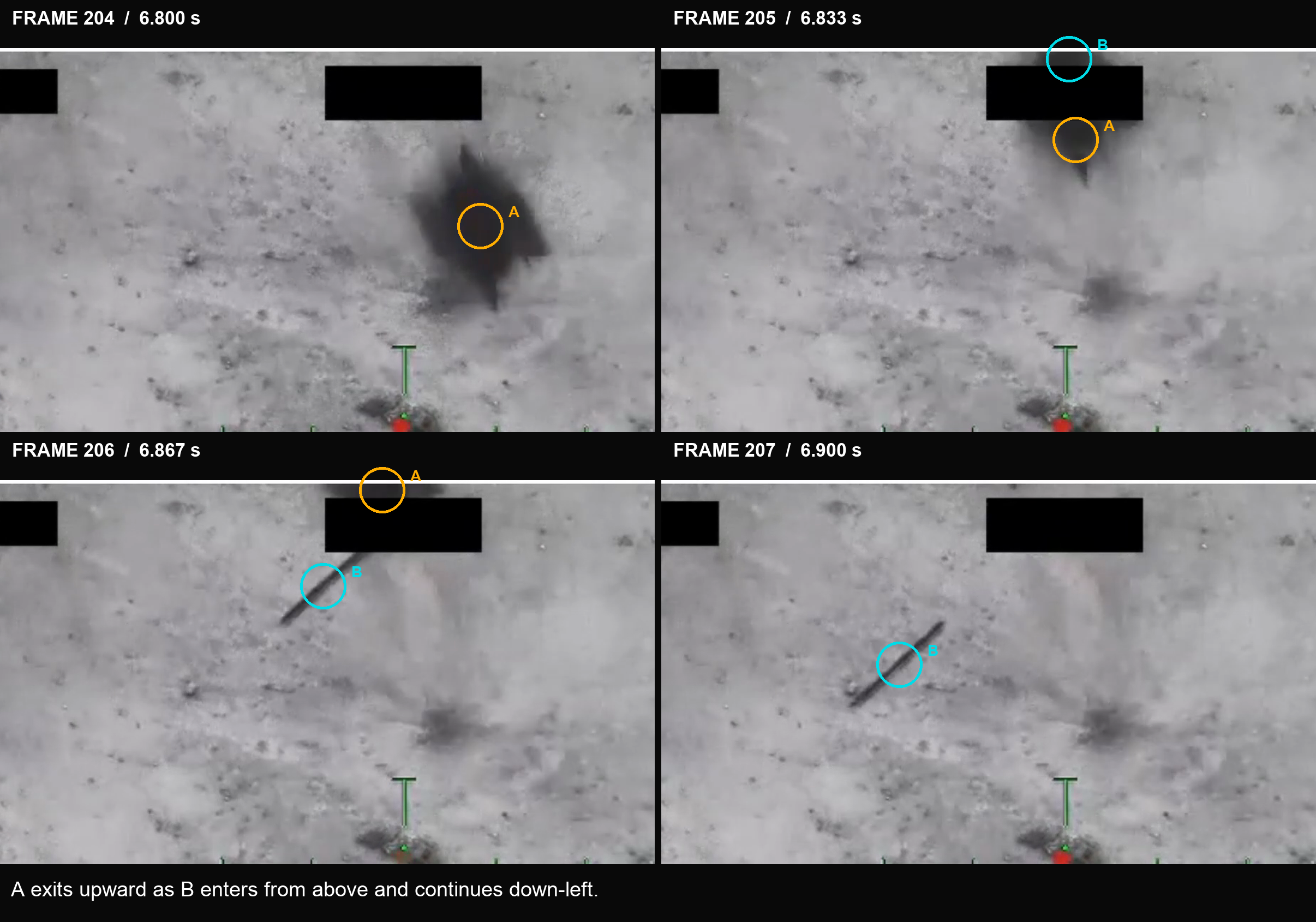
Download the full-resolution four-frame contact sheet (PNG, 2412 × 1690). It was built from frames 204–207 of the original released MP4; the orange and cyan circles are UAP Logbook annotations.
For less than a second, a dark form rises through a military sensor view over the Middle East. Near the top of the frame, another mark appears to shoot away at an angle. Played at normal speed, the sequence can look like one UFO changing shape and making an instantaneous 90-degree turn.
That interpretation moved quickly after the Department of War included the clip in PURSUE Release 04 on July 10. Steven Greenstreet rejected the single-object reading in a post on X:
“But it's actually 2 different objects crossing paths.”
Mick West later quoted Greenstreet’s post and put the moment into a broader category of accidental alignments:
“Coincidences are the fuel of UFOlogy.”
“Sometimes a couple of birds or bugs cross the camera at just the right moment.”
On July 12, after both posts were public, UAP Logbook examined the original released MP4 frame by frame. This analysis does not establish who first proposed the two-track reading. It tests that reading against the source file. The result does not depend on identifying either mark: two separate image tracks move in different directions, and for two consecutive frames both are visible simultaneously at different positions.
What is DOW-UAP-PR030?
DOW-UAP-PR030 is labelled an unresolved UAP report from the Middle East in 2023. The official description says United States Central Command submitted 10 seconds of infrared footage from a U.S. military platform to AARO. Two areas of contrast transit the sensor field of view between 00:06 and 00:07.
Its timeline separates the movement into two paths. The first contrast area enters from the lower right and exits through the top. A second, smaller area enters from the top and exits through the bottom. The record does not identify either one.
The original Release 04 ZIP contains the clip as DOD_111830028.mp4; the public listing gives the base filename as DOD_111830028. Its duration, terrain, sensor display, and crossing sequence match the PR030 detail page. The agency presents its description as information, not an analytical judgment or factual determination about the event.
| File property | Original MP4 |
|---|---|
| Resolution | 1920 × 1080 |
| Frame rate | 30 frames per second |
| Video frames | 308 |
| Duration | 10.2667 seconds |
| Video codec | H.264 High, progressive |
Two tracks meet near the top of the frame
Track A first becomes visible at the lower-right edge around frame 192, or 6.400 seconds. It moves continuously up and left. By frame 204 it is near the upper part of the image, and by frame 206 only its edge remains at the top.
Track B arrives from above while Track A is still present. It then moves down and left across the frame. The two paths differ in both direction and apparent speed.
The strongest evidence sits in frames 205 and 206, recorded at 6.833 and 6.867 seconds. Track A and Track B are visible at the same time, separated in the image. This rules out a simple edit in which one isolated mark disappears and another begins later. The two image regions overlap in time.
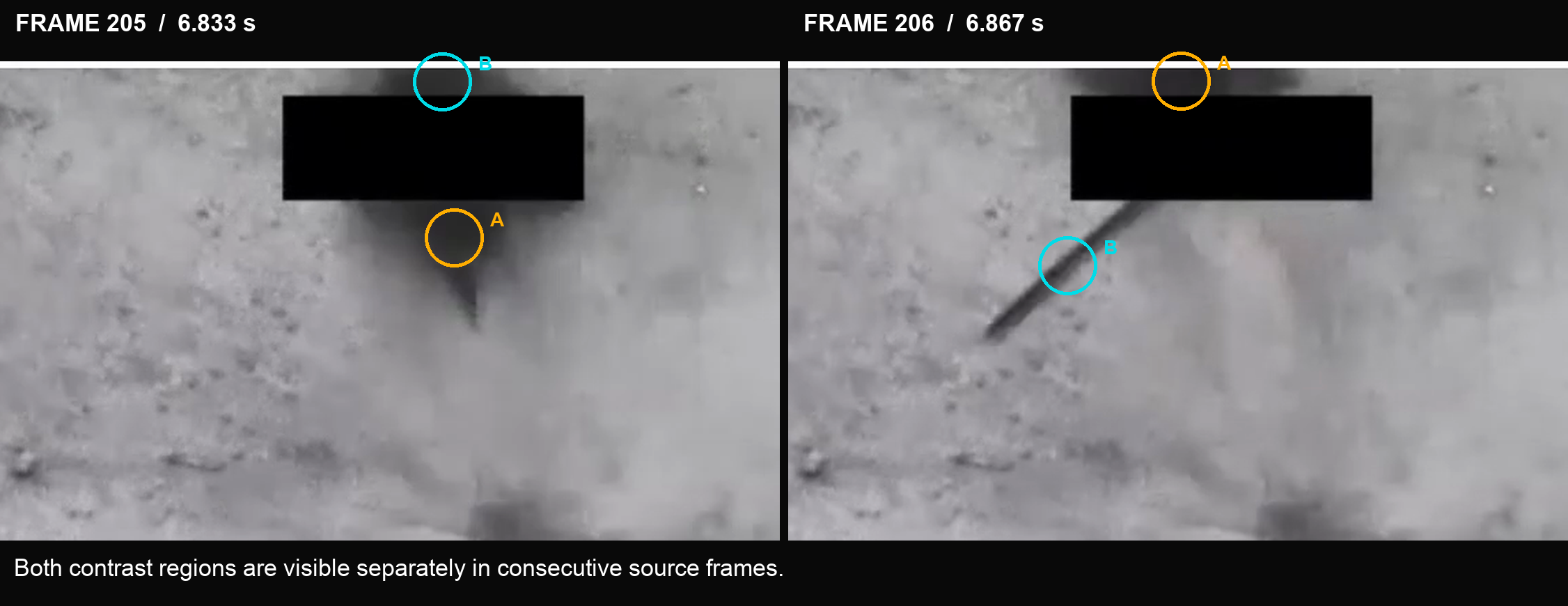
| Frame | Time | Track A | Track B |
|---|---|---|---|
| 192 | 6.400 s | Enters at lower-right edge | Not yet visible |
| 204 | 6.800 s | Approaches top of frame | Not yet clearly separated |
| 205 | 6.833 s | Visible near top | Enters above at a separate position |
| 206 | 6.867 s | Exiting at top edge | Visible lower and farther left |
| 209 | 6.967 s | No longer visible | Continues down-left |
How the tracks separate from camera motion
A moving sensor can make a stationary or slow object appear to accelerate across a display. PR030 includes enough visible terrain to compare that background motion with the movement of the two marks.
UAP Logbook registered the frames against visible terrain while masking the sensor overlay and the moving regions. Across the relevant sequence, the estimated background displacement remained around one pixel or less. The two tracks moved by hundreds of pixels. The reticle also stayed fixed in the display while both marks travelled relative to it and the ground.
The background measurement is incompatible with a large camera pan producing the directional split. At normal playback speed, the eye can instead join Track A’s exit to Track B’s entrance and read the two paths as one continuous movement.
PR34 uses the same phrase in a different record
PURSUE already contains another file built around a 90-degree-turn claim. DOW-UAP-PR34, from Greece in October 2023, is paired with mission report DOW-UAP-D33. That report says a tracked object made multiple 90-degree turns near the ocean surface at an estimated 80 mph.
The source structure is different. In PR34, “90-degree turns” is language from a mission report, accompanied by a warning that descriptive and estimative terms reflect the reporter’s interpretation. In PR030, the 90-degree path is a social reading of two crossing contrast regions. The shared phrase should not collapse the two records into the same claim.
Shape and identity remain out of reach
The two-track finding is stronger than any claim about what caused the tracks. Both regions are heavily blurred, palette-processed contrast marks. Neither holds a stable outline long enough to show wings, a body shape, or another identifying feature.
The orange centre visible in part of Track A is a sensor-display palette effect, not a measured natural colour. The clip supplies no range, field of view, raw sensor data, platform geometry, or second imaging channel. Pixel movement cannot be converted into physical size or speed without that information.
Birds and insects remain possible classes for nearby, out-of-focus transits, but PR030 does not distinguish them from other causes. West’s quoted suggestion is an interpretation, not an identification carried by the file.
The path recorded in the pixels
The original MP4 does not show one resolved object arriving at a point, changing direction, and leaving on a new heading. It shows two spatially distinct contrast regions with different trajectories, visible together in consecutive frames.
The display records two tracks against a stable background. Track A is still leaving when Track B has already entered, and frames 205 and 206 hold both of them separately. Whatever produced the marks, the single path exists in the viewer’s reconstruction, not in the released frame sequence.
Sources
- Department of War: PURSUE Release 04 portal, DOW-UAP-PR030 description, and original video ZIP, July 10, 2026.
- Department of War: DOW-UAP-D33 mission report, Greece, October 2023.
- Steven Greenstreet: two objects crossing paths, July 10, 2026.
- Mick West: visual coincidences and UFO interpretation, July 12, 2026.