Main Article / Jul 23, 2026
3I/ATLAS Is the Third Interstellar Visitor. Avi Loeb Still Won't Rule Out Artificial.
The third interstellar object on record, four SETI searches that turned up nothing artificial, and Avi Loeb's evolving public position — laid out, dated, and with the parts that could not be independently verified flagged.
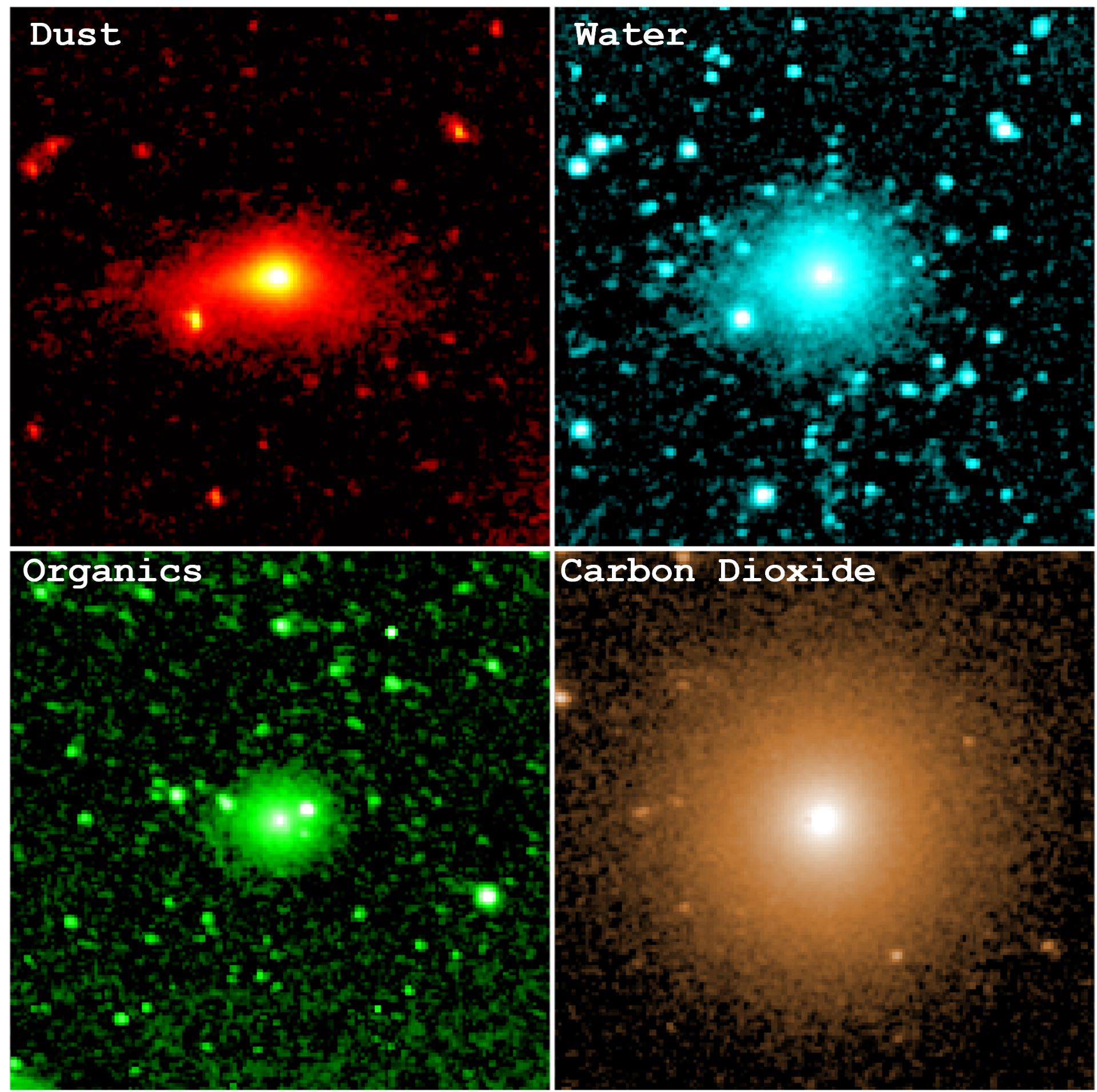
3I/ATLAS, discovered on July 1, 2025 by the NASA-funded ATLAS survey, is only the third confirmed interstellar object ever recorded, after 1I/'Oumuamua in 2017 and 2I/Borisov in 2019. Nearly every space agency and independent research team that has studied it calls it a natural comet; Harvard astrophysicist Avi Loeb keeps it at a modest but nonzero "artificial" probability on his own classification scale.
The trajectory and what the telescopes saw
The object reached perihelion around October 29-30, 2025, at roughly 1.4 AU from the Sun — just inside Mars's orbit — and made its closest approach to Earth on December 19, 2025, at a safe distance of about 1.8 AU (170 million miles). It posed no impact risk at any point in its trajectory, and by June 2026 it had already passed Jupiter's orbit and was about a billion miles out, permanently departing the solar system.
NASA's own materials describe the object as "active," meaning it has an icy nucleus and coma — the standard basis for classifying it as a comet rather than an asteroid. MeerKAT's October 2025 detection of a hydroxyl signal, the spectroscopic fingerprint of water ice sublimating in sunlight, reinforced that natural-comet reading before perihelion even occurred.
The four SETI searches, and what they found
The most thorough radio technosignature effort ever aimed at an interstellar object turned up nothing artificial.
The SETI Institute's Allen Telescope Array campaign, led by Sofia Sheikh, scanned 1-9 GHz starting within days of discovery in July 2025; after filtering nearly 74 million raw hits down to 211 candidates, all 211 traced back to Earth-based interference or satellites.
Breakthrough Listen ran follow-up observations with the Green Bank Telescope, Parkes/Murriyang, and FAST, tightening sensitivity limits to between roughly 5 watts (Parkes at closest approach) and 0.1 watts (Green Bank, December 18, 2025) of equivalent radiated power — the equivalent of a mobile phone at the object's distance, in the most sensitive case. MeerKAT, which detected the natural hydroxyl signal in October 2025, ran at 0.17 W EIRP sensitivity.
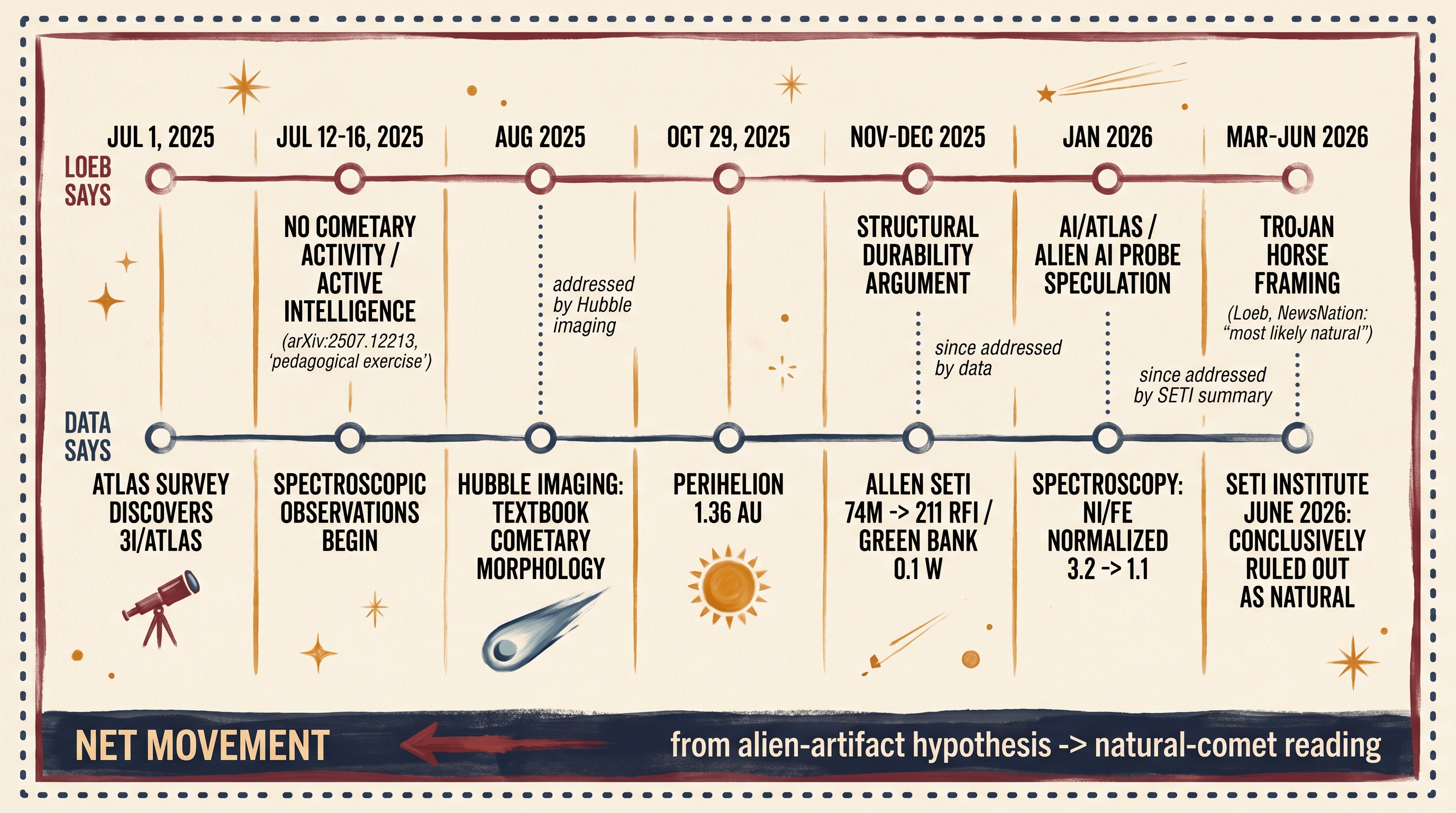
The SETI Institute's June 2026 summary was blunt: all detected signals "traced back to technology on the surface of the Earth or our own Earth-orbiting satellites," and researchers said they had "conclusively ruled out 3I/ATLAS as anything other than a natural object".
That combined null result is the strongest evidence yet that 3I/ATLAS is not transmitting anything, though it does not by itself resolve every anomaly Loeb has raised about the object's composition and behavior.
What Loeb is actually arguing
Loeb's public position has shifted in emphasis over the past year, and it's worth being precise about the sequence rather than treating it as static.
In July 2025, shortly after discovery, Loeb argued the object lacked the classic gas-and-dust tails of a comet and speculated it could be a technological artifact with "active intelligence" — a position he and two co-authors put on the arXiv as a preprint on July 16, 2025 (arXiv:2507.12213, "Is the Interstellar Object 3I/ATLAS Alien Technology?", described by its own authors as a "pedagogical exercise" that offered "no clear evidence of alien involvement"). NASA rebutted the position, with the agency's senior scientist for planetary science saying in substance that 3I/ATLAS "appears to be a comet. It behaves like a comet and closely resembles the comets we are familiar with." The Hubble Space Telescope imaging in late August 2025 settled the empirical question by showing a teardrop-shaped dust cocoon around the nucleus and a clear tail pointing away from the Sun — textbook cometary morphology.
After the object survived perihelion intact, Loeb pointed to its structural durability in November 2025 as further reason to keep the artificial hypothesis open, even as the same MeerKAT hydroxyl detection was being read by others as confirmation of ordinary cometary activity.
By January 2026, following a fresh round of coverage, Loeb was floating the more specific and more widely covered claim that 3I/ATLAS could be an "alien AI" probe, which drew significant pushback from the scientific community.
Loeb has consistently maintained he does not fully endorse the artificial explanation himself, framing it instead as a hypothesis that merits rigorous testing rather than dismissal — a nuance that gets flattened in most headline coverage of his claims.
A dedicated fact-check tracking Loeb's individual claims against the observational record exists and is worth consulting directly for anyone wanting a claim-by-claim reconciliation, since his position has been characterized differently across outlets depending on which statement is quoted.
Where the field stands
NASA, the SETI Institute, and the bulk of published research now treat the natural-comet explanation as settled, or close to it. The June 2026 SETI Institute technosignature report placed firm upper limits on any possible transmitter power on or near the object and found nothing inconsistent with a natural body. The object's outbound trajectory — already past Jupiter and receding at high speed by mid-2026 — means no further close-approach data is coming; whatever anomalies remain unresolved will likely stay unresolved for this particular object.
What's still unclear
A few things are worth flagging for anyone using this as a source document:
Coverage of Loeb's claims has evolved in tone across 2025-2026, from "lacks a comet tail" (September 2025, since contradicted by later imaging) to "could be alien AI" (January 2026) — these are distinct claims made at different times, not a single consistent position, and should be dated precisely rather than merged.
The specific "18 anomalies" figure and the Rank 4 classification scale referenced in earlier drafts of this piece could not be independently verified against a primary Loeb source in this pass and should be checked directly against his Medium posts before publication.
ESA's JUICE/JANUS flyby data and any post-Jupiter Loeb commentary from March-April 2026 were not confirmed independently here and would benefit from a direct pull of ESA's own release language.
No source reviewed here confirms whether Loeb has publicly lowered his rating after the Jupiter flyby, as the original draft claimed — that specific detail needs sourcing before it's stated as fact.
Sources
- SETI Institute, "Breakthrough Listen Observations of Interstellar Object 3I/ATLAS," December 2025–June 2026
- Wikipedia, "3I/ATLAS" (orbital elements, perihelion, Earth/Jupiter encounters, ESA observations)
- 3I-ATLAS.net fact-check page, "Avi Loeb and 3I/ATLAS: Every Claim, Every Rebuttal, and What the Data Show"
- Avi Loeb, "Updating the Loeb Classification Scale of 3I/ATLAS," Medium
- Avi Loeb, "Where is 3I/ATLAS Now," Medium
- Avi Loeb, "Q&A About 3I/ATLAS, a Week Before Its Closest Approach to Jupiter," Medium
- Avi Loeb, "SPHEREx Images and a New Anomaly Regarding the Gas Plume Around 3I/ATLAS After Perihelion," Medium
- Avi Loeb, "About UAP and Interstellar Objects," Medium, June 2026
- Sofia Z. Sheikh et al., "A Search for Radio Technosignatures from Interstellar Object 3I/ATLAS with the Allen Telescope Array," arXiv:2512.18142, December 2025 (published AJ 172, 1, 2026)
- Futura Sciences, "Scientists finally reveal what the mysterious interstellar object truly is," English edition, 2026
- Futurism, "Scientists Announce Results After Scanning 3I/ATLAS for Alien Signals," 2026
- inkl, "Avi Loeb Keeps 3I/ATLAS At Rank 4 — Suspense Builds As New Data Looms," 2026
- BBC Sky at Night Magazine, "Alien-hunting scientists pointed their best telescopes at interstellar visitor 3I/ATLAS," 2026
- Particle, "SETI Finds No Radio Signs From Interstellar Visitor 3I/ATLAS," June 2026
- NASA, "SPHEREx Examines Comet 3I/ATLAS's Coma," January 2026
- Sci.News, "3I/ATLAS Shows Signs of Full Cometary Awakening after Recent Solar Encounter," January 2026