Main Article / Jul 22, 2026
The Mars rock that made NASA say "life" — and what came after
On August 7, 1996, Bill Clinton stood on the White House South Lawn to announce potential signs of ancient Martian life in meteorite ALH84001. What followed was not a clean debunking, but a decades-long debate over organic chemistry, nanofossils, and planetary geology.
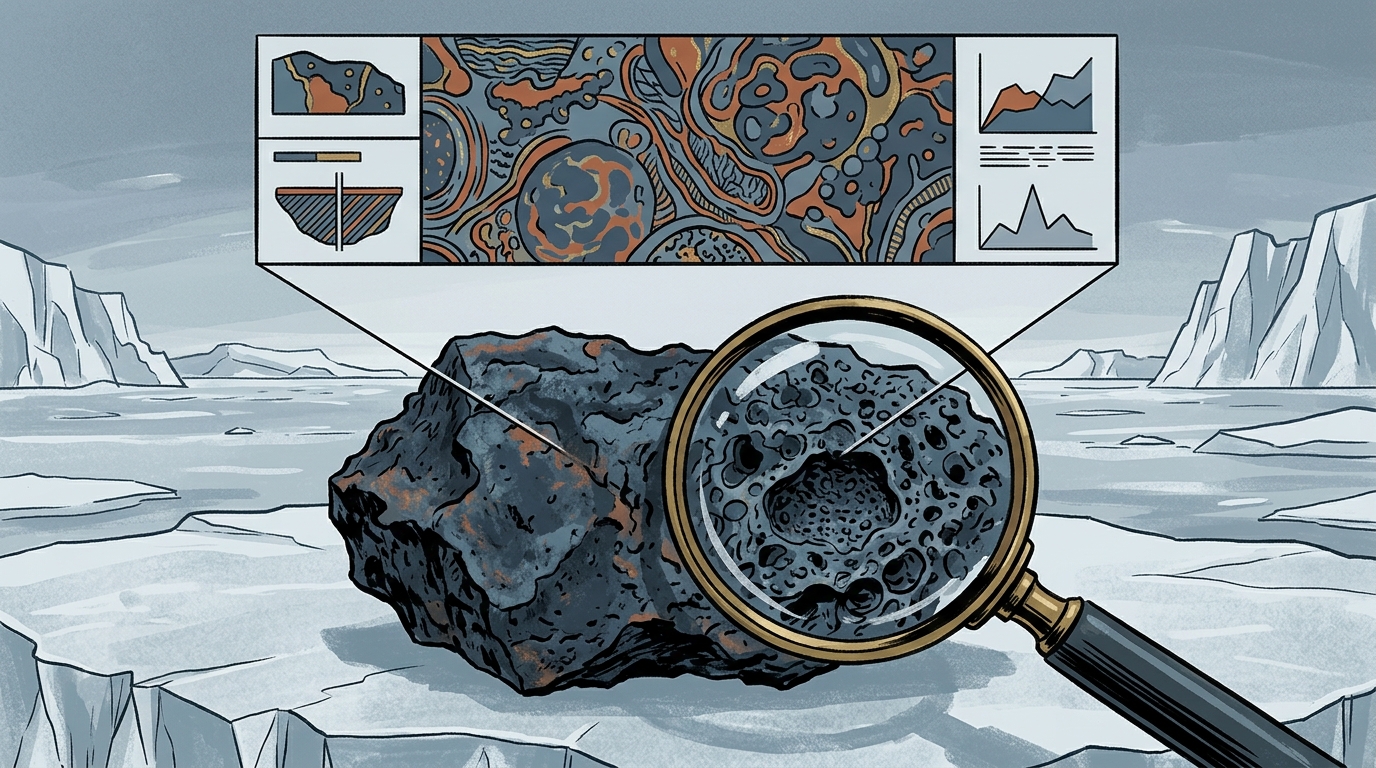
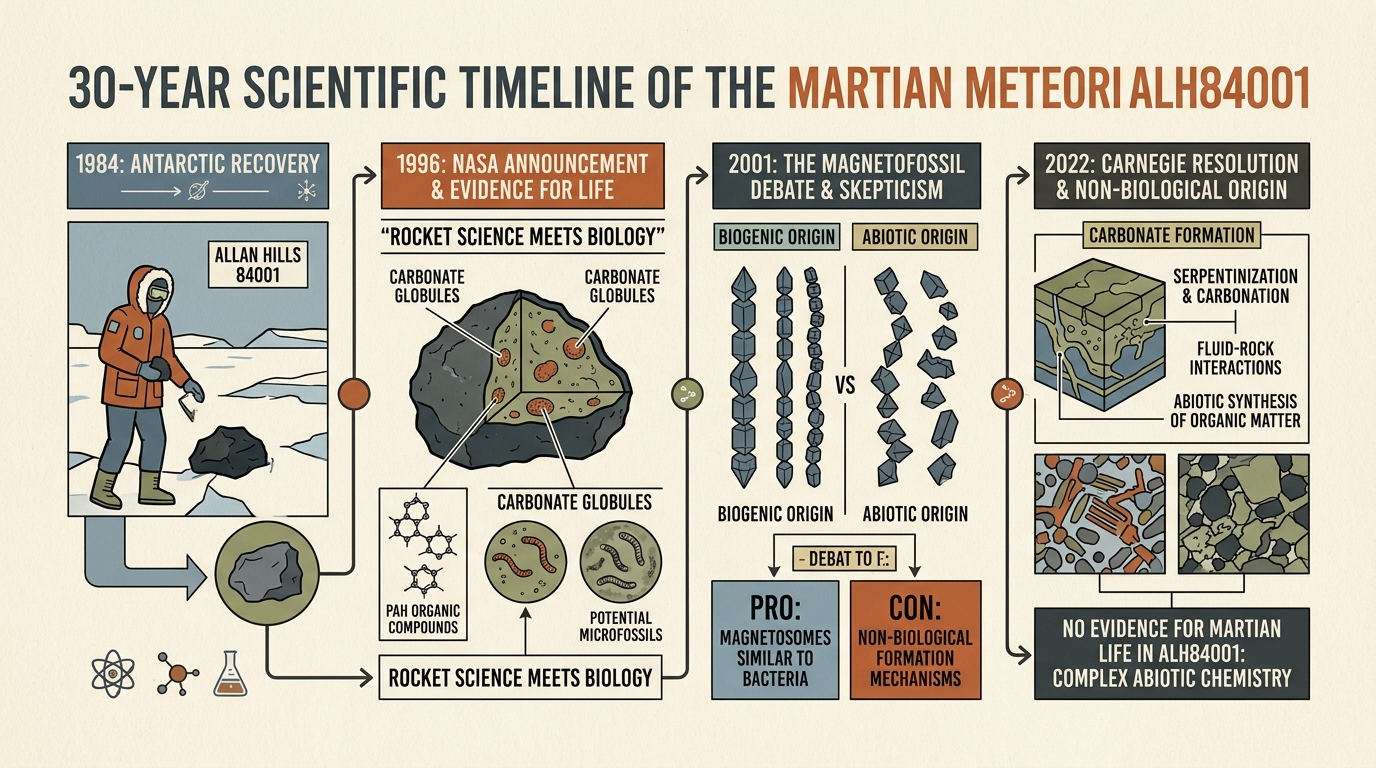
On August 7, 1996, Bill Clinton walked onto the White House South Lawn to talk about a rock. Not just any rock — a 1.9-kilogram chunk of grey-green stone, pulled from the ice of Allan Hills, Antarctica, twelve years earlier by a U.S. meteorite-hunting expedition. It carried the unglamorous catalog number ALH84001, but the announcement that day gave it a very different kind of significance.
“Today, rock 84001 speaks to us across all those billions of years and millions of miles,” Clinton said. “It speaks of the possibility of life. If this discovery is confirmed, it will surely be one of the most stunning insights into our universe that science has ever uncovered.”
Clinton notably hedged his own statement — reminding reporters that the finding “must be confirmed by other scientists” and announcing a bipartisan space summit to figure out what to do next, a level of caution that gets lost in most retellings of the speech.
The address coincided with a paper in Science by a NASA Johnson Space Center team led by David McKay, alongside Everett Gibson, Kathie Thomas-Keprta, and Stanford chemist Richard Zare — reporting several independent lines of evidence that pointed, in their view, toward ancient Martian microbial activity. It became one of the biggest science stories of the decade. Three decades on, the rock is rarely cited as proof of alien life — but the more interesting story isn’t a clean, one-sided debunking. It was messier, slower, and far more instructive than most summaries suggest.
Four clues, one rock
McKay’s team didn’t hang their case on a single observation. They pointed to four features, all clustered inside tiny carbonate globules embedded in fractures in the meteorite:
- Carbonate discs: Orange-tinted carbonate mineral discs that formed roughly 3.9 to 4 billion years ago, implying liquid water once moved through the rock.
- Polycyclic Aromatic Hydrocarbons (PAHs): Complex organic molecules concentrated near the carbonate rims.
- Magnetite and iron-sulfide grains: Tiny mineral crystals resembling, in size and shape, the magnetic crystals that certain magnetotactic bacteria grow on Earth to orient themselves along magnetic fields.
- Microscopic structures: Egg-shaped and tubular features, 20 to 100 nanometres long, visible under electron microscopy and reminiscent of microfossils.
No single feature proved anything on its own. The claim rested on all four showing up together in the exact same micro-environment — a circumstantial case, built the way a detective builds one.
A debate that refused to resolve cleanly
Here is where popular retellings oversimplify: the story is not a 1996 claim followed by a decade of steady debunking. It was a genuine back-and-forth that dragged on for years, with each side scoring points.
Contamination was the earliest weak point. By 1997–98, Jeffrey Bada and A.J. Timothy Jull showed that terrestrial amino acids and carbon-14 had seeped into the meteorite from Antarctic ice meltwater during its 13,000 years on Earth, muddying the organic-chemistry evidence. The nanofossil claim also drew immediate skepticism — structures at 20 nanometres are smaller than a ribosome, too small to plausibly hold the cellular machinery of life, and similar shapes turned out to form during ordinary electron-microscopy sample preparation.
But the magnetite argument didn't die quietly — it came roaring back. In late 2000 and again in February 2001, two separate research teams — one led by Thomas-Keprta, another by Imre Friedmann of NASA Ames — published new findings in Science and PNAS arguing that a quarter of the magnetite crystals in ALH84001 were indistinguishable from bacterially produced magnetite, and that some were arranged in chain-like structures resembling strings from magnetotactic bacteria. Most outside specialists remained unconvinced, but it was a real scientific counter-offensive, not a footnote.
The rebuttals kept coming from both directions. When Peter Buseck’s team published an electron-tomography study challenging the magnetite evidence, the original Johnson Space Center team fired back publicly, arguing Buseck’s group hadn’t examined the actual ALH84001 magnetite population properly. As late as 2009, new isotopic work from some of the original NASA authors argued the biological explanation was still the most economical one — nearly 13 years after the original announcement. This was not a field that quietly moved on.
What finally shifted the consensus
The clearer turning point came in January 2022, when Andrew Steele’s team at the Carnegie Institution published a nanometer-scale reanalysis in Science. Using fresh thin sections and advanced isotopic and mineralogical imaging, they found the organic molecules were tied to minerals produced by two specific, well-understood water-rock reactions: serpentinization (where iron- and magnesium-rich rock reacts with circulating hot water to release hydrogen) and carbonation (where dissolved CO2 reacts with minerals and gets reduced into organic compounds).
Both processes happen constantly on Earth’s ocean floor without any biology involved. The organics were real, and Martian — the geochemistry itself was legitimate. What they weren't was biological.
Crucially, Steele’s team framed this less as a "gotcha" and more as a natural evolution of technique: the 1996 interpretation had been a reasonable hypothesis given what was measurable with 1990s technology, not a mistake born of carelessness.
Why the rock still matters
The lasting effect of ALH84001 wasn't the claim — it was the response it forced. The controversy helped push NASA to establish its Astrobiology Institute in 1998 and, eventually, tighter frameworks like the Ladder of Life Detection, which demand multiple independent lines of evidence and explicit ruling-out of non-biological explanations before any biosignature claim gets taken seriously.
That discipline is now standard practice. When Perseverance flags organic molecules on Mars, or when material from asteroid Bennu gets analyzed in a lab, the caution baked into today's protocols traces directly back to the lessons of this one Antarctic rock — not because it proved life, but because it proved how easily a plausible-sounding case can be wrong, and how long it can take science to sort that out.
Sources
- McKay, D. S., et al. (1996): “Search for Past Life on Mars: Possible Relic Biogenic Activity in Martian Meteorite ALH84001”, Science, 273(5277), 924–930.
- Steele, A., et al. (2022): “Organic synthesis associated with serpentinization and carbonation on early Mars”, Science, 375(6577), 172–177.
- Thomas-Keprta, K. L., et al. (2001): “Truncated hexa-octahedral magnetite crystals in ALH84001: Biosignature of ancient Martian life”, PNAS, 98(5), 2164–2169.
- Friedmann, E. I., et al. (2001): “Chains of magnetite crystals in the meteorite ALH84001: Evidence of biological origin”, PNAS, 98(5), 2176–2181.
- Buseck, P. R., et al. (2001): “Magnetite morphology and the search for life, a Martian meteorite: Magnetofossils Revisited”, PNAS, 98(24), 13490–13495.
- NASA Astrobiology: “An update from ALH84001”, NASA Astrobiology Program.
- President Bill Clinton (1996): Remarks on the Discovery of Martian Meteorite ALH84001, White House South Lawn, August 7, 1996.
- Bada, J. L., et al. (1998): “A Search for Endogenous Amino Acids in Martian Meteorite ALH84001”, Science, 279(5349), 362–365.