Main Article / Jul 22, 2026
Which UAP cases remain unexplained? A 2026 evidence ledger
Some UFO reports have been tied to satellite flares, balloons, aircraft or optical effects. Others remain open because the public record is thin. Here is what the UAP evidence ledger actually shows in 2026.
AARO’s latest annual report starts with a useful corrective to the usual UAP argument. It records 319 incoming reports, but it does not treat them as one pile of equally strange evidence. Some had enough data for a conventional identification; others did not. A few were still being investigated. Those are different kinds of files, even when they share the same three-letter label: UAP.
That distinction has become more useful than the old question of whether a case is “real.” The reports are real as reports. What changes from case to case is the provenance of the image, the quality of the sensor data, the number of independent witnesses, and whether a proposed explanation can be tested.
The U.S. government’s term is UAP; most readers still search for UFO cases. Neither word is an explanation. An unresolved case can mean an unfamiliar object, a missing file, a poor video, or simply too little information to finish the work.
What has been substantially explained
AARO’s newest public annual report offers the clearest current example. During the reporting period, the office’s new three-dimensional modelling capability helped analysts resolve 238 reported UAP as satellite flares: sunlight reflecting from satellite surfaces at a particular angle. That is a method-wide result, not a claim that all 238 came from the 319 reports in the FY2025 intake. Within that intake, AARO assessed 44 space-domain reports as flares with high confidence.
The same FY2025 intake produced a larger, more ordinary set of closures. AARO resolved 114 of its 319 reports as balloons, birds, satellites, aircraft, unmanned systems, one commercial rocket launch and one manned jet pack. It also resolved 256 older reports during the same period. The count matters because “unresolved” does not describe the average case in the file.
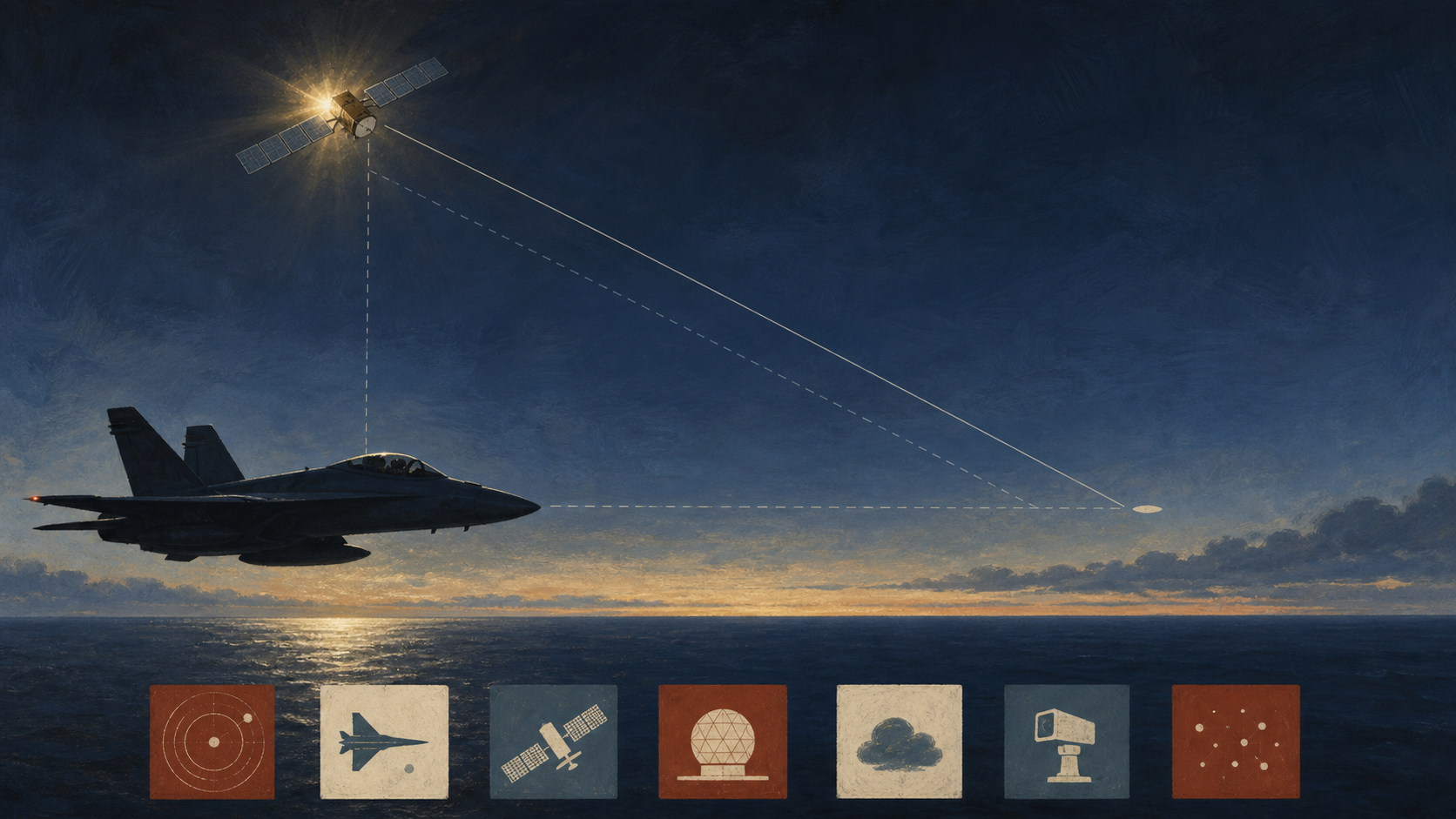
That does not mean every light in the sky is a satellite. It means an apparent light has to survive a check against orbital position, geometry and time before it earns a more exotic label. AARO has also published separate papers on forced perspective and parallax, the visual effects that can make a stationary or slow object appear unusually large or fast from a moving aircraft.
The basic lesson is not that witnesses are foolish. A flare, a distant aircraft or a balloon can look genuinely strange from the wrong angle. The dramatic version often fails only after someone reconstructs the geometry.
What was not established in the first place
Some of the strongest-sounding UAP claims were never supported by a strong public chain of custody. The word “recovered,” for example, can drift a long way from a laboratory report.
In 2024, AARO released the result of an Oak Ridge National Laboratory examination of a magnesium-alloy specimen that had been publicly linked to claims of extraordinary properties and a recovered extraterrestrial vehicle. The laboratory’s findings described an ordinary terrestrial alloy composition and structure; AARO said it found no evidence that the material had extraordinary capabilities. That does not settle every material claim ever made. It does close the door on treating this particular specimen as public proof of antigravity technology.
The same discipline applies to released video. A Pentagon or AARO release can establish that a military system recorded or received a report. It does not automatically establish the object’s identity, speed, origin or unusual performance. Several recent AARO releases explicitly describe what appears on screen while warning that the narrative is not an analytical conclusion.
The famous Navy cases: a real record, an incomplete answer
The 2004 Nimitz encounter remains compelling because it is more than one blurry frame. Navy personnel have described a multi-day operational context, radar activity and a visual encounter with a white “Tic Tac”-shaped object. The short FLIR1 clip released to the public comes from that broader story.
But the public record still does not let an outside reader independently reconstruct every claimed acceleration, altitude or manoeuvre. The full sensor record has not been released. The public video is not a flight-data package. The encounter is therefore stronger as a documented military report and witness account than as public proof of a craft with known extraordinary capabilities.
The same distinction matters for the 2015 GIMBAL and GOFAST videos. Their Department of Defense provenance is not in serious doubt. Their dramatic online interpretations remain separate claims. A clip can be authentic while the object in it is still unidentified, and an object can be unidentified while its apparent motion is shaped by zoom, tracking, aircraft movement or missing range data.
What is actually open now
AARO’s FY2025 report contains one genuinely interesting open entry: a U.S. Navy unit operating off Virginia reported about 100 airborne UAP and two likely uncrewed surface systems. The office says it is still investigating with the reporting unit.
That is not a public case file. AARO has not released the date, imagery, unit, object descriptions or a conclusion. It is open because the agency says it is open — not because the public has evidence for a particular answer.
More broadly, AARO transferred 191 of the 319 reports in its FY2025 intake to an “active archive” for cases without enough data for a comprehensive assessment. This is the category most often misread online. Insufficient data is an administrative and analytical status, not a certificate of anomaly.
Two reports did describe electronic or avionic interference said to be associated with UAP near an operational aircraft. AARO has not determined whether, or to what extent, the reported effects were caused by a UAP. That is a real unresolved safety question — but it is not yet a demonstrated UAP capability. The report also says no FY2025 submission indicated a flight-safety concern.
The new files are not new answers
The Department of War’s PURSUE programme is the other major 2026 development. Its first four tranches, released from May to July, put declassified and historical records on a public portal. The department explicitly describes the collection as unresolved files: records for which it cannot make a definitive determination, often because the available data is insufficient. It invites outside analysis, but a file’s inclusion in PURSUE is not a finding that the object defied known physics.
That distinction is worth keeping when a released frame or clip begins to travel faster than the accompanying file. A good next step can be an original video, a sensor log, a contemporaneous report or a second source with matching time and location. Without those, a dramatic record may be worth preserving and reporting on without being promoted to an answer.
What public analysis can — and cannot — settle
There is more than one public analysis of the famous Navy videos. The useful question is whether an analysis starts with data that outsiders can check, and whether its conclusion survives the missing variables.
A reconstruction is not a verdict on a witness
Pilots and other witnesses are not disposable once a video has a technical explanation. They can establish the operational setting: what was seen outside the frame, how a crew reacted, what the weather and mission were like, and whether more than one person or sensor was involved. A public reconstruction does a different job. It asks whether the released image, display data and known geometry support a particular claim about speed, distance, rotation or manoeuvre.
The two forms of evidence can agree, complement each other, or remain in tension. A geometry analysis can show that a target’s apparent motion is compatible with parallax without proving that every observation made during an encounter was mistaken. A witness account can make a short clip more meaningful without supplying the missing range, time-synchronised telemetry or raw sensor record needed to verify an extraordinary performance claim. The right question is not which side “wins”; it is which part of the account each source can actually test.
GOFAST illustrates the limit cleanly. AARO’s 2025 calculation used the public clip to assess the object’s altitude and a conventional range of possible speeds. Its appendix also says the office could not obtain witness accounts from the F/A-18F aircrew and lacked the original file and its metadata. The finding therefore bears on the motion visible in the released video, not on an aircrew narrative that the analysis did not have.
Nimitz is the reverse problem. David Fravor’s public testimony and the accounts of other Navy personnel make it a fuller reported encounter than the clip alone. But those accounts do not make the unreleased sensor record appear. They justify taking the encounter seriously; they do not let a reader calculate every reported acceleration. Any proposed explanation should account for the witness record where it can. Any extraordinary claim should also survive the data that are available. Until both tests can be run against the same complete record, the public answer remains incomplete.
GOFAST is the clearest example of a claim that can be narrowed substantially from the public record. Mick West and other independent analysts had argued that the clip’s apparent speed could be driven by viewing geometry. NASA used the video to illustrate the same parallax problem in its 2023 independent-study report. AARO later published a case-resolution card and a technical appendix: using the display data from the public clip, it assessed the object at roughly 13,000 feet, moving within a conventional speed range rather than skimming the ocean at extraordinary speed. AARO could not identify the object or calculate one exact path, because the original file and complete metadata were unavailable. That is a meaningful resolution of the performance claim, not a full identification of the object.
GIMBAL is less settled. West’s public reconstruction argues that the apparent rotation may be an infrared glare and sensor effect associated with a distant conventional aircraft. A competing 2023 preprint by independent researchers Yannick Peings and Marik von Rennenkampff reconstructs flight paths that would be unusual if the object was within the range described by the aircrew. The decisive range and the underlying radar record are not public, so neither reconstruction can turn the released clip into a conclusive account of the encounter. AARO still lists GIMBAL as unresolved.
The same limit applies more strongly to Nimitz. The encounter has multiple witnesses and a wider operational narrative than the short FLIR1 clip, but the public does not have a complete, time-synchronised sensor package from which to calculate every claimed movement. AARO’s 2025 workshop paper identifies lost or weakly retained records in the Nimitz case as an example of the field’s data problem. Public reconstructions, including West’s, can test what the clip alone does and does not show; they cannot independently settle the whole event.
The Virginia report sits at the other end of the scale. AARO says it is actively investigating a Navy report of about 100 airborne objects and two likely uncrewed surface systems. It has not released imagery, date, location, sensor data or object descriptions. There is therefore no public technical analysis to weigh yet — only an official statement that the case remains under investigation.
What “anomalous” should mean
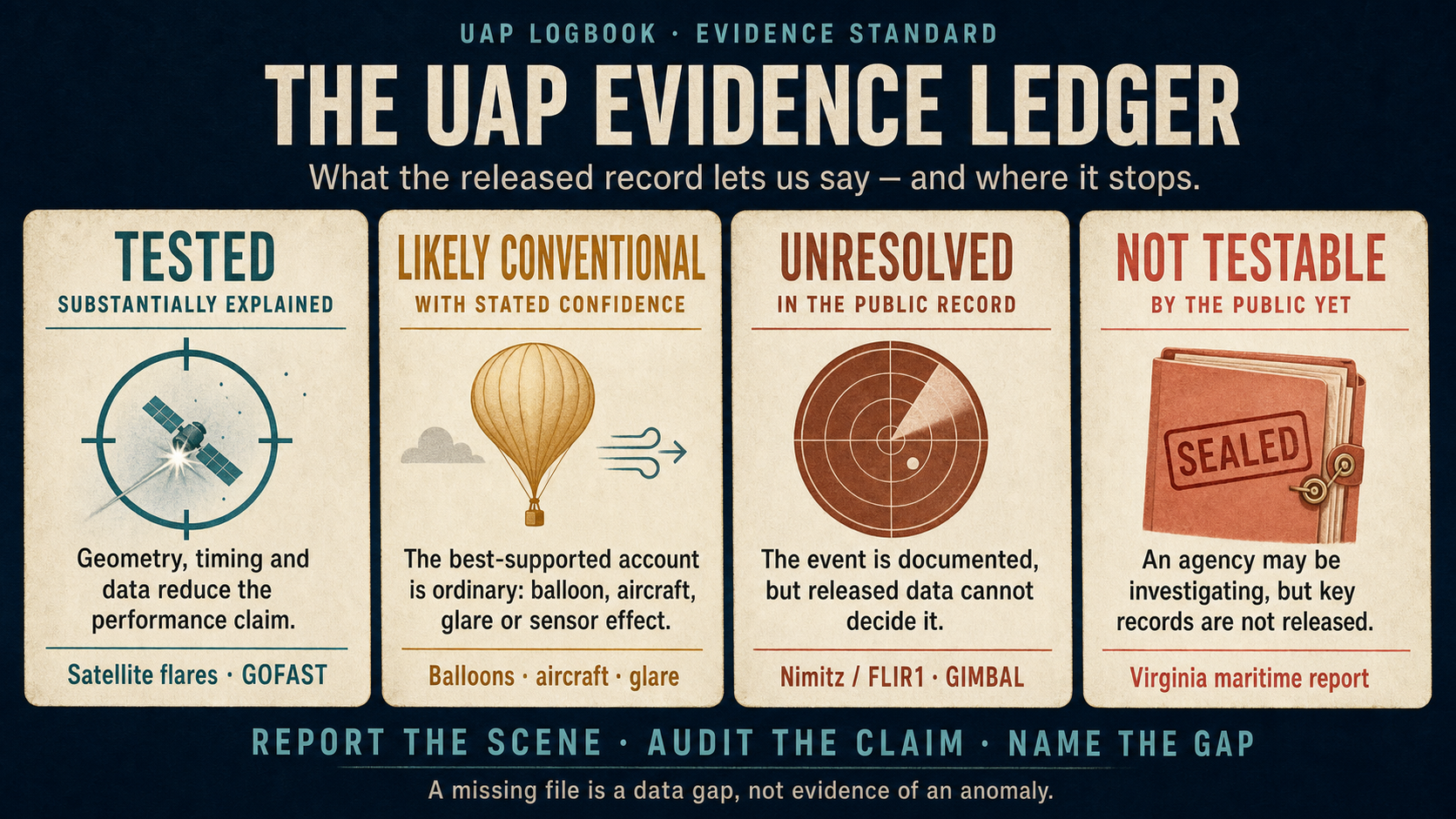
A useful evidence ledger has at least four columns: explained; probably conventional but not fully identified; open because the data is inadequate; and open after serious, checkable analysis. The fourth is the small and important category. It should not be filled merely because an observer is credible, a video is unsettling, or a story has circulated for years.
For the public record in July 2026, the Virginia event belongs in the open column. The Nimitz record belongs in the serious-but-incomplete column. Satellite flares and well-tested visual effects belong in the resolved column. The examined magnesium specimen belongs in the claims that did not survive laboratory testing.
That leaves room for surprise. It also makes the next good piece of evidence easier to recognize: raw sensor data with time and location information; an independently checkable second source; a recovered object with a documented chain of custody; or a technical analysis that another team can reproduce. Until then, “unidentified” remains a description of the file, not a conclusion about the universe.
Sources
- All-domain Anomaly Resolution Office: Fiscal Year 2025 Consolidated Annual Report on Unidentified Anomalous Phenomena, posted July 20, 2026.
- AARO: UAP reporting trends, accessed July 21, 2026.
- AARO UAP records and information papers, including papers on satellite flaring and forced perspective/parallax.
- AARO: Correlations of Starlink Satellite Flaring with UAP Observations, December 2024.
- AARO: Effect of Forced Perspective and Parallax View on UAP Observations, May 2024.
- AARO and Oak Ridge National Laboratory: analysis of a metallic specimen, released 2024.
- AARO: “Go Fast” case resolution and methodology appendix, February 2025.
- NASA: Unidentified Anomalous Phenomena Independent Study Team final report, September 2023.
- Mick West: “A Gimbal Glare Explainer”, January 2022.
- Yannick Peings and Marik von Rennenkampff: “Reconstruction of Potential Flight Paths for the January 2015 Gimbal UAP”, 2023 preprint.
- AARO: 2025 UAP Workshop — Narrative Data, Infrastructures, and Analysis, on the limits of retained Nimitz records.
- AARO: Official UAP imagery, current unresolved status for FLIR1 and GIMBAL.
- Department of Defense statement on the release of Navy UAP videos, April 27, 2020.
- Department of War: Presidential Unsealing and Reporting System for UAP Encounters (PURSUE), accessed July 22, 2026.
- U.S. House Oversight Committee: July 2023 UAP hearing, including Commander David Fravor’s submitted statement and testimony.