Main Article / Jul 23, 2026
Karl Nell's Sol Foundation paper is the UAP disclosure blueprint Congress has now ignored three times
Colonel Karl E. Nell wrote the most legislatively detailed insider case for UAP disclosure any American has put in writing. The bill it was built to underwrite is now the most-stripped amendment in modern defense policy.
Colonel Karl E. Nell never filed a sworn whistleblower disclosure or published a memoir. In May 2025, he published something narrower and more useful to the people who actually write the laws: a 25-page policy paper for The Sol Foundation, modeled on a 1992 statute, telling Congress exactly how to move UAP records out of the intelligence community's filing cabinets and into the National Archives. Titled "The UFO Enigma: A Call for US Government Disclosure," the paper is the longest, most legislatively specific argument for UAP disclosure any insider has put in writing. The bill it was written to underwrite has now been stripped from a defense bill three times in a row.
The 2025 UAPDA amendment — the Schumer-Rounds-Gillibrand version filed July 29, 2025, as S.Amdt.3111 to the FY2026 NDAA — did not survive the conference committee. Neither did the equivalent language in 2023 or 2024. What the FY2026 NDAA did carry, in Sections 1555, 1556, and 1561, was a set of smaller AARO-process provisions: congressional briefings on UAP intercepts by NORAD and NORTHCOM, a consolidated classification guide, and an interagency data-sharing mandate. The 9-person civilian review board, the 25-year disclosure presumption, and the eminent-domain clause — the architectural pieces of Nell's paper — were dropped, again.
The paper and what it proposes
Nell's argument moves through a sequence of claims about U.S. government history. The U.S. has, on its own record, never resolved a UAP case publicly. The alphabet-soup of investigations — Project Sign, Project Grudge, Project Twinkle, Project Blue Book, the Condon Committee, the 1947 Twining memorandum, AAWSAP, AATIP, the UAP Task Force, AOIMSG, AARO — all share a common shortcoming: none produced definitive public resolution. From there, the paper builds toward its centerpiece, an Independent Review Board.
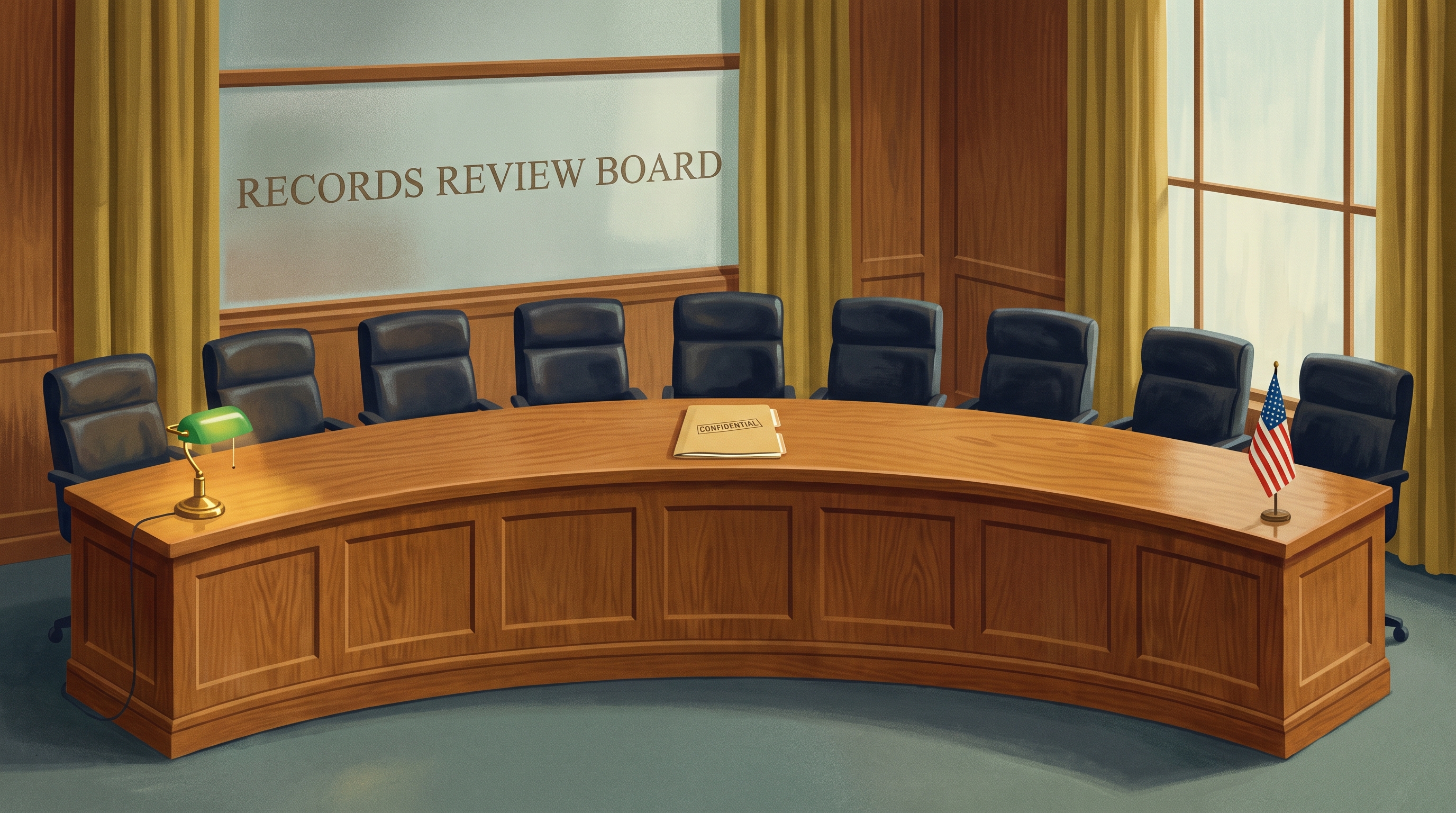
That board, in the form the amendment proposes, would consist of nine citizens at the "uppermost tiers of their professions" — Cabinet-deputy, three-star, or Nobel-nominee level — nominated by the President and confirmed by the Senate. Its job is to centralize, assess, and adjudicate the release of every UAP record, with the explicit authority to call a national science or medical addendum if the evidence warrants it. Sunset is set "no earlier than the end of this decade" — 2030 or later.
The model Nell borrows is the President John F. Kennedy Assassination Records Collection Act of 1992, with two additions the original law never had. One is a benchmark-driven "UAP Campaign Plan" specifying the conditions under which postponed material becomes public. The other is a 25-year presumption of immediate disclosure, with every exception logged in the Federal Register.
The provision that has drawn the most attention — and the most heat, in conference — is the eminent-domain clause. The amendment would direct the executive branch to reclaim "any and all technology and materials that incorporate science and technology that lack prosaic attribution or known means of human manufacture." Nell justifies this by citing whistleblower testimony that recovered material was allegedly transferred to private aerospace contractors to avoid oversight, and reaches for maritime salvage law to argue that any private holder is a "finder" rather than an owner — entitled to a fee, not a permanent claim. The legal theory draws on Boom Co. v. Patterson (1879) for the proposition that eminent domain "appertains to every independent government." Critics, including Republican staff in the House Intelligence Committee and, according to Liberation Times, in the office of Senate Minority Leader Mitch McConnell, have called the provision an overreach.
Two of the paper's smaller proposals round out the package: a six-point compensation scheme for any private holder that cooperates with a government takeover (a grace period, reimbursement, an optional grant to continue reverse-engineering work, and co-ownership of new intellectual property), and a controversial line that has done more work in the political coalition around the bill than anything else in the document: "UFO disclosure is the only truly nonpartisan topic in the United States today, and every member of Congress should support its reintroduction in 2025 and vote yea."
Who Karl Nell is, by his own account
The paper's brief author biography is where the argument's authority rests, since the entire proposal depends on Nell's credibility as an insider. He describes himself as a retired U.S. Army colonel whose last active-duty assignment was as the Army's director supporting the UAP Task Force. Before that he served as modernization advisor to the Vice Chief of Staff of the Army, deputy chief of staff for U.S. Africa Command, and commander of the 336th Expeditionary Military Intelligence Brigade. Outside the military he has worked with Bell Laboratories, Lockheed Martin, and Northrop Grumman TASC, and he now runs StarDustX Materials, a metamaterials startup.
His public profile grew well before the paper. He told a SALT investor audience in 2024 that he had "zero doubt" nonhuman intelligence exists and interacts with humanity. He repeated a version of that claim under oath to the House Select Committee on the Chinese Communist Party. At the November 2024 Sol Foundation symposium at Stanford, he said he had firsthand exposure to reverse-engineering work — a step past anything he had said on the record before. The May 2025 paper reads as the footnoted, written form of a position he had been building on stage for two years.
What the paper assumes but does not prove
The paper rests on three premises it does not defend with named evidence. Each of them is doing real work in the argument.
The recovered-technology premise is the load-bearing one. Nell names no program, no company, no document. He cites "whistleblower testimony," a category that, as of mid-2025, points mainly to David Grusch's 2023 sworn statements, which Grusch himself qualified as secondhand. AARO's 2024 Historical Record Report reached the opposite conclusion: it found no evidence any government investigation had confirmed extraterrestrial technology, and called claims about specific reverse-engineering programs "inaccurate." Nell's paper does not engage that report.
He also assumes that AARO is structurally incapable of doing the Review Board's job. Nell calls AARO "middle management" inside a historically resistant department, and argues a civilian board would be complementary, not redundant. That is a fair institutional observation. It also sidesteps whether AARO has had the access and time to test the specific program-level claims a new board would be built to adjudicate.
He further assumes that the JFK Records Act analogy is sound legally as well as rhetorically. The Kennedy records were the property of federal agencies. The records Nell's amendment would seek are, by his own account, partly in private hands. The Kennedy Act never had to invoke eminent domain to work. The UAP version would, and that legal mechanism has no precedent test.
These gaps are not reasons to dismiss the paper. They are the things a serious legislative reading would push on. The Sol Foundation published the paper as a recommendation, not as a finding. The bill is what the argument is for.
Three times through conference, three times out
The pattern across NDAAs is consistent enough to be its own story.
In 2023, Senators Schumer and Rounds offered the original UAPDA as a manager's amendment to the FY2024 NDAA. It passed the Senate in July 2023. The House Intelligence Committee, then chaired by Rep. Mike Turner, moved to strip the eminent-domain provision in conference. The final FY2024 NDAA, signed into law December 22, 2023, kept a NARA records-collection framework and stripped the independent review-board mechanism. Senators Schumer and Rounds called the conference outcome a setback and committed to reintroducing the stripped provisions.
In 2024, the same language went into the FY2025 NDAA cycle. The conference again removed the review-board and eminent-domain provisions. The final FY2025 NDAA, signed December 23, 2024, kept AARO whistleblower protections, quarterly congressional briefings on AARO's records backlog, and authorization for AARO to compel inter-agency cooperation on declassification reviews. The Schumer-Rounds language stayed out.
In 2025, Representative Eric Burlison, R-Mo., submitted the UAPDA as a House amendment to the FY2026 NDAA, after Senators Schumer, Rounds, and Gillibrand filed S.Amdt.3111 to the same bill in the Senate. According to Liberation Times, reporting in 2025, Senator Mitch McConnell's office — specifically his chief of staff, Terry Carmack — pressed to have the amendment removed, in part on germaneness grounds. Burlison confirmed at a September 9, 2025 House Oversight hearing that his amendment had not made the House NDAA package. The final FY2026 NDAA, signed into law December 18, 2025 (P.L. 119-60), passed the House 312-112 and the Senate 77-20. It did not include the UAPDA. The UAP-relevant sections it did include — 1555, 1556, and 1561 — are AARO process provisions, not the record-disclosure architecture the paper proposes.
At a June 9, 2026 press conference on the Capitol steps, alongside Grusch and four bipartisan lawmakers, Burlison confirmed the third straight strip. By that point, the FY2027 NDAA cycle was already in motion.
The competing pathway: executive disclosure
While the legislative path has been moving sideways, the executive disclosure path has been moving forward. On February 19, 2026, the Trump administration issued a presidential directive ordering federal agencies to begin identifying and releasing UAP and extraterrestrial-life records. The first tranche, the PURSUE file drop on May 8, 2026, put several hundred previously classified UAP files into the public record through a Department of War portal at war.gov/UFO.
Christopher Mellon, the former Deputy Assistant Secretary of Defense for Intelligence whose 2017 disclosures helped launch the modern UAP transparency era, called the PURSUE release "a meaningful step towards transparency, not because it resolves the major questions, but because it puts something important on the record." Mellon is not a neutral outside commentator. He is on the Sol Foundation's speaker list, alongside Garry Nolan, Peter Skafish, Karl Nell, and David Grusch, and has been part of the foundation's programming since the inaugural 2023 symposium at Stanford. The quote belongs in the record, with that context attached. He also noted in the same period that AARO had missed statutory deadlines for its Volume 2 historical report and 2025 annual report.
The two pathways pull the disclosure conversation in different directions. The legislative path produces a permanent civilian institution with subpoena power and a sunset date. The executive path produces rolling disclosures filtered through existing classification review. They are not mutually exclusive, but they are not the same thing. A reader who finishes Nell's paper in mid-2026 has to ask which of the two tracks is doing the work, and which is taking the burden off the other.
What the paper did, what it did not do
A year after publication, the paper has done the work the Sol Foundation intended it to do. It gave Schumer, Rounds, and Gillibrand a footnoted, sourced document to attach to the amendment. It gave journalists one long document to cite when explaining the architecture. It gave Nell a fixed, on-the-record position distinct from his conference remarks.
What it has not done is move the UAPDA across the conference-committee finish line. The bill is the third-stripped provision in modern defense policy. The Sol Foundation will publish a follow-up, and the FY2027 NDAA cycle is already open. The paper is what the argument is for. The argument has not yet won.
Sources
- Karl E. Nell, "The UFO Enigma: A Call for US Government Disclosure," The Sol Foundation Policy Papers, Volume 2, No. 2, Spring 2025 (PDF)
- Garry P. Nolan on X: "A great position paper put forward by Colonel Karl Nell from the Sol Foundation," 12 May 2025
- S.Amdt.3111 to S.2296 (FY2026 NDAA), Schumer/Rounds/Gillibrand, filed 29 July 2025, Congress.gov
- House Armed Services Committee Print, FY2026 NDAA enrolled bill text and joint explanatory statement, P.L. 119-60
- Congressional Research Service, "FY2026 NDAA: Status of Legislative Activity," IN12653
- National Defense Authorization Act for Fiscal Year 2026, Wikipedia (P.L. 119-60 vote summary)
- Schumer-Rounds press release on the UAP Disclosure Act of 2023 (Senate Democrats)
- Schumer-Rounds floor colloquy on the UAPDA in the FY2024 NDAA (Senate Democrats)
- The Debrief, "The Senate Just Passed Its Massive Defense Bill: Here's What That Means for UAP Disclosure"
- Disclosure Archives, "The disclosure-act trajectory: Schumer-Rounds, year by year"
- Mungo Mash UAP Legislation Tracker, U.S. UAP bills and public laws
- Liberation Times, "Sources Blame Senator McConnell for UFO Transparency Law Failure"
- Infinity Explorers, "Congress Left the UAP Disclosure Act Out of the 2026 NDAA," June 9, 2026
- "The UAP Disclosure Act," NYU Journal of Legislation and Public Policy, Vol. 27 No. 2 (March 2025)
- AARO, "Report on the Historical Record of U.S. Government Involvement with Unidentified Anomalous Phenomena (UAP), Volume I," March 2024
- DefenseScoop, "'Data alone is not disclosure': UAP research community reacts to first PURSUE file drop," 14 May 2026
- The Liminal Report, "Presidential Directive: Alien File Disclosure," February 2026
- The Sol Foundation, "The Sol Foundation Initiative for UAP Research and Policy" (2023 inaugural symposium speaker list, including Christopher Mellon)
- The Debrief, "The Sol Foundation, Academia's New UAP Think Tank, Releases Videos of Lectures From Its Inaugural Symposium"