Main Article / Jul 30, 2026
Belgium's UFO wave: the reports, the F-16 intercepts, and the famous triangle image
In the winter of 1989–90, reports of silent triangles spread across Belgium. On one March night the Air Force scrambled F-16s. The most famous photograph came later — and it did not survive.
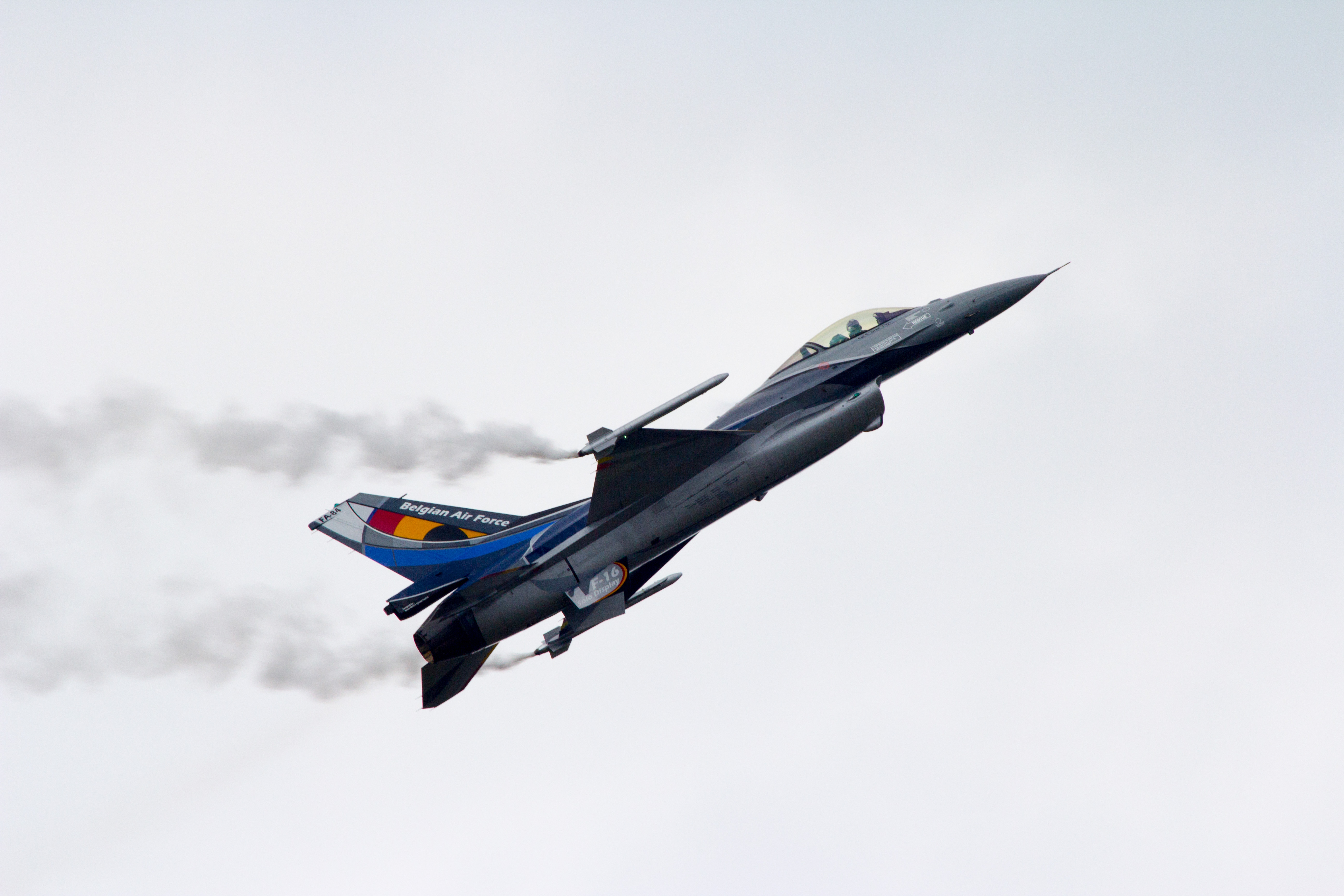
Near midnight on March 30, 1990, Belgian air-defence staff were taking calls about lights over the centre of the country. The reports had a familiar shape by then: a large, quiet triangle with lights at the corners. The Belgian Air Force sent up two F-16s from Beauvechain. Between 00:07 and 00:54, they made nine attempts to intercept a target. The pilots obtained short radar locks on three occasions. Neither reported seeing a target.
That single night became the hard centre of the Belgian UFO wave — a winter of reports that is often retold as one neat case, with one famous photograph as its proof. It was never that neat. The reports, the F-16 response and the photograph belong in the same story, but they are not the same kind of evidence.
A winter of triangles
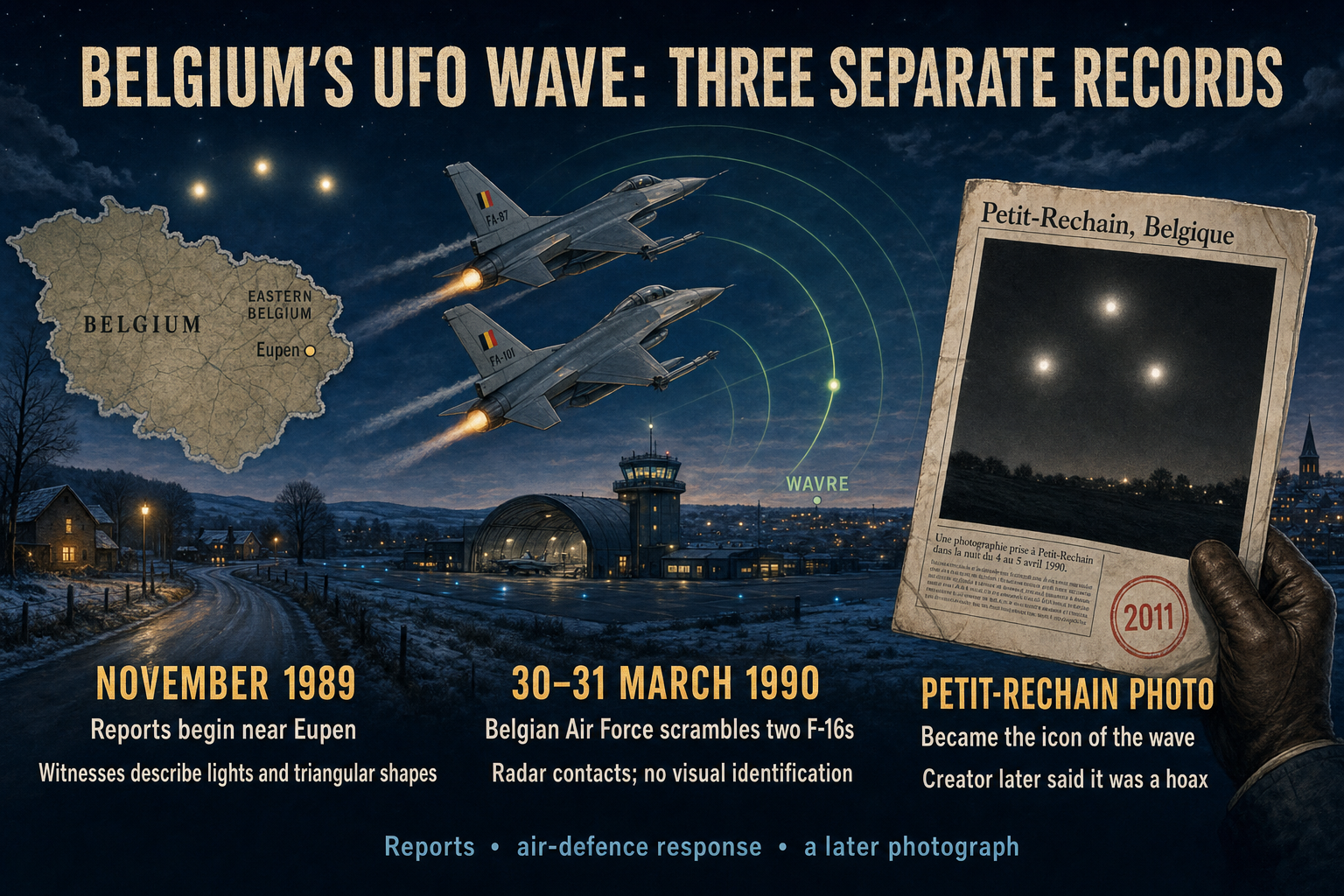
The first large public burst came on November 29, 1989, around Eupen and the German border. Witnesses described a dark, low, triangular object with lights, sometimes said to be almost silent. Reports continued through the winter. The Belgian civilian research group SOBEPS — the Société Belge d'Étude des Phénomènes Spatiaux — gathered accounts alongside police and military reporting. The descriptions made the story unusually durable: not a distant dot, but a shape people thought they could recognize.
People could agree on three lights and still disagree about distance, size, altitude, whether there was a solid object between them, or how it moved. But the accumulation mattered operationally. On March 30, calls reached the Belgian air-defence system while reports came in from the Wavre area. That is why the case has a military file at all.
The F-16 night
The Belgian Air Force account, written by Major P. Lambrechts, records ground-radar returns and repeated attempts by the two F-16s to acquire a target. The contacts were brief. The aircraft radar registered returns more than once, but neither pilot made a visual identification. It is a record of an attempted intercept, not a certificate that a triangular vehicle was flying over Belgium.
That distinction matters because the often-repeated speed and altitude figures come from short radar tracks, not from a continuously observed object with an independently measured flight path. A technical review led by Lieutenant Colonel Salmon, released in 2025 after a records request, digitized the cockpit-radar video and reconstructed the contacts against the ground-radar trace. Its conclusion was that Kalman-filter effects in the F-16 fire-control radar could produce the apparent extreme manoeuvres. That is a technical explanation of the radar figures, not a visual explanation of every report from that winter.
An air-defence response happened. Controllers and pilots worked a live problem. In July 1990, Colonel Wilfried De Brouwer, then the Belgian Air Force's chief of operations, presented the radar material publicly. The record he brought forward preserves a strange, incomplete sequence in which reported lights, ground radar and airborne radar did not resolve into a visual identification.
The image everyone remembers
Most people who know the Belgian wave know one picture: a black triangle with lights against a dark background, said to have been taken near Petit-Rechain on April 4, 1990. It appeared in books, television programmes and magazine spreads until it became a visual shorthand for the entire wave.
It should not carry that weight. In 2011, a man identified as Patrick Maréchal told Belgian television that he had made the image with a small polystyrene triangle and lights. The photograph is not a secure record of an aerial object. It cannot demonstrate what people in Belgium saw months earlier or what the F-16s were trying to identify.
The admission does not settle the wider reports. It removes the one image that popular culture taught readers to treat as their visual answer.
Why the file stayed open
The UK Ministry of Defence later summarized the episode in its released UFO material: an unidentified radar target was reported over central Belgium, two F-16s were scrambled, the pilots saw nothing, and the object was not identified. The British record also says Belgium did not alert the UK at the time because there was no evidence of a threat to NATO airspace.
That is a more modest ending than the familiar legend, but a more interesting one. Belgium had a sustained run of reports, a real air-defence response, and radar material that did not produce a visual identification. It did not produce a publicly established non-human craft. And the photograph that made the case easy to picture belongs on a separate line of the timeline.
What the Belgian wave can still tell us
The case still resists a one-line verdict. Witness accounts describe a shared experience, but do not establish a common object or flight path. The short radar locks were real data points, yet the later technical analysis offers a conventional account of their most dramatic figures. And the picture that came to symbolize the case has its own, separate history.
That does not require dismissing the people who called police, spoke to SOBEPS investigators or watched the sky that winter. It requires keeping the reports, the air-defence record, the radar analysis and the photograph in their own places. Thirty-six years later, the Belgian wave remains a real episode of reports and an unresolved air-defence incident — without the easy visual answer that made it famous.
Sources
- The National Archives (UK): UFO reports — released UK Ministry of Defence summary of the 1990 Belgian episode and its limited UK record.
- Belgian Air Force: Lt. Col. Salmon F-16 radar trace report — English translation and scan of the March 30–31, 1990 air-defence technical record; use against the original/archival document wherever possible before publication.
- Belgian Air Force: Major P. Lambrechts report — contemporary chronology of the March 30–31 mission, including the nine interception attempts and brief radar locks.
- COBEPS: Belgian wave report — civilian research compilation, including discussion of the 1990 night and meteorological context; not an official finding.
- Gesellschaft zur Erforschung des UFO-Phänomens: the Petit-Rechain photograph — contemporary account of the 2011 television admission and the image’s history.
- Wikimedia Commons: Petit-Rechain triangle photograph — image record and provenance note; do not use as article feature or evidence of the March intercept.