Main Article / Jul 28, 2026
Hangzhou Xiaoshan Airport shut down over a UFO that radar never tracked
A crew on final approach saw something twinkling in the dark, and one of China's busiest airports went quiet for 56 minutes. A source whispered "military connection" to China Daily. The aviation chief said no conclusion had been drawn. Radar never tracked the object, officials never released a photograph of it, and the images that traveled the world turned out to be an aircraft and a rocket launch from another country.
 \n
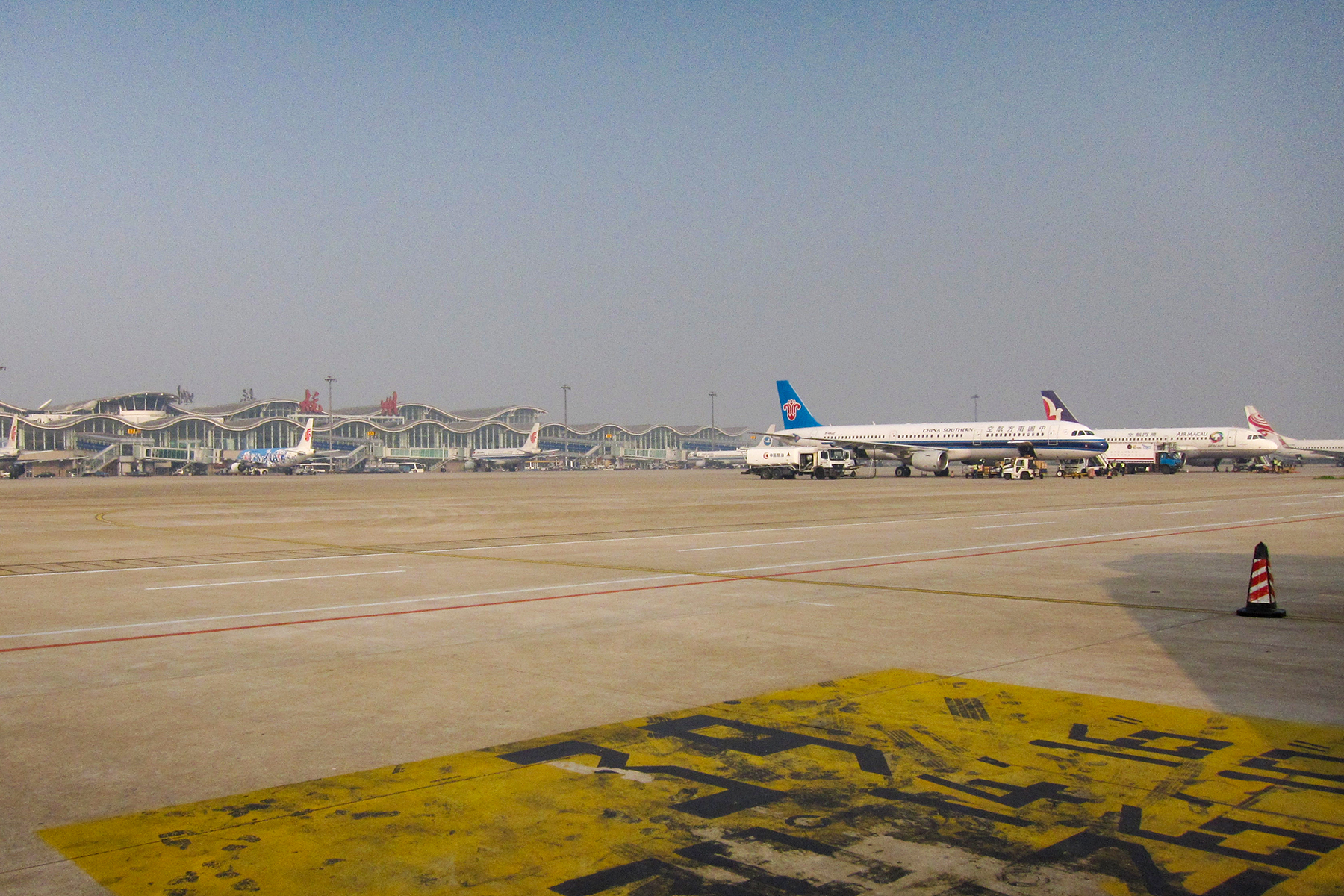
\n At about 8:40 in the evening on 7 July 2010, the crew of a flight preparing to land at Hangzhou Xiaoshan International Airport radioed air traffic control with an unusual report: something was in the airspace above the field, and it was glowing.
\n\nControllers halted every takeoff and landing within minutes. Twelve inbound flights were sent to other cities, six outbound flights sat on the ground, and by the time the runway reopened around 9:41 p.m. the object was gone. In the weeks that followed, dramatic "Hangzhou UFO" photographs traveled around the world. The airport closure was real. The photographs and the video that went with the story were not.
\n\nWhat the Chinese record actually shows is narrower and stranger than the viral version: an object seen by two flight crews, never picked up on radar, never photographed by any authority, and never officially explained. The one source who pushed past "we don't know" offered just four words — a "military connection" — and then disappeared from the story.
\n\nWhat the airport actually reported
\n\nRuan Zhouchang, the media director at Xiaoshan, gave reporters the basic numbers. The runway was closed from about 8:45 p.m. until 9:41 p.m. — roughly 56 minutes. Eighteen flights were affected: twelve arriving and six departing. Some outlets, including the Christian Science Monitor, described a closure closer to two hours; Ruan's figures, repeated by China Daily and the South China Morning Post, are the ones the airport stood behind.
\n\nThe arriving flights could not land and were diverted. The early wire reporting named two fields, Ningbo and Wuxi. A more detailed account from Zhejiang Online split the twelve inbound flights across four: three to Ningbo, six to Nanjing, two to Nanchang, and one to Wuxi. The six departing flights were held for an hour or more, and some passengers reported waiting three to four hours.
\n\nOne inbound flight from Chongqing was meant to touch down at 9:10 p.m. At about seven or eight thousand metres over the Xiaoshan area its crew was told to hold. The aircraft circled for roughly half an hour before being waved in.
\n\nAirport staff made one point firmly to the Hangzhou Net newsroom: this was not weather. Between 8 and 9 that evening there had been no rain and no thunderstorm over Hangzhou, and air traffic control ruled out abnormal weather as the reason the field closed.
\n\n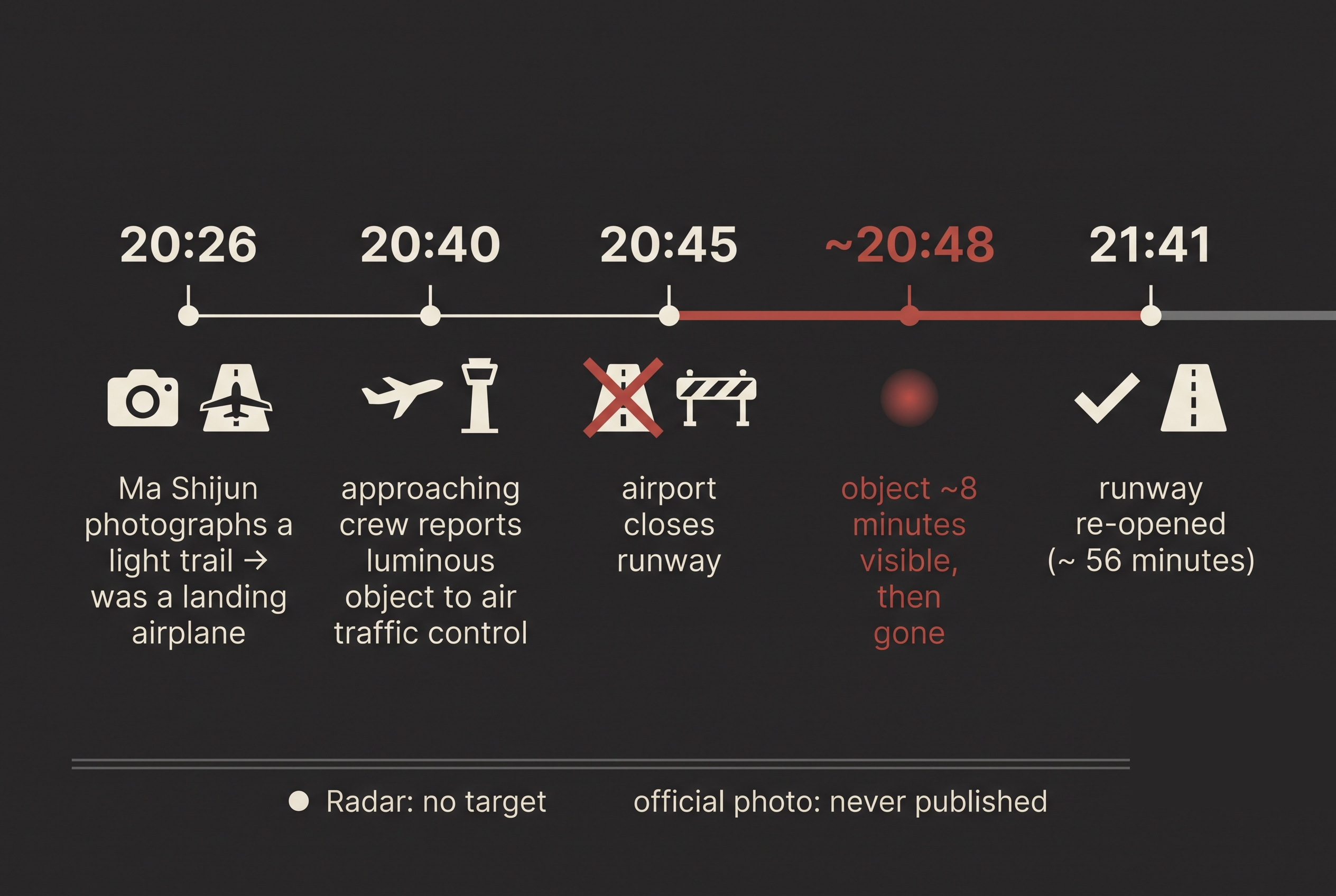 \n
\n Who saw the object
\n\nThe first report came from a cockpit. CAAC Zhejiang officials and the regional air traffic office told reporters that a flight crew on approach had spotted the object. Ground staff said neither the passengers in the terminal nor the workers on the apron were in a position to see anything; one staff member told reporters only observation instruments had picked it up.
\n\nThat account did not hold. Passengers on at least one arriving flight said they looked out the window and saw a faint, flashing object in the distance before it vanished, and villagers near the airport reported the same. Witnesses quoted by Zhejiang Online placed it to the southeast of the field, roughly over the Guali and Dangshan area, and said it lasted only a few minutes. A person described as familiar with the matter put the appearance at about eight minutes. An airport worker described the object as a round point of light that flashed and then faded quickly.
\n\nThe one line that reached past "unidentified"
\n\nMost of the public statements about Xiaoshan stop at "unknown." One China Daily report from 10 July does not.
\n\nThe same article carries Wang Jian, identified as head of air traffic control with CAAC's Zhejiang branch, telling Xinhua that "no conclusion has yet been drawn." And it carries an unnamed "source with knowledge of the matter" who told China Daily that the object had a military connection. The two statements sit a few paragraphs apart and pull in opposite directions: one official says the case is unresolved, one anonymous voice says it has a category.
\n\nAn earlier report carried by the PTI wire and republished by India's Rediff went further still, claiming that authorities had already learned what the object was but that it was "not the proper time to publicly disclose" the information because of a military connection. That framing was never repeated on the record, never confirmed by CAAC's own investigation, and never formally withdrawn. The "military connection" phrase has no follow-up anywhere in the primary record.
\n\nAn astronomer offered a third reading to the same China Daily article. Zhu Dayi of the Shanghai Observatory said the twinkling could have been light from below the horizon reflecting off an aircraft flying very high in good visibility, a phenomenon that usually appears around an hour after sunset. "If the speed of the twinkling object is extremely high, it could be a military aircraft," he said. "But no conclusion can be drawn now, as the information is limited."
\n\nThe same report also exposed an administrative tangle. According to airport staff, it was not even clear which authority would have been responsible for tracking the object, because the CAAC East China office and the airport divide responsibility by altitude and neither had claimed the case. An anonymous CAAC East China staffer told China Daily the first task was to find out how the owner of the object had got approval to fly it, "even a fire balloon needs to get the authority's permission before lifting off." An industry insider said any compensation for the diverted airlines should come from the object's owner.
\n\nWhat the radar did and did not show
\n\nThe radar question moved twice.
\n\nEarly reporting suggested the object had been caught by monitoring equipment and was faint or invisible to the naked eye. By 10 July, China Daily was already running the airport's own contrary position: a staff member at Xiaoshan told the paper the object "did not show up on the airport's radar." That admission came from the airport itself, days before any outside body looked at the case.
\n\nThe joint investigation that followed reached the same place from the other direction. A team drawn from the Beijing UFO Research Organization and the Shanghai UFO Exploration Research Center visited the airport, the CAAC Zhejiang bureau, the CAAC East China Air Traffic Management Bureau, and the CAAC East China Regional Administration on 14 and 15 July. Its initial findings, released on 25 July through the Beijing Times and Chinese wire services, said radar had not detected the rumored object. Two flight crews had seen it with their eyes.
\n\nZhou Xiaoqiang, the secretary-general of the Beijing group, explained the gap in technical terms. Civil aviation radar and military radar are different systems, he said. Civilian radar relies on aircraft carrying and transmitting an identification signal, and an aircraft that does not broadcast one may pass through the picture without being sorted out at all. On that reading, an object without a transponder could move through the radar coverage without registering cleanly while remaining perfectly visible from a cockpit window. He called it a blind spot.
\n\nThe research team was not the aviation authority, and Zhou said as much. His group had never seen the pilots' sighting report, had not been able to locate the pilots, and was still waiting for the authority's own conclusion.
\n\nThe photographs, and a video from the wrong country
\n\nThe images that made the case famous were not the object.
\n\nThe most widely used photograph was taken by a resident named Ma Shijun, who told Xinhua he had been walking with his wife when he felt "a beam of light over my head," looked up, saw a streak of bright white light, and shot the picture at 8:26 p.m. "Whether the object was a plane, or whether it was Xiaoshan Airport's UFO, I don't have a clear answer," Ma said. The joint investigation team had the image examined and concluded it was an aircraft on its landing approach. Zhu Jing, curator of the Beijing Planetarium, told Xinhua the object looked "just like a plane shining its strobe lamps."
\n\nA second photograph, taken over Hangzhou's city centre in the late afternoon before the closure, showed a red point with a long trail. The investigation concluded that image was sunlight reflecting off an aircraft and had no link to the airport event. Local astronomers reached the same view within days, arguing from the image's brightness and the daylight conditions that it most likely showed a sunlit plane or a meteor.
\n\nZhang Yunhua, a member of the team, drew one careful line. Identifying Ma Shijun's photograph as an aircraft did not prove that the object the crews saw was an aircraft. The flight crews had given no bearing, altitude, or other data that could be matched to the photograph, so the two could not be connected technically. The relationship stayed open.
\n\nThe misattribution traveled further abroad than the Chinese record supports. A video that circulated under a "UFO over Hangzhou" label was picked up by a Fox News affiliate and then by the Los Angeles Times, both presenting it as footage of the incident. As The Atlantic reported on 19 July, the video was not filmed anywhere near Hangzhou. Geoffrey Forden, an MIT physicist who tracks rocket launches on his Arms Control Wonk blog, identified it as a routine Progress cargo rocket lifting off from the Baikonur Cosmodrome in Kazakhstan on 30 June, a week before the Hangzhou event and about two thousand miles away. Both outlets pulled the video.
\n\nOn the official side there was no imagery to correct. The aviation authorities never released any photograph or video of the Xiaoshan object, and the research team said the material circulating online had no demonstrated link to the event. Robert Sheaffer, writing in the Skeptical Inquirer's November-December 2010 issue, catalogued the rest: one "rectangular object with a beam" turned out to be a long-exposure shot of a police helicopter searchlight that had been online before the incident, and a short news-broadcast clip of a bright dot was consistent with Venus or a distant rocket plume.
\n\nWhat the investigation concluded, and what it left open
\n\nThe joint team reached two findings. First, there was no evidence linking the Xiaoshan event to an extraterrestrial flying saucer. Second, because civilian radar has blind spots and the available information was limited, it did not rule out a private or military aircraft as the cause. Chinese state reporting summarized the official expert view as an aircraft on descent reflecting light, with the possibility of "an unexpected flying vehicle" left on the table.
\n\nA separate, unofficial theory had already been moving through Chinese media. A source quoted by China News Service suggested a private plane, noting that Jiangsu and Zhejiang are home to a growing population of wealthy private-aircraft owners. Wang Jian, in the same China Daily interview, dismissed that idea as "just a guess."
\n\nThe official CAAC conclusion the research team said it was still waiting for does not appear to have been published. Wang Jian's "no conclusion has yet been drawn" stands as the last on-the-record position from the aviation authority, and the anonymous "military connection" remark was never revisited by any body that later spoke for attribution. An airport closed on the strength of a crew's visual report, in normal weather, over an object that was gone within minutes, and the most concrete surviving fact about that object is that two flight crews told controllers it was there and the controllers believed them.
\n\nHow the story ran ahead of the record
\n\nThe English-language version moved faster than the Chinese record and ended up further from it.
\n\nThe closure was about a week old before it broke into the U.S. mainstream; ABC News ran a detailed report on 14 July, and CNN and others followed. The coverage often led with the now-debunked photographs and with internet speculation that ranged from a hidden U.S. bomber to a Chinese missile test. Later English-language UFO databases and roundups pushed the case considerably harder. They attributed it to a declassified U.S. State Department file, to American military UAP record sets, and to an explicit Chinese military denial of any test or training flight.
\n\nNone of that is in the primary record. China Daily carries an unattributed "military connection" remark that no one followed up. China News Service carries an anonymous private-plane suggestion that Wang Jian waved away. There is no declassified foreign file, no named U.S. record, and no official military denial. Set next to the regional context of summer 2010 — a Xinjiang sighting days earlier that Chinese astronomers attributed to missile debris, and the string of reports ABC counted as the eighth UFO wave in the country since June — Xiaoshan sits as the case where the authorities closed an airport and then never said what had crossed it.
\n\nRelated UAP Logbook articles
\n\n- \n
- The 1998 Cangzhou UFO intercept is China's strangest military case \n
- The Yunnan, Guizhou and Hunan UAP wave of March 2025 \n
- What other countries are doing about UAPs \n
- How fireballs and re-entry debris become UFO reports \n
Sources
\n\n- \n
- China Daily: "UFO remains a mystery" (10 July 2010, by Yang Yijun): Wang Jian's "no conclusion has yet been drawn," quoted through Xinhua; the unnamed source who said the object had "a military connection"; Zhu Dayi of the Shanghai Observatory on a sunlit high-altitude aircraft or a fast military aircraft; the airport's admission that the object "did not show up on the airport's radar"; the closure window of 8:45 p.m. to 9:41 p.m.; twelve inbound diversions and six delayed departures; the Shanghai Evening News estimate of more than 2,000 affected passengers; the split of responsibility between the airport and CAAC East China by altitude; and the "first such closure" comment from an unnamed CAAC East China staffer. \n
- China Daily: "Flights diverted, delayed as UFO detected hovering" (9 July 2010): the initial closure report and diversion of inbound flights to Ningbo and Wuxi. A related China Daily account, carried by PTI and republished by Rediff (9 July 2010), reported that authorities had learned what the object was but considered it "not the proper time to publicly disclose" the information because of a military connection. \n
- South China Morning Post: "'UFOs' cause flight delays at Hangzhou" (8 July 2010): the airport spokesman's wording, the 8:45 p.m. advisory, the 9:41 p.m. all-clear, six outbound and twelve inbound flights affected, and the launch of a CAAC investigation alongside the Zhejiang provincial government. \n
- Hangzhou Net / Hangzhou News Center (9 July 2010, by Luo Yi) — original page offline: duty manager Luo Miaoxiang and the 8:45 p.m. reroute notice; CAAC Zhejiang officials confirming the object was seen by a flight crew, not radar; the normal-weather confirmation; and the reported position to the southeast over the Guali and Dangshan area. \n
- Zhejiang Online, via the Ningbo News Center (9 July 2010) — original page offline: the twelve inbound diversions split as three to Ningbo, six to Nanjing, two to Nanchang, and one to Wuxi; the Chongqing flight that circled for about half an hour; the roughly eight-minute appearance; and the rejection of the Solar Impulse night-test theory. \n
- China News Service / China News: investigation report (25-26 July 2010) and People's Daily Online (26 July 2010): the joint Beijing-Shanghai investigation team (Zhou Xiaoqiang, Zhang Yunhua, Lou Jinhong, Bai Tao); its 14-15 July visits to the airport and CAAC bodies; the finding that radar did not detect the object and that two flight crews saw it; the conclusion that the widely circulated photographs were aircraft; the "no evidence of an extraterrestrial flying saucer, but private or military aircraft not ruled out" determination; and the official expert summary of an aircraft on descent reflecting light. \n
- hsw.cn, reproducing Legal Evening News (Fazhi Wanbao, 25 July 2010) — original page offline: team member Zhang Yunhua on why identifying Ma Shijun's photograph as an aircraft does not establish what the flight crews saw, given the absence of bearing or matching data. \n
- ABC News: "UFO in China's Skies Prompts Investigation" (14 July 2010): the crew's first detection at about 8:40 p.m.; eighteen flights affected; Ma Shijun's account of photographing a streak of light at 8:26 p.m. via Xinhua; Beijing Planetarium curator Zhu Jing's "plane shining its strobe lamps" assessment; and the broader summer 2010 context, including the Xinjiang sighting and the eighth-report-since-June count. \n
- The Atlantic: "A UFO Over China?! Well, No." (Alexis C. Madrigal, 19 July 2010): a Fox News affiliate and the Los Angeles Times published a video presented as the Hangzhou incident that was in fact a Progress cargo rocket launch from Baikonur, Kazakhstan, on 30 June, identified by MIT physicist Geoffrey Forden (Arms Control Wonk); both outlets removed it. \n
- Robert Sheaffer, "Hovering UFO Closes Chinese Airport," Skeptical Inquirer, vol. 34 no. 6 (November-December 2010): English-language skeptic analysis of the imagery, including the police-helicopter long-exposure and Venus/rocket explanations, and a near-identical 2001 airport closure in Barnaul, Siberia attributed to Venus. \n