Main Article / Jul 30, 2026
A paper says plasma may be alive. Its case rests on 18 seconds of Shuttle video
A 2025 paper reads 91 frames from the STS-75 tether experiment as evidence of living, communicative plasmoids. The footage is real. The jump from moving lights to life is much larger.
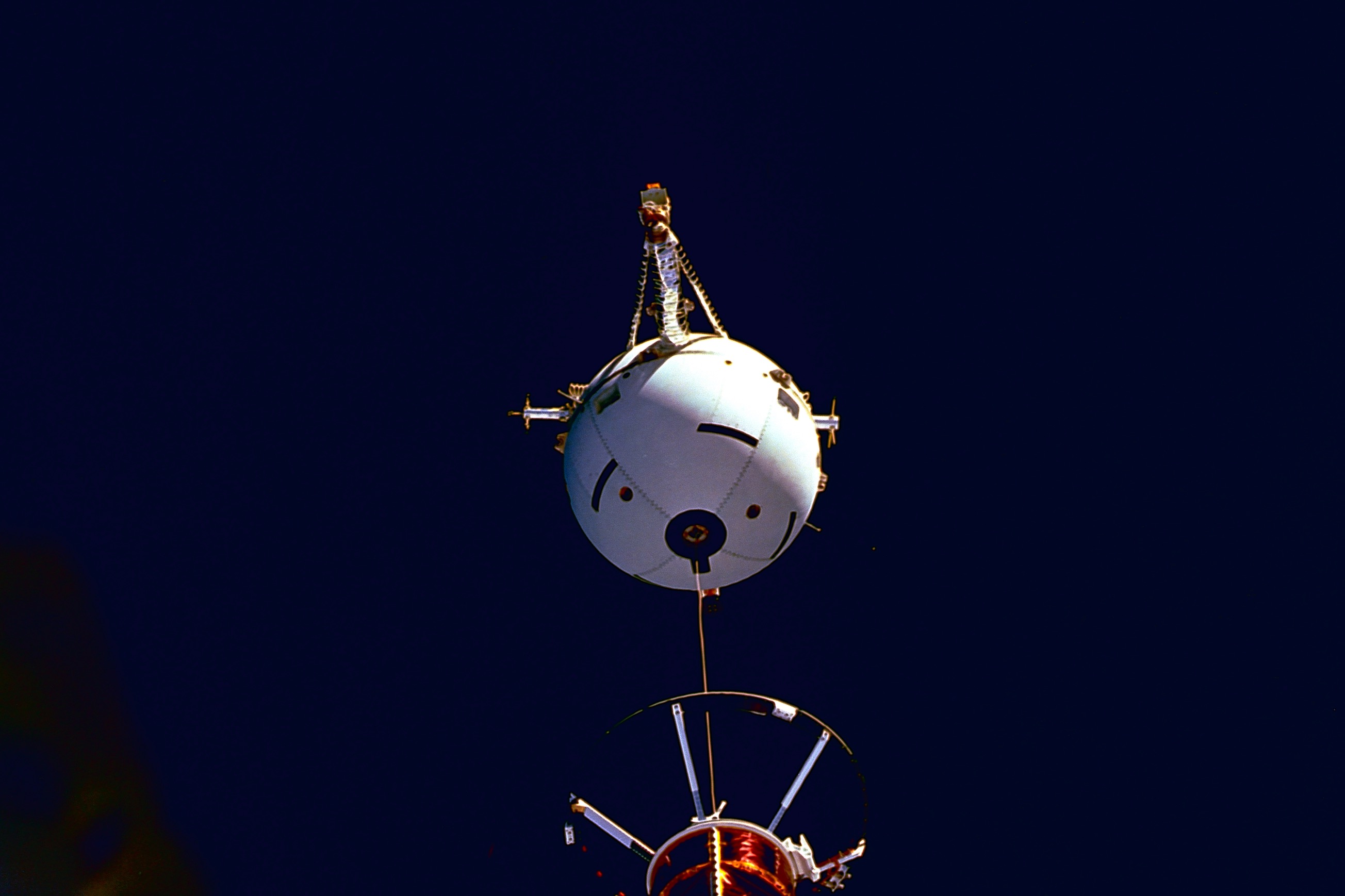
In February 1996, the Space Shuttle Columbia carried an Italian-American satellite into orbit on a conducting tether. The experiment was designed to study electrodynamics in the ionosphere. On its third day, the tether broke and the satellite drifted away. NASA calls the mission a success in data-gathering terms despite the loss.
Nearly three decades later, Rhawn Gabriel Joseph and six co-authors make a much larger claim from video of that mission in the Journal of Modern Physics. They argue that glowing, plasma-like features near the tether were living entities: self-illuminated plasmoids that communicate, seek contact, divide and may even carry RNA, DNA and a "plasma genome."
That language matters because David Grusch used a related phrase at a Capitol UAP event in June 2026: "sentient plasmoid life." Asked about non-human species, he described a range from corporeal bipedal life to that category, without naming a document, specimen, laboratory or source chain. The paper predates Grusch’s remark. It does not show where he got the phrase or what he meant by it. But it shows that a fully formed plasma-life hypothesis was already available in the public conversation.
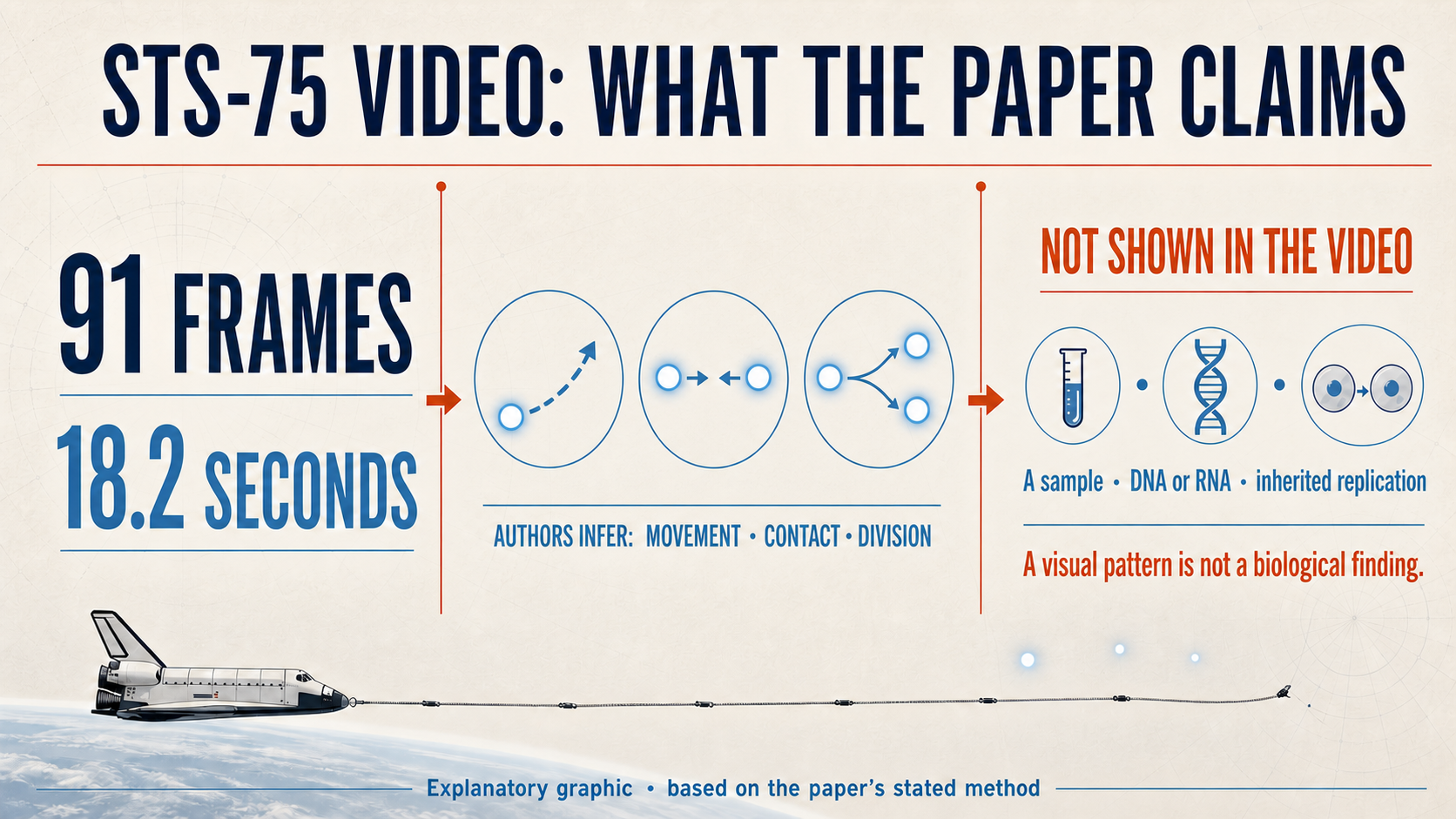
The most ambitious part of the paper rests on 18.2 seconds of video. Its authors extracted 91 frames, each 0.2 seconds apart, from STS-75 footage of the Tethered Satellite System. They tracked the changing shapes and apparent movements of lights near the apparatus. The footage and the mission are real. Whether those frames demonstrate life is the much harder question.
From a Capitol phrase to a published hypothesis
Grusch did not cite this paper, and it would be wrong to treat the resemblance in language as a link between them. His statement remains his own unsupported account. The connection is narrower: the paper gives readers a concrete version of what "plasmoid life" can mean when someone tries to turn a plasma term into a biological category.
That makes the paper a better place to test the phrase than to validate it. Its claim is specific enough to inspect: STS-75 video, a defined 18.2-second sequence, named enhancement steps and a proposed list of life-like behaviours. The evidence can be checked without pretending it answers Grusch’s larger claim.
What the paper actually does
The authors do not present a recovered sample or a new instrument measurement. They interpret imagery. In their account, plasma-like forms approach the tether, change shape, collide, merge and separate. They report inferred speeds of up to 35.6 kilometres per second and turns of up to 163 degrees from the image sequence. Those are not independent measurements of identified objects; they depend on the paper's frame-by-frame interpretation. The same reading becomes the basis for terms such as "mutual awareness," "communication" and "cellular mitosis."
There is an important processing step. The methods say the original NASA video was digitized with Final Cut Pro. For the paper's morphological analysis, the authors used Fotor to apply anti-blur, brightness, contrast, sharpness and red, green and blue filters. Such work can make a faint video easier to inspect. It can also make interpretation more dependent on choices about frames, enhancement and what counts as a boundary or a moving object.
That does not mean a processed frame is worthless. It means the raw segment, camera information, exposure, target geometry and every processing setting matter before someone can infer speed, structure or interaction from it.
Known plasma physics is not the same as biology
Plasma is the fourth state of matter: a gas in which enough particles are electrically charged for electromagnetic forces to shape how it behaves. In laboratory and space settings, dusty plasmas can form ordered structures, waves and collective motion. That is a real physics field, not a UFO invention.
The paper's strongest rhetorical move is to place those known behaviours next to biological words. Order, movement and apparent interaction can look striking on screen. None of them, by themselves, establishes an organism. A crystal grows. Fire spreads. A computer can react. Those observations do not settle the life question.
What would count as life?
There is no single definition that ends every scientific argument about life. NASA's working definition is still a useful test: a self-sustaining system capable of Darwinian evolution. That puts reproduction, heredity, variation and an energy-processing system at the centre of the question.
The authors argue that a plasma can have a cell-like boundary and may have taken up material from Earth’s upper atmosphere. But the article does not identify a self-maintaining chemical system, show replication with inheritance, detect RNA or DNA in a plasma, or demonstrate evolution across a population. It proposes routes by which those things might be possible; it also states that there is currently no evidence that these plasmoids contain a genome or even a single strand of DNA.
That gap is not a semantic quibble over what the word “life” means. It is the difference between a visual resemblance and a testable biological claim.
The Shuttle record is more interesting than the headline
STS-75 was not an ordinary camera pointed at the night sky. The Tethered Satellite System was a powered experiment in the electrically charged upper atmosphere. NASA says it was intended to study electrodynamics, and that valuable data had been gathered before the tether separated. Any bright feature near that setup needs to be read with the experiment, camera and environment in view.
That is why this is worth following. Not because 18 seconds settles a cosmic question, but because it gives a concrete test: find the original video segment, reproduce the frame extraction and processing, identify what the camera could see, and ask independent plasma physicists what behaviour the images can support.
Until that work is done, the paper is a vivid hypothesis built on real Shuttle footage. It does not establish that NASA filmed a new domain of life.
Related UAP Logbook reading
- What did David Grusch mean by “sentient plasmoid life”?
- Hessdalen’s lights have their own field station
- NASA UAP audio: particles, fireflies and the sound layer
Sources
- Joseph et al., “Plasmas: A Fourth Domain of Life?”, Journal of Modern Physics 16 (2025), 1269–1387, DOI 10.4236/jmp.2025.169066 — the claim, its 91-frame STS-75 sequence and the authors’ stated processing method.
- NASA: STS-75 — mission context, TSS-1R purpose and the tether separation.
- NASA Technical Reports Server: STS-75 Flight Day 5 — NASA video catalogue record describing the tether break and the mission footage.
- NASA Astrobiology: “Forming a Definition for Life” — NASA's working definition and its reproduction/heredity/evolution criteria.
- Tsytovich, Morfill et al.: dusty plasma structures — the physics context for self-organization; not evidence of biological life.
- NASA Johnson Space Center / Wikimedia Commons: STS-75 Tethered Satellite System deployment — feature image, public domain.